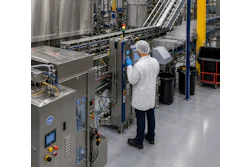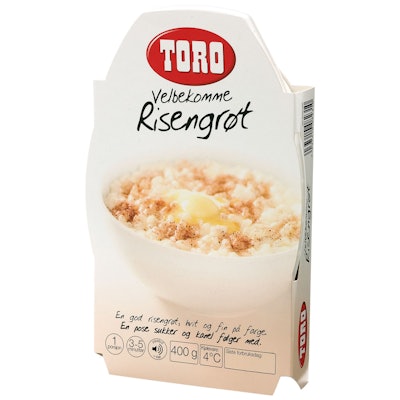
A user of MicVac microwave pasteurization technology since 2006, Rieber & Son recently added its third microwave pasteurization line to its headquarters plant in Elverum, Norway. The new line is dedicated to a popular Norwegian specialty called Risengrot, a rice pudding consisting primarily of rice, milk, and vanilla that is eaten just about any time of day as either a dessert or as part of a breakfast, lunch, or dinner. By dedicating the new line to this product alone, the firm is better positioned to produce the 20 or so other SKUs in its Toro Velbekomme line of ready meals.
The MicVac method of preparing food involves a thermoformed tray filled with a mix of partially cooked and raw ingredients. A typical combination might be chicken, pasta, and broccoli. Risengrot is a little different in that it’s one precooked item, rice pudding. But the final cook/pasteurization concept applies here just as it does with other varieties. Also, the same ease of preparation is delivered to the consumer. After several minutes in the microwave oven, the product is ready to be eaten.
Onto the filled tray a flexible film lidding is heat sealed in place, but just before it’s applied, a small hole is punched in the lidstock. Over this hole is applied the patented MicVac valve, which is essentially just two pieces of PVC that are ultrasonically sealed to each other. Says MicVac key accounts manager Johan Zetterberg, “The valve looks simple enough, but in fact it’s pretty complex.”
Filled and lidded trays proceed next through the MicVac microwave tunnel. The trays are conveyed three across, and they spend, in the case of this particular product, a little less than nine minutes in the tunnel. During this cook process, the MicVac valve opens to release internal pressure created as the food releases steam. The patented valve is designed so that it can open and close multiple times.
Once the pasteurization process is complete, the trays are single filed. As they enter a spiral cooler, the MicVac valve closes. Steam trapped inside the tray condenses, which causes internal vacuum pressure to build and causes the bottom of the specially developed FlexTray to curve upward while the lidding film is pulled down towards the food contents in the tray.
The whole idea is to minimize exposure to thermal processing compared to more conventional methods such as batch retort or “sous vide” processing. Because food spends less time getting cooked, taste, texture, and nutrient retention are all optimized. Consumers can enjoy a delicious, convenient, ready meal without artificial preservatives or flavorings.
Refrigerated shelf life, meanwhile, is a generous 42 days in the case of this Risengrot product. Consumers prepare the food item by popping it into the microwave oven. And they’re spared the guesswork that sometimes comes with microwave heating a ready meal because when the dish is ready for serving, the MicVac emits a whistling sound as it opens to allow steam to be vented.
Secondary packaging
When Rieber installed this third microwave pasteurization system, the firm also surrounded it with a number of automated packaging systems. For example, ahead of the pasteurizing tunnel is a filling system from Mondini, represented in North America by Harpak-Ulma (www.harpak-ulma.com). It picks nested trays by means of a vacuum pick and sends them beneath a filling nozzle. Integrated into the Mondini system is a MicVac valve applicator that operates essentially just like a pressure-sensitive labeler—except that the film lidding material is punched with a hole before the pressure-sensitive valve is applied.
Trays are monolayer PP from Faerchplast (www.faerchplast.com). For the Risengrot product, the forming depth is 45 mm. Lidding material, supplied by Scanflex is a lamination of peelable PP/nylon.
Once trays are filled and lidded, the’re conveyed through a Mettler-Toledo metal detector/checkweigher. Then the single line of trays is divided into three lanes, the configuration in which the trays travel through the MicVac microwave pasteurization tunnel. During the microwave cook process, the MicVac valve opens to release internal pressure created as the food releases steam.
As soon as the pasteurization process is complete, trays enter a spiral cooler and the MicVac valve closes. Steam trapped inside the tray condenses. This causes internal vacuum pressure to build, causing the bottom of the specially developed FlexTray to curve upward while the lidding film is pulled down toward the food contents.
Graphics on the unit packs are on the paperboard sleeves, and these are applied automatically by a Kliklok Certiwrap C80, a medium-speed machine designed specifically for sleeving of low-profile trays. Each flight has positive control of both the sleeve and the tray going into it, accurately registering one to the other. In the event of a jam, the machine stops automatically and the tray is released, allowing for easy removal by the operator.
Sleeved trays are conveyed to an automatic case packer from Osterberg, a part of Peterson Packaging Group. It erects retail-ready corrugated cases from flat blanks and upends the unit packs before pushing six units into a tray. The case is then folded around the six and hot melt glued.
Date coding is executed three different times by machines from three different makers. The sides of individual PP trays receive date and lot code from a Linx system from Diagraph. Paperboard sleeves are given an ink-jet date code by a Domino system. And finally, a Willett system prints an ink-jet code on the retail-ready case.
The Risengrot product has proven as popular with consumers as the dishes previously offered in the Toro Velbekomme line. Over the past six years, annual production has increased to more than six million chilled ready meals—in a country with just five million inhabitants. Looking ahead, production manaer Dag Kjelsrud anticipates nothing but steady growth for the production of ready meals.
“We wouldn’t be where we are today without MicVac,” adds Kjelsrud.