Consumer fondness for stir fry meals has healthy ramifications for packagers and their converters alike. A good example is Modesto, CA-based Mallards Food Products, a division of Davis Lay. The food processor is building substantial retail and foodservice sales with its Ginger Stir Fry sauce and marinade in blow-molded bottles of polyvinyl chloride.
These containers are extrusion blown in two sizes by Premier Plastics (San Jose, CA). Premier molds a variety of bottle shapes on 14 machines (see page 36). Not only does the converter manufacture the containers, it also labels them on four new Label-Aire (Fullerton, CA) Model 2111M blow-on applicators. Premier operates two labeling "systems," each equipped with two labelers. For Mallards' ginger sauce, Premier uses the two-labeler setup to label the front and side panels of the containers.
"Container labeling is a value-added service Premier provides that eliminates one variable we no longer need concern ourselves with," says Glenn Davis, Davis Lay's president. Premier molds two sizes of the handled PVC container, one a 22-oz (48- to 52-g) bottle for retail sales, the second a 48-oz (70-g) version for foodservice markets. These are the only rigid containers used by the packager. Its other food products are sold in pouches, which are typically emptied in a single use.
"We originally sold the retail version of the ginger sauce in a 32-ounce size that was molded by another converter," says Davis. "But that size was too big and its price point too high. Our particular product can go a long way. It isn't used all at once. We wanted to go to a smaller size and lower the price. Premier was proactive in helping us solve our problem. They found a way to make it happen."
Automated labeling
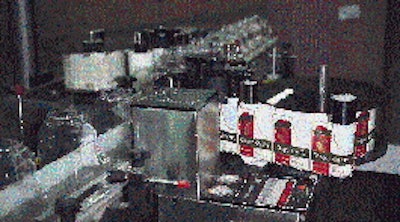
At Premier Plastics, the labeling process begins as operators place blow-molded containers onto an infeed conveyor belt on the standalone labeling "system." The system includes the two labelers mounted onto a T-base support and conveyor. MPI Label Systems (Stockton, CA) served as systems distributor.
Pressure-sensitive paper labels are supplied by Label Technology (Merced, CA). The label converter buys metallized paper from outside vendors, then prints the web flexographically in six colors. A clear laminate is applied on top of the inks, providing scuff and moisture resistance.
The approximately 3.5-mil structure is the same for both the 22- and 48-oz containers, though the L-shaped label measures 2 1/2" W x 3 1/2" H for the smaller container; 3 1/2" x 4 3/8" for the larger.
The main body panel label is applied first, then the side panel label. The primary label web unwinds and is held in place with constant vacuum on a honeycomb grid section of the labeler. This grid includes 36 holes that contain air-jet inserts. When the container is detected by an infrared sensor, a signal is sent to the 2111M's microprocessor. The microprocessor calculates conveyor speed and sensor position to trigger an air blast through the inserts, blowing the label accurately into position on the container.
As the container is conveyed away from the first applicator, a turning bar on the conveyor's guardrail turns it 90°. The container's side panel is subsequently labeled by the second 2111M. Bottles are bulk-packed into corrugated shipping cases, with 16 cases manually placed on a pallet for shipment to the packager for filling.
Video training for labeler
Premier Plastics has always applied labels automatically for Mallards' stir fry ginger sauce, but before acquiring the 2111M's in early '94, it hand-labeled bottles for other customers.
"When we applied labels by hand, we gathered as many people as we needed to label in order to complete an order and deliver it on time," says Premier production manager Greg Newman. "That sometimes required massive labor. But that wasn't the only problem with manual labeling. Labels are hard to apply accurately by hand. You take your time to position them, but at the last second before you put them on, you move slightly and that throws off the position. You can try to remove the labels and the adhesive, but that takes time.
"Often, we couldn't salvage them. That created label and container spoilage. By automating our labeling process, we can apply labels faster and with consistently excellent accuracy. Without counting spoilage, we conservatively estimate saving at least $50ꯠ a year for other customers whose bottles we label."
Premier Plastics jump-started its automated labeling with the help of Label-Aire's Model 2111M applicator set-up and operation video cassette. Premier management and operators made extensive use of the tape to learn how to work the machines, according to Newman.
"When we first bought the machines almost nobody here was familiar with them," he explains. "The video allowed us to work on the machine, set it up and adjust it. It was like having an engineer in our back pocket. We can review this tape again and again, either here at the plant or we can let operators take it home and watch it at their leisure. And, it works well for new employees who need to learn how to use the labelers. No other vendor has anything like this. It's been wonderful.
"We operate in a world of just-in-time deliveries, and offering a labeled container provides extra value and ties us closer to our customers," asserts Newman. "I believe labeling is something you'll see more molders do in the future."
"Premier's service will come back to them in spades because this product has become one of our top three sellers," says Mallards' Glenn Davis. "Our volume has increased appreciably and we are now ordering about 40ꯠ bottles a month from them."