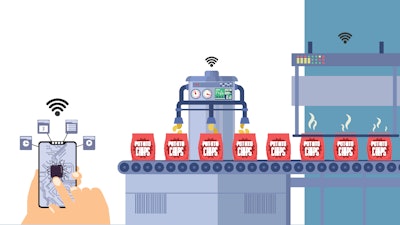
Snack food companies are using technology like virtual reality, video training, and automated sensors to improve employee training, reduce errors, and enhance workplace safety. These tools help workers learn faster, overcome language barriers, and prevent costly mistakes.
- Virtual reality headsets provide first-hand manufacturing floor experience before employees begin work, improving training effectiveness
- Video training and digital manuals are stored near equipment for quick reference without needing supervisor assistance
- Automated sensors and rejection points catch packaging defects automatically, reducing human error and creating a second safety layer
- Technology translates materials for non-English speaking employees, bridging language gaps in workforce development
- Automation reduces repetitive motions, protecting workers from potential injury while improving operational efficiency
Snack food market employers continue to look for ways to improve employee training, and technology is providing an edge.
That’s according to PMMI Business Intelligence’s “2024 Snack Foods Packaging Trends,” where Business Intelligence researchers surveyed and interviewed several snack producers on their outlook of the snack foods market, emerging machinery and market trends, and current challenges.
Taking advantage of technology
Researchers found that employee training and troubleshooting are how technology is most widely used among snack food-producing companies.
Videos are used for training employees both at hire and for new machinery. Manuals and troubleshooting assistance are often stored on computers near equipment so that they can be referred to quickly and without the need for further assistance from leadership. In one instance, virtual reality (VR) is being used to assist with maintenance and fixing of machines.
“We have used virtual reality headsets—before the employee walks onto the floor, they actually get a first-hand experience on what to expect on the manufacturing floor and that’s part of the part of the training. We have used software to train them on various food safety and quality aspects,” an External Quality Assurance Manager at a large consumer packaged goods (CPG) company told the PMMI Business Intelligence team in an interview.
Bringing employees up to speed and reducing error
Technology is being used to bring employees up to speed on training, especially on equipment that has more robust technology. It has been used to translate materials for employees that do not speak English. It is also being used to help with repetitive motions so that humans don’t have to make potentially harmful repeated movements. Moreover, technology has served as a second layer of safety, using sensors to pull something that might not be packaged correctly.
“We’re looking to mitigate the human response factor for some of our food safety safeguards with technology,” said a Project Engineer from a cookie and cracker company. “We’re looking to add different types of sensors and automatic rejection points. Instead of pausing the line and requiring human intervention to pull the defective product off and then restart the machine, we’re looking to automate some of those pinch points that require a lot and also add a second layer of safety.”
SOURCE: PMMI Business Intelligence: 2024 Snack Foods Packaging Trends
For more insights from PMMI’s Business Intelligence team, find reports, including “2024 Technology & Workforce: Using Smart Technologies to Bridge the Skills Gap” and “2024 Transforming Packaging and Processing Operations” at pmmi.org/business-intelligence.
Download the FREE report below.