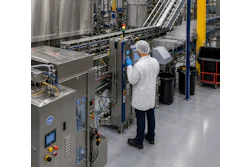
The Absolut Company, Ahus, Sweden, owned by the French company Pernod Ricard, operates its expansive vodka distillery 24/7 all year long and produces 700,000 liters of Absolut vodka per day. Sold in 126 countries, Absolut is the third largest brand of alcoholic spirits in the world, just behind Bacardi and Smirnoff.
Continuous distillation of the vodka, bottle filling, capping, labeling, casing, palletizing, and warehousing operations all are conducted at the Ahus facilities. The distinctive shape of the Absolut bottle was inspired by the old-fashioned Swedish apothecary flask. Today, Absolut markets its products in 10 different glass bottle sizes.
For its bottle accumulation, buffering, and conveyance, Absolut uses the DYNAC system from Hartness International. The Swedish vodka producer discovered the DYNAC accumulator at the Milan packaging show in 2000. The system is engineered to provide pressure-less product conveyance, accumulation, buffering, and line balancing benefits for high-speed lines. As Absolut Automation Engineer Jasper Hilhorst reports, “We liked the DYNAC accumulator’s unique design that allows us to accomplish a lot of accumulation within a minimal floor space without any risk of damaging the bottles.”
Absolut-Ahus installed its first DYNAC in 2001. The installation was performed by Hartness engineers from the USA. During later installations accomplished over the last several years, additional machines were installed by personnel from Hartness Europe. Hilhorst notes, “We currently have eleven systems running in our plant—one DYNAC Model 6100 and ten Model 6400s. There are a lot of factors that influence line performance. But in general, we have gained approximately 5% to 18% more efficiency per machine with the DYNAC equipment, depending on the bottle size we are running. We don’t run all bottle sizes on all lines. Also, high noise due to container–to-container contact is eliminated, and risk of bottle scuffing is averted.”
Versatile to accommodate and quickly changeover a range of product/package sizes/shapes/weights, the DYNAC 6400 is a single-line FIFO (First In, First Out) accumulation system. Its space-saving DYNAC-centric spiral line configuration eliminates complicated controls and enables close coupling of machine centers. As a result, machinery floor space requirements are reduced, fewer operators are required, and utility consumption is decreased.
Hilhorst adds, “We have an excellent relationship with Hartness and receive almost instant feedback in cases of service or spare parts issues. Hartness is a much appreciated supplier to The Absolut Company.”
Watch a video related to this article at pwgo.to/1065.