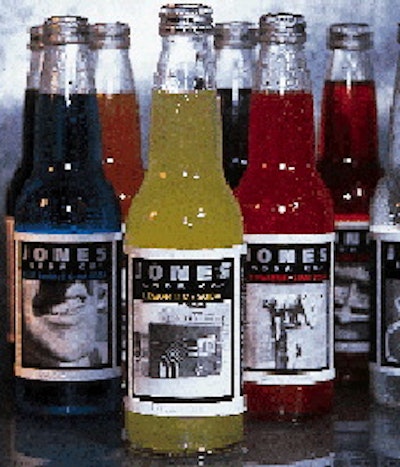
The label encourages consumers to send in photos they took themselves, which may appear on the label of one of 10 flavors of Jones Soda. The Vancouver, British Columbia, Canada-based company hopes to turn its empties into collectibles. "We decided that we couldn't compete with the multinational corporations in a traditional environment," says Peter van Stolk, president and CEO of Urban Juice and Soda. "We had to be smarter." Smarter meant introducing the carbonated soft drinks in nontraditional outlets, including tattoo parlors and skateboard shops, where they're gaining popularity with members of the subculture. It also meant combining traditional flavors and a standard long-neck bottle with retro graphics that feature both black-and-white and color photographs. Lawson Mardon (Northbrook, IL) supplies the 54# wet-strength glue-applied paper labels, which are process-printed in five colors with a UV coating. Each flavor has six labels featuring different photo images. Labels are collated by the converter so that when applied, bottles for each flavor have an equal amount of all six labels. Photo images are changed periodically, incorporating those sent in by consumers. This process is "fairly expensive," admits Urban Juice, but it's a central part of the Jones Soda image. Jones Soda has been available in Canadian, as well as Northeast and West Coast U.S. markets since mid-1996, and national expansion is planned. Suggested retail price ranges from 99¢ to $1.29 per bottle.