A&Z Pharmaceutical reduced nutraceutical blending time by 90% by replacing V-cone blenders with a rotary batch mixer, cutting cycles from 45-60 minutes to approximately 4 minutes while maintaining strict uniformity and GMP compliance.
- 90% time reduction: Blending cycles dropped from 45-60 minutes to 4 minutes using rotary batch mixing technology
- Faster lubrication process: Adding magnesium stearate now takes 30 seconds instead of 5 minutes, reducing over-lubrication risk
- Maintained quality standards: Uniform mixing achieved without compacting materials or damaging products, meeting all FDA GMP requirements
- Flexible capacity: Rotary mixer performs equally well at partial loads (15% capacity) and full capacity, enabling scalability
- Improved sanitation: Large access doors allow thorough cleaning and visual inspection without disassembly, streamlining changeovers between formulations
Facing rapidly increasing demand for its health and wellness supplements, A&Z Pharmaceutical expanded its Hauppauge, N.Y., operations with a new 26,700-sq-ft production wing dedicated to nutraceutical products. Along with the physical expansion came a critical process change: The company replaced traditional V-cone blending on the new line with rotary batch mixing—cutting blending times by more than 90% while maintaining strict uniformity and GMP requirements.
“We make uniformity claims for all the actives in our formulations, and we have to meet those claims in the final product—whether it’s a capsule, tablet, or powder drink,” says Marian Vija, Director of Research and Development at A&Z. “Our biggest need was a way to achieve that uniformity without compacting the materials or damaging the product.”
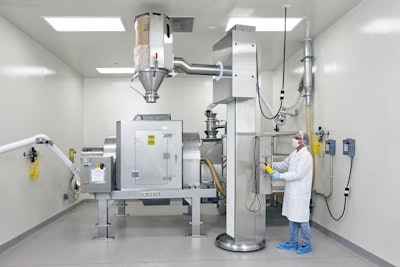
 The 40-cu-ft (1,133 l) capacity Rotary Batch Mixer yields uniform blends in short mixing cycles without degradation, or segregation upon discharge.Munson Machinery/A&Z Pharmaceutical
“That’s 11 to 15 times faster than what we were seeing with the V-cone blenders,” Vija says. “And it gives us flexibility, because the mixer performs just as well at partial loads—down to about 15% of rated capacity—as it does at full capacity.”
Controlled loading and critical lubrication
Operators load raw materials into the stationary inlet using a drum lift, following a prescribed order defined in the master batch record. According to Vija, material characteristics often dictate sequencing.
“Half of the time they’re very fluffy materials that would occupy the whole volume of the machine,” she explains. “So, we load those first, then add another ingredient to reduce the overall volume and allow for proper mixing.”
For tablet and capsule formulations, magnesium stearate or a similar dry lubricant is added near the end of the cycle. Lubrication is a critical control point: As little as one gram of magnesium stearate can treat hundreds of cubic feet of product. Too much lubricant—or too long a mix cycle—can prevent particles from binding properly during compression.
“With the rotary batch mixer, adding lubricant only extends the cycle by about 30 seconds,” Vija says. “In our V-blenders, it added about five minutes. The shorter exposure significantly reduces the risk of over-lubrication and overmixing.”
Once blended, finished batches are discharged back into the same GMP-lined fiber drums used to receive the ingredients. One operator controls the mixer speed at the panel while a second positions drums beneath the discharge gate to manage controlled fill. The blended batch is discharged into lined fiber drums, as dust is collected by a vacuum. Operator adjusts the mixer to rotate slowly during discharge.Munson Machinery/A&Z Pharmaceutical
GMP-driven sanitation and changeover
Given the variety of nutraceutical formulations produced on the line, A&Z established a rigorous sanitation protocol to prevent cross-contamination and maintain FDA Good Manufacturing Practice compliance. After discharge, the mixer is placed under vacuum to remove residual dust. Large access doors on opposite sides of the vessel allow full visual inspection and hands-on cleaning of all product-contact surfaces.
The interior is pressure-washed with hot water, followed by circulation of a hot-water cleaning solution while the vessel rotates. After draining and rinsing, the system is treated with 70% isopropyl alcohol in two successive cycles, then dried under vacuum for approximately two hours before the next production run.
“The large doors let us thoroughly clean and inspect the vessel without moving the drum or disassembling components,” Vija notes. “That’s a big advantage from both a sanitation and labor standpoint.” Ingredients are transferred from drums to the mixer in a sterile, dust-free manner, isolated from the plant atmosphere.Munson Machinery/A&Z Pharmaceutical
Validation before full-scale production
Before committing the system to production, A&Z validated performance using actual formulations at Munson’s test facility on a laboratory-scale rotary batch mixer. Four minutes was established as the optimal cycle time. The company then conducted full content-uniformity studies on commercial-scale batches produced in-house.
“We obtained excellent results—uniformity and a good, repeatable mixing procedure,” Vija says. “The blends are suitably robust for both compression and encapsulation, which was a critical requirement for us.”
Throughput gains without sacrificing quality
For A&Z, the shift to rotary batch mixing has delivered the rare combination of higher throughput, improved process control, and reduced risk on critical formulation parameters. By slashing blending times from nearly an hour to just minutes, the company has increased line capacity without compromising uniformity, tabletability, or GMP compliance.
“As demand continues to grow, the shorter cycle times and flexibility we get from this mixer give us room to scale,” Vija says. “We’re producing faster, but with better control of the variables that matter most to product quality.”