Our recent visit here uncovers the group’s latest research and developments in RFID. The group is led by research director Daniel Engels and project director Rich Fletcher. The graduate students working on various projects are Alki Delichatsios, Uttara Marti, Rich Redemske, and Jonathan Wolk.
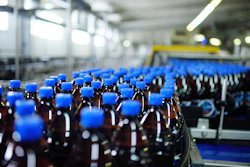
Tagging bottled water One of the toughest applications for RFID in packaging is said to be high-moisture products. MIT is pushing the envelope in one of its latest research projects by developing a UHF RFID tag for single-serve PET bottles of water. The goal is a tag that can be read at the item level at least two layers deep when cased in a 4x6 arrangement. The tag will be wrapped around the bottle like a label. Researcher Alki Delichatsios will be working on this project through summer 2006.
Air gaps and helpful metal Another project hopes to provide evidence that the words helpful and metal can be used together in conjunction with RFID. Researcher Uttara Marti has studied the effect of air gaps in RF performance. In summary, air gaps are good.
“In this case, metal is good,” observes Engels of research involving aluminum-foil-lined materials. Properly placed, these materials can direct the RF energy deeper within a pallet load to read tags on packages.
World’s first graphical simulation Implementation of graphical simulator, by researcher Jonathan Wolk, is claimed as the world’s first real-time visual 3-D modeling of reader-antenna and tags.
With the software simulation program, users can place a tagged box into a field and see how well it performs within the variables of antenna type; polarization; field strength; and tag placement on the box. Box contents can be air (empty), liquid, or aluminum. The view can be reoriented or zoomed in or out in 3-D.
Field probe update We also wanted to get a first-hand look and an update on MIT’s economical RFID field probe, which we covered in an article published in January. Developed by Rich Redemske, the 9’’x3’’field probe integrates an Electronic Product Code RFID tag emulator and a sensor probe.
Redemske has been working on increasing the probe’s read distance range. Initially it was 2 meters, currently it’s 3 to 4 meters, and the next goal is a range of 4-5 meters, or about 15 ft.
“Rich Fletcher and myself take a great deal of pride in the students for jobs very well done,” says Engels.
For further information on these MIT RFID projects, contact Dr. Daniel Engels at the Auto-ID Labs, 617/252-1490, www.mit.edu/auto-id.
For the complete article with pictures, see: packworld.com/go/c149