Mechatronics innovations are helping food processors overcome limited engineering resources and workforce challenges by automating changeovers, integrating advanced sensors for predictive maintenance, and standardizing controls across equipment to increase efficiency and reduce downtime in 2026.
- Cost reduction: Automated changeover costs have dropped from $3,000 to under $1,000 per adjustment point over the past decade.
- Sensor integration: Food producers are adding inexpensive sensing technology to legacy equipment to build data foundations for AI applications and predictive maintenance.
- Standardized controls: OEMs like Bühler are moving toward single-platform control systems across all machines and plant operations by 2030.
- Workforce challenge: Mass customization and exploding SKUs create complexity for younger operators, driving demand for advanced equipment and system integrators.
- Predictive maintenance: Companies like Valley Queen are transitioning from preventive to predictive maintenance using wireless vibration sensors and CMMS systems to monitor equipment health in real time.
Food processors and manufacturers are seeking higher margins. Mass customization and the explosion of stockkeeping units (SKUs) in operations create additional complexity for younger operators and plant staff. A lack of operator experience and tools is a recurring theme in PMMI’s “2025 Knowledge Transfer for Machine Operators” report. “We’re getting better at documenting it now, but for so long the operator would come in and [say], ‘Oh, I like this dial here and I like this dial here,’” said a survey respondent. “And then the dial gets out of calibration and then it’s hard to replicate that again, and you’re constantly trying to fuss with it.”
Engineering advances in equipment and line designs are allowing food producers to do more with less, as engineering teams get smaller. Companies are turning to advanced equipment to reduce changeover time, implement upgraded sensing technology for legacy applications, lay the foundation for machine learning, and recruit system integrators for immediate projects.
Engineering simplifies food operations
The recent IFT FIRST Conference in Chicago revealed a food industry undergoing dramatic shifts with consumers, including continued demand for protein-based food formulations, an increased focus on healthy eating—driven in part by benefit stacking—and smaller portion sizes.
These shifts are being felt in operations, but food producers are turning to engineering advances in mechanical, electrical, sensing and software to increase volume and throughput.
Engineering resources are limited, according to Ryan Park, Engineering and Applications Manager, SPI Automation, part of the Grote Company Family of Brands. “For food processors, the challenge is having fewer engineering resources and working with many suppliers to get projects completed,” says Park. SPI Automation is a system integrator that builds control panels, offers robotics expertise and integrates mechanical equipment for the food processing segment.
Outside engineering teams, working through system integrators, are helping fill the gap for food producers, as new line configurations and data collection expertise are needed. “A systems integrator can understand all the operating conditions in the plant and help streamline projects for bootstrapped teams and design better mechatronic solutions,” adds Park.
Receiving feedback from operators, plant managers are now seeking to standardize controls across processing equipment. This has always been a challenge for the food industry due to acquisitions of legacy equipment, but swapping out control architectures is getting more attention.
“If the plant has a standard in their machine specification, they can move to one architecture for all systems regardless of the machine builder,” says Troy Manley, Sales Director, Food & Packaging, Festo North America. “This would create a more seamless integration for the plant and reduce the need for all the different skillsets needed for the architectures.”
Bühler recently announced its next-generation Nutrex 7 Series extrusion system is taking this approach from the equipment side. “The company's fully revised control system is the flagship of Bühler’s automation strategy that will standardize all machine and plant controls on a single platform by 2030,” according to a recent press release in May.
Adding more intelligence and flexibility to machines is a priority, according to Adrian Staerkle, Team Manager R&D Automation Software at Bühler Inc. “A flexible machine must accommodate different products and process conditions without being unnecessarily oversized or inefficient,” says Staerkle. “Motors, drives, and heating and cooling systems must be correctly dimensioned while still providing the operating range customers require.”
At the heart of mechatronics is the simplification of component integration across engineering disciplines, and inexpensive sensing technology is part of the process. Adding sensors to legacy equipment is helping plants build the data foundation for AI applications, including semantic and ontology-based intelligence layers.
“We’ve seen a considerable increase in equipment-level diagnostics for energy monitoring over the last few years,” says Steve Bain, Industry Segment Manager, Food & Packaging, Festo. “Monitoring compressed air usage at the machine level is great for diagnosing changes in machine behavior.” Festo’s MSE6-E2M energy module is one example of a monitoring solution that adds to the plant’s bottom line by identifying and preventing continuous leaks during downtime.
“Customers want greater visibility into electrical power, compressed air, water and other utility consumption,” adds Staerkle. “The key is to connect these measurements with the product, recipe and current operating state. A temperature, pressure or motor-load value becomes considerably more useful when it can be associated with a specific batch, product, production phase or alarm.”
Adding sensors and the drive toward predictive maintenance continues with plant expansions. The Valley Queen plant in Millbank, S.D., recently completed a $50 million expansion that increased its processing capacity by 25% for cheese, whey, whey protein, lactose and anhydrous milk fat products. The co-manufacturer works with large companies, such as Arla Foods Ingredients, and more volume and throughput was on the horizon.
“We had a lot more equipment coming in,” says Eric Pulling, Utility Process Manager, Valley Queen. “That means we had a lot more needs—not just for vibration monitoring, but [asset condition] monitoring in general.”
With the protein and wellness boom, Valley Queen is ramping up its whey production. The co-manufacturer added a large blower to meet these needs, which included a positive-displacement pump that drew in air and pressurized it to generate airflow that transports products through tubes to the packaging room.
“This is an extremely critical part of the production process,” Pulling explains. “We need to make sure we maintain a flow of product through the facility. And if there are any problems with the equipment, we want to know right away.”
Pulling says knowing the health and wear of the machine’s components is essential for uptime. “We want to make sure that we have an idea of how those are running at all times and not causing too much vibration or heat,” Pulling adds.
For this project, Valley Queen installed Fluke wireless vibration sensors on the blower equipment, and the technology connects to eMaint, a computerized maintenance management system (CMMS). Pulling has also installed 3561 FC sensors on auger bearings, an electric motor and pillow block bearings that connect to the blower’s centrifugal fan. “We have installed three sets of sensors on high-RPM equipment that have not had any failures,” Pulling adds. “When the sensors show vibrations trending upwards, we know we need to schedule service soon.”
Valley Queen adds that it currently employs a preventive maintenance approach, but with the installation of the new monitoring equipment, the dairy ingredient manufacturer will move to predictive maintenance.
The stakes are high in predictive maintenance, particularly regarding data foundations and AI-based strategies. While many AI conversations in 2026 focus on unsuccessful projects, new pilots are much more narrowly focused, and applications such as predictive maintenance seem to be excellent candidates.
“Food producers are not simply asking for more sensors,” Staerkle says. “They are seeking greater process transparency and actionable information that supports practical production decisions.”
Engineering quick changeovers
Today’s mass customization and younger workforce are driving food processors to identify advanced equipment and engineering approaches to reduce downtime and increase OEE.
Volume is needed. “The consumer packaged goods (CPG) industry has seen a one billion unit-volume decline since 2019,” said Arnold Kogan, Managing Director and Partner, Boston Consulting Group (BCG), during The Connected Worker conference in October 2025. “We have reported the decline is concentrated in the ‘at-home staples’ sector, with a 2-4% decline between 2022 and 2023 alone.”
The focus on optimizing automated changeovers is being felt, according to Festo’s Bain. “The cost for automating changeovers has decreased drastically over the last decade,” says Bain. “We were challenged with hitting less than $3K per adjustment point 10 years ago and now getting under $1K per point is very achievable. And, this comes as the cost of downtime increases due to labor and operating costs.”
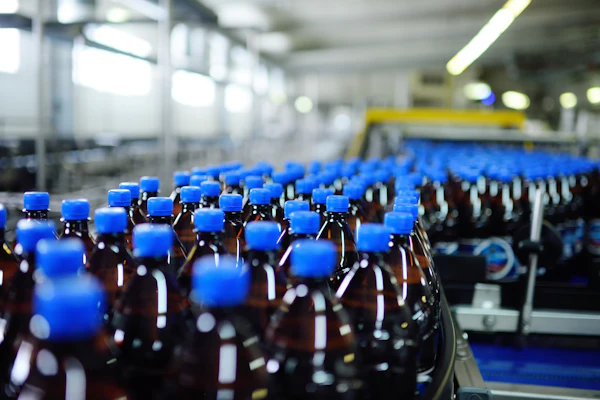
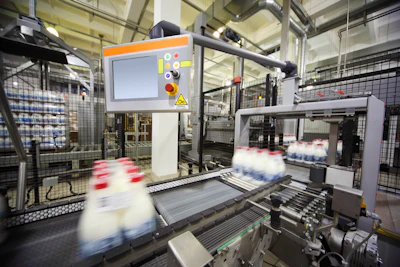
The convergence of open APIs, sensing, mechanical and industrial networking is driving advances in changeovers, particularly automated ones. Septimatech Group, Inc., a provider of custom solutions for packaging lines, offers automated changeover options for beverage lines or hard-to-reach sections via a distributed control architecture. The automated application features mechanical elements, such as feed/timing screws, downed-bottle reject systems, adjustable guide rails and bottle inverters.
Operators choose from a menu of SKUs at an HMI terminal, and conveyor guide rails automatically adjust.
OEMs are also offering advanced software features to help reduce changeover time. Bühler’s Nutrex 7 Series Extruder optimizes changeovers with its StepFlow software that standardizes startup and shutdown sequences. “It helps the machine reach stable production conditions more quickly and shut down in a controlled manner, reducing production time, raw-material losses and dependence on individual operator experience.”
Legacy food and beverage plants are also searching to reduce changeover times with system integrators. “We can retrofit systems to store recipes with dosing quantities on a centralized computer and feed multiple mixing lines at a facility to manage recipes across machines,” says SPI Automation’s Park. “This speeds up changeovers between recipes, allows for more diverse recipes, and ensures recipe consistency.”
Engineering resources remain scarce for many food producers, but advanced equipment, software and engineering services are helping operators increase uptime.