Britvic's Rugby facility used AI-based condition monitoring to detect an abnormal pump operation and prevented six hours of unplanned downtime, saving 288,000 bottles of lost product and 2,000 liters of water. The early alert allowed the maintenance team to repair the pump during a planned stop in just 45 minutes, demonstrating how predictive maintenance technology delivers immediate financial and operational value.
- Six hours of downtime prevented through early detection of pump abnormality at Britvic's Rugby facility
- 288,000 bottles of product loss and 2,000 liters of water saved by avoiding unplanned failure and extra cleaning cycles
- 45-minute repair window achieved during planned maintenance, compared to potential line-stopping emergency
- Alfa Laval's Clariot solution uses AI analytics and sensors to monitor rotating equipment independently of business systems
- Uptime and sustainability linked — prevented failures reduce waste from product loss, energy use, chemicals, and labor
Unplanned downtime remains one of the largest hidden costs in beverage manufacturing, particularly in facilities that rely on pumps to support continuous production across multiple lines. At Britvic’s Rugby, U.K., facility, early detection of a pump issue helped the company avoid six hours of unplanned downtime, 288,000 bottles of lost product, and 2,000 liters of cleaning water.
The facility uses Alfa Laval’s AI-based condition monitoring solution to monitor pumps and other rotating equipment. According to Alfa Laval, the system detected abnormal operation on a critical pump and alerted operators before the issue caused a failure. Britvic’s maintenance team then repaired the pump during a planned production stop, completing the work in 45 minutes.
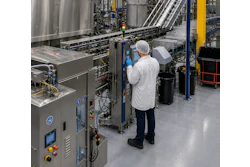
 Early notification allowed Britvic’s maintenance team to repair a critical pump during a planned production stop, preventing the loss of 288,000 bottles.Britvic/Alfa Laval
Britvic’s Rugby plant uses hundreds of pumps to support round-the-clock production across beverage lines. Any unexpected pump failure can interrupt production, create product loss, and require additional cleaning cycles. In this case, early notification allowed the maintenance team to act before the equipment issue became a line-stopping event.
Early warning reduces risk
Condition monitoring gives maintenance teams a different view of asset health than scheduled inspections alone. Instead of waiting for a set inspection interval or reacting after failure, the system tracks operating data and flags abnormal conditions before they escalate.
“In today’s manufacturing environment, uptime and sustainability are increasingly linked,” says Torsten Pedersen, Commercial Head Condition Monitoring, Alfa Laval Fluid Handling. “Our customers are looking for solutions that improve productivity and operational efficiency, and this is exactly where condition monitoring creates value.”
Alfa Laval says its Clariot condition monitoring solution uses sensors, AI-based analytics, and secure connectivity to monitor pumps and rotating equipment. The system is designed for hygienic process industries and can detect issues related to process conditions, installation problems, and mechanical wear.
According to Alfa Laval, the technology operates independently of business-critical systems and is compatible with most pump brands. It can be scaled across production lines, factories, and global operations.
“We firmly believe that condition monitoring and predictive maintenance is becoming standard practice in modern manufacturing,” says Pedersen. “The value is no longer theoretical, and cases like this clearly demonstrate the positive business impact.” Alfa Laval’s condition monitoring system helped Britvic’s Rugby facility detect a pump issue before failure, avoiding six hours of unplanned downtime.Britvic/Alfa Laval
Downtime and sustainability connect
The Britvic case also shows how maintenance decisions can affect resource use. Alfa Laval says the early repair helped Britvic avoid an unexpected clean-in-place cycle, saving 2,000 liters of water, along with associated energy and chemicals.
That connection between uptime and resource efficiency is becoming more important. A prevented failure can protect production time, but it also can reduce waste tied to product loss, cleaning, energy use, and labor.
At Britvic’s Rugby facility, one notification gave the maintenance team enough time to act before failure. That turned a potential six-hour production loss into a 45-minute planned repair.