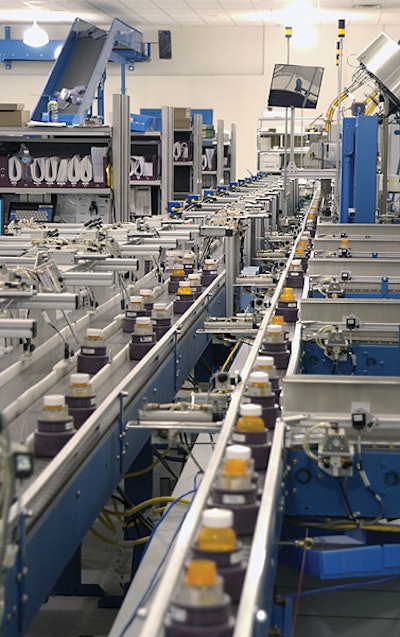
McKesson APS-High Volume Solutions-SI/Baker, a division of McKesson, served as the line’s systems integrator. Positioned at different areas throughout the line are five Plus Module fill stations containing 150 cells.
Each station includes a hopper with a counting disk that counts drug tablets or capsules, then releases them into a chute that drops the pills into waiting bottles below. Bottles are automatically labeled at three stations before they proceed along the main packaging line. The pressure-sensitive labels with prescription information are printed at each of these three stations by an Intermec unit.
The five fill stations are mounted to conveyors perpendicular to the main conveyor. Booher describes a bottle’s path on the line as similar to a car trip to run errands where you first enter the freeway, then exit as necessary to pick up what you need, then go back onto the freeway.
Directing bottle traffic on the line is the radio-frequency identification system supplied by RFID, Inc. This system includes dozens of readers mounted at various points under the main conveyor line. Each reader is cabled to an antenna that constantly emits a radio-frequency signal. As a bottle in a puck is conveyed in the proximity of each reader, the RFID chip or tag on the puck responds to the signal of the reader. The tag, a passive device that includes an electrically erasable programmable read-only memory (eeprom) chip and a copper coil for an antenna, supplies a number, 123 for example, that correlates to the prescription in the bottle in that puck. That information goes to a host computer that relays instructions to direct the puck downstream.
The process continues throughout the line. Near the end of the line, bottles index to five stations where pharmacists make a final visual quality check to “make sure the right pills are in the right bottle,” says Booher. From there, bottles index to downstream capping and induction sealing.
Capped containers are conveyed in their pucks under the Enercon induction-sealing unit, which is mounted on the conveyor. As pucks with bottles are conveyed, they pass through an electromagnetic field, called an eddy current, that’s induced into a foil layer in the cap liner. The process results in resistance heating of the foil, according to Enercon, which melts a polymer-based coating that bonds to the lip of the pill bottle and creates a hermetic seal.
Booher estimates that the line speed is 1’/second. The line runs on one shift, five days a week, with limited weekend production.
New bottles
This fall, Tri State Distribution began supplying Prescription Solutions with see-through amber polypropylene bottles that it produces by injection/stretch blow molding. Tri State believes this is the first time this molding method has been used for PP bottles for mail-order pharmaceuticals. The vendor says the increased crystallinity of the material provides better barrier properties, strength, impact resistance, and clarity than the more traditional injection-molded PP bottles they replace. The bottles are made using resin from Chevron Phillips on new Aoki molding equipment.
Prescription Solutions uses four bottle sizes, ranging from 90 cc to 625 cc. A Kaps-All capper applies new injection-molded PP child-resistant closures from Van Blarcom Closures. They include a liner for induction sealing and are designed to be both easy to open and child resistant.
“On the floor,” Booher summarizes, “the operation works like any neighborhood pharmacy, only larger. It performs all the equivalent tasks from taking the bottle off the shelf, counting out pills, putting them in prescription bottles, putting a label on them, and having a pharmacist check to make sure everything is filled correctly.”