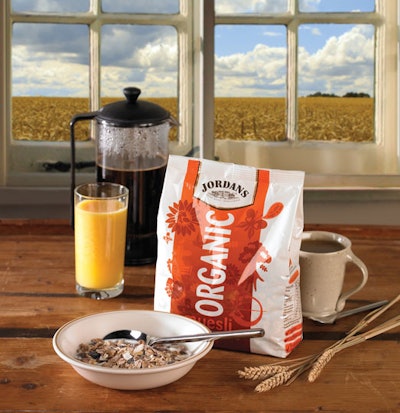
This new bag is reportedly the first 100% biopolymer, biodegradable laminate to enter the retail market in Europe. The new package consists of two biopolymer films. The inner layer is white Mater-Bi film from Novamont (www.materbi.com). The outer layer is reverse printed clear NatureFlex film from Innovia Films (www.innoviafilms.com).
Mater-Bi biodegradable and compostable corn starches have been successfully used in loosefill, thermoformed containers, and transparent packaging films. NatureFlex is manufactured from renewable wood-pulp sourced from managed plantations. Both are certified to EN13432 and ASTM D6400 composting norms.
Jordans and supply chain partner Alcan Packaging (www.alcanpackaging.com) devoted three years of effort to the development of the package. The new flexible bag was recognized as the 2007 Best Bioplastics Application-Packaging at the 9th Annual European Bioplastics Conference.
Jordans’s stated goal is to minimize the impact of its packaging on the environment, while recognizing that the main function of all food packaging is to keep the contents safe for consumption. The company’s cartons for breakfast cereals and cereal bars, for example, are manufactured using at least 80% recycled card stock. The remaining 20% comes from sustainable forests.
Jordans tells the public that, “We know that the way in which we do business has an impact on the world around us, and we work hard to ensure that this impact is constructive and positive rather than damaging.”
The packaging industry is making enormous strides toward improving sustainability. Every week, it seems, there is an announcement of a significant improvement to a package in terms of increased recycled content, light-weighting, improved cube utilization, and lower energy usage and greenhouse gas emissions. There will come a point, however, when sustainability’s low hanging fruit will be harvested; and new solutions based on renewable resources, like the biopolymer bag introduced by Jordans, will have to be considered. The demand for petroleum is outstripping supply. Oil recently surpassed $100 a barrel for the first time in history. The faster brand owners and converters begin learning the ins and outs of renewable packaging materials and applying that knowledge, the more sustainable their packaging options will be.
Malcolm Cohn, market manager for the Americas, Innovia Films, Inc. offers this advice for the application of new renewable polymers or fibers. “Do not try to replicate an existing package made from petroleum products,” he says. “Instead continue to use the knowledge of light weighting and reducing the headspace of the package to reduce the total amount of material.
“Re-examine the shelf life requirements of the package. With the present state of the technology, shorter, yet sufficient, shelf life opens up application opportunities for bio-polymers. Graphics on the package should also inform the consumer that the packager is using earth-friendly renewable materials. Studies indicate that consumers respond to this message.”
For more on the Jordans package, see page 66.