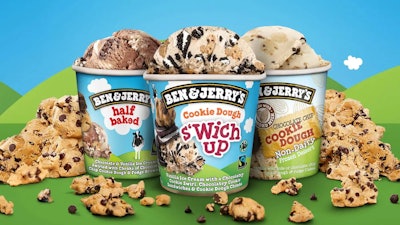
Unilever is separating its ice cream business, which generated €7.9 billion in 2023 sales, to focus on core brands and accelerate growth. The separation will be complete by end of 2025 and includes a productivity program cutting 7,500 jobs.
- Unilever's ice cream division generated €7.9 billion ($8.6 billion) in 2023 sales, representing 13% of total company revenue
- Ice cream brands include five of the top 10 global brands: Ben & Jerry's, Wall's, and Magnum
- Full separation expected by end of 2025, with activities beginning immediately
- Productivity program will save €800 million ($875 million) over three years through 7,500 job cuts, mostly office-based roles
- Separation allows focus on complementary businesses in Beauty & Wellbeing, Personal Care, Home Care, and Nutrition
To accelerate its Growth Action Plan (GAP), launched in October 2023, Unilever announced that it would separate its Ice Cream division from the rest of the business. Pointing to what it says is a very different operating model, the company contends the move will be good for the future growth of Ice Cream as well as Unilever.
Unilever owns more than 400 brands sold around the world. The separation of the Ice Cream business removes a distraction from core competencies in Beauty & Wellbeing, Personal Care, Home Care, and Nutrition, and allows Unilever to become a “simpler, more focused company,” according to a company statement.
“Under the Growth Action Plan, we have committed to do fewer things, better, and with greater impact,” says Hein Schumacher, CEO of Unilever. “The changes we are announcing today will help us accelerate that plan, focusing our business and our resources on global or scalable brands where we can apply our leading innovation, technology, and go-to-market capabilities across complementary operating models.”
Unlike Ice Cream, the remaining business groups have complementary routes to market, R&D, manufacturing, and distribution systems. Ice Cream has distinct characteristics, requiring a supply chain and point of sale that support frozen goods, a different channel landscape, more seasonality, and greater capital intensity.
Unilever sells five of the top 10 selling global ice cream brands—including Ben & Jerry’s, Wall’s, and Magnum—bringing in sales of €7.9 billion ($8.6 billion) in 2023 and accounting for 13% of the company’s total sales. However, the division had a disappointing year, with declining market share and profitability. Though underlying sales grew 2.3%, that was based on higher prices rather than increased volumes, which fell by 6%.
Also in October, Unilever announced that Matt Close, president of Ice Cream, would leave the company at the end of 2023, replaced by Peter ter Kulve, who moved over from the fast-growing Home Care division. Under the new leadership, Ice Cream has been making significant operational changes expected to drive stronger performance, including improved productivity and efficiencies, product rationalization, and investment behind significant innovations.
As a separate business, Ice Cream will be able to better grow its business, allocating capital and resources to support its distinct strategy, and optimize its manufacturing and logistics network, Unilever says. Separation activity will begin immediately, with full separation expected by the end of 2025.
Productivity program will result in 7,500 layoffs
Unilever also announced the launch of a major productivity program, “driving focus and faster growth through a leaner and more accountable organization,” the statement says.
The program is expected to save the company about €800 million ($875 million) over the next three years. The program is expected to further reduce complexity and duplication, and drive efficiencies through technology-led interventions, process standardization, and operational centers of excellence.
“The board is determined to transform Unilever into a higher-growth, higher-margin business that will deliver consistently for all stakeholders. Improving our performance and sharpening our portfolio are key to delivering the improved results we believe Unilever can achieve,” says Ian Meakins, chair of Unilever. “The separation of Ice Cream and the delivery of the productivity program will help create a simpler, more focused, and higher-performing Unilever. It will also create a world-leading ice cream business, with strong growth prospects and an exciting future as a standalone business.”
About 7,500 predominantly office-based workers will be affected globally. That’s close to 6% of Unilever’s total workforce.