When a new technology disrupts long-standing, traditional practices, it can be challenging to incorporate new techniques into old work routines. Augmented (AR) and virtual reality (VR) technologies have been buzzwords in the industry for a couple of years now, but the benefits that the technology brings have been highlighted more than the actual steps and processes to implement it. This has machine builders wondering if the technology is practical for their business. Other industries such as automotive and aerospace have successfully implemented the technology and have used it for years to streamline manufacturing and assist with maintenance and assembly… so why can’t the packaging and processing industries do the same?
When OEM Magazine reported on altered reality more than two years ago, the technology was in its infancy and may not have been OEM-ready. But with more practical use cases from packaging and processing machine builders, it appears that augmented and virtual reality have finally arrived.
The Difference Between Augmented and Virtual Reality
While both versions of altered reality use some of the same technology and provide an enhanced virtual experience, the capabilities, equipment and software needs vastly differ.
Virtual reality is an artificial, computer-generated simulation of a real-life environment. Virtual headsets provide a firsthand experience of a simulated reality, to the exclusion of the actual surroundings. The technology needed to simulate virtual reality is a headset, such as the Oculus Rift or the HTC Vive, which retails anywhere from $120 to $800.
The environment itself can be created through a coding language known as virtual reality modeling language (VRML), which can also be found in the AutoCAD files that OEMs already use to create 3D models of their equipment.
Since operators cannot see the real world around them when they are using a virtual reality headset, the opportunities virtual reality brings to manufacturing and service are limited. But it still offers a unique approach to trade show marketing, machine demonstrations and employee training.
Augmented reality, on the other hand, layers computer generated enhancements, like digital images and graphics, over an existing reality. This allows users and operators to interact with the world around them while in an augmented reality state. Augmented reality uses headsets, too, but unlike virtual reality headsets, they allow operators to see through the headset into the real-world. This technology may prove to be ideal for remote maintenance, employee training, and machine assembly. Augmented reality headsets like Google Glass or Microsoft HoloLens retail anywhere from $199 to $4,500.
How AR and VR impact your machine builder
As technology adoption soars, different use cases have surfaced from OEMs using altered reality to make a difference in their operations and how they handle customer relationships.
One of the areas that stands to be revolutionized by AR is field service and remote maintenance. Augmented reality headsets like Google Glass and Microsoft HoloLens allow OEMs to successfully and quickly fix equipment from a remote location by being able to look into the equipment in real time without having a service tech or employee fly out to the your site. This eliminates the cost and time it takes to send out a technician to a plant, while also expediting the time it takes to get a machine back up and running.
Use cases
Tetra Pak, a Swiss food packaging and processing equipment manufacturer, has deployed about 140 Microsoft HoloLens headsets in the field that its customers use for remote support.
“What we have seen is the speed in which we are able to resolve issues can be much faster and so that’s one of the key benefits for our customers,” says Seth Teply, Tetra Pak’s Vice President of Services for the U.S. and Canada.
Machine operators can dial into the remote support network, and a Tetra Pak specialist will see what the person in the field sees through cameras embedded in the Microsoft HoloLens headset. They can also quickly drag and drop any documents into the view of the headset that the operator may need to fix the equipment. The Tetra Pak specialist can also validate the results of the work remotely, which has proven to be successful for the OEM, according to Sasha Ilyukhin Vice President of Industry 4.0 solutions and customer success, who is leading Tetra Pak’s Industry 4.0 efforts.
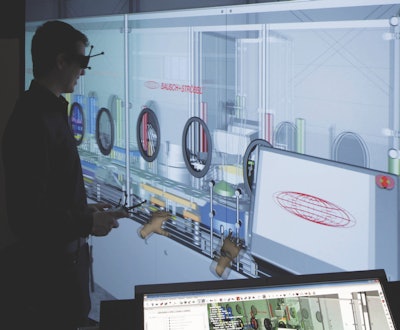
Bausch+Ströbel, a German pharmaceutical equipment manufacturer, started using virtual reality in 2013 for digital engineering and product development. It has since applied it to many aspects of its business including virtual mock-up studies, design reviews, safety studies, ergonomic studies, failure mode effects analysis, machine redesign assessments, computer-aided engineering and more.
“When we introduced the VR system, our customers and our staff were quite curious,” says Florian Naser, who works in the systems product creation of applications at Bausch+Ströbel. “At the beginning, it was strange for everybody to work with a machine mock-up that they could not touch because it was a very different sensory experience. Still, the spatial view and fine details of the machine model were convincing, and it wasn’t long before curiosity transformed into continued support of the technology. We’ve been working with VR for a few years now and there are benefits for our customers and us.”
Addressing AR challenges
While the technology benefits may seem like a no brainer, there are challenges associated with all aspects of AR and VR. But luckily, some OEM peers have paved a way for an easier implementation.
For remote maintenance, OEMs may face strong headwinds from end users’ security-minded IT departments as the machine builder must patch into a Wi-Fi network to connect to their machine.
An OEM may set up its own demilitarized zone (DMZ) router placed in the end user’s facility to collect data from its equipment and store it in the cloud. Should a cyber breach or attack occur, the DMZ functions as an isolated network between the Internet and the end user’s network, allowing the end user and machine builder extra time to detect and address a breach before hackers were to completely penetrate the internal network.
According to Ilyukhin, having enough network bandwidth to support remote maintenance is also key because even if the network is onsite, it still operates as a Wi-Fi network and with so many devices communicating and connecting to equipment, the signal isn’t always strong enough. Tetra Pak used repeaters—a device that receives and retransmits signals—and dedicated routers to ensure the network was strong enough to clearly and accurately handle remote support.
Because Tetra Pak works with end users in the food and beverage industries, another point of contention between OEMs and CPGs is having cameras on the factory floor. As AR headsets have cameras embedded in them, end users often worry about factory conditions being photographed and leaked—should there be an instance of misconduct or subpar sanitation conditions, for example. Tetra Pak mitigates this concern by explicitly disclosing how the technology will be used—and will not be used—inside a customer’s factory, outlined in an in-depth agreement and site survey.The end user may choose to control when the OEM accesses that system.
Another main barrier between OEMs and successful implementation of AR and VR technologies comes down to the implementation process itself and assigning responsibility to either a team within the OEM’s company or a third party vendor.
This article is an abridged version. For the full article, including more on AR and VR applications and challenges, click here.
Looking for an answer to your processing or packaging challenge? Make plans to visit Healthcare Packaging EXPO Las Vegas and co-lated PACK EXPO, Sept. 23-25 for the latest materials and machinery.