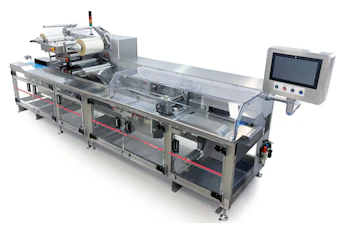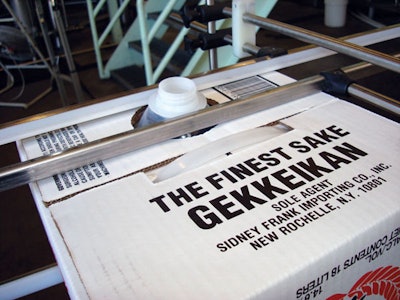
Says the company’s director of engineering, Jack Grosskopf, “There are ‘opportunities’ in the Cubitainer container handling, filling, and capping aspects due to its composition. The plastic ‘container’ is not rigid or capable of supporting itself; it is supported by the cardboard box.”
As Grosskopf explains, conventional indexing systems, such as starwheels, do not fit this application, as the neck of the Cubitainer needs to be located and trapped for filling and capping, but cannot be used for indexing. This must be accomplished by moving the case. In addition, inconsistencies in the case substrate and the shape of the container mean that from one case to another or from one batch of cases to another, there can be case-dimension differences. “These tolerances accumulate in the filling and capping areas and can create issues in getting multiple nozzles and capping heads aligned with the neck openings,” Grosskopf relates.
Making container positioning even more crucial is the size of the filling nozzle. To maximize production rates by minimizing filling time, National Instrument uses the largest nozzle possible. As a result, the position of the neck as it relates to the position of the nozzle must be precise.
To address these issues, a flighted conveyor chain is used to index the cases. This allows for separation of the cases, which minimizes the tolerance buildup and allows the case to be positioned accurately for the locators. The locators precisely position the neck of the cube and hold it there to allow the nozzles to enter the cube. A similar indexing arrangement is utilized for capping, as well.
Another difference found with the Cubitainer is in the capping process. In a typical bottle-capping machine, the equipment grips the bottle, applies the cap, and torques the cap closed. In most cases, the bottle is rigid enough to withstand the application torque required to sufficiently cap the bottle. With the Cubitainer, however, the gripping surface is the cardboard case. Therefore, during torquing, if the case is gripped, the neck of the bag will rotate in the case, creating crazing in the cube. To address this situation, National Instrument designed a locating and clamping system that rigidly holds the neck ring during torquing.