CIP optimization in beverage manufacturing requires fixing operational problems first, understanding three distinct CIP types, and iteratively testing changes while validating both conformance and performance to achieve significant savings in water, energy, and production time.
- CIP optimization requires plants to be in a stable, high-performing state before attempting efficiency improvements.
- The three main CIP types are clean and sanitation CIP, cleaning-only CIP, and flavor changeover CIP, each with distinct goals.
- Switching from a 5-step hot-water wash to a 3-step cold wash can save 75 hours of production time, 1,500 cubic meters of water, and 60 million BTUs annually.
- Optimization is iterative—extending wash intervals, adjusting CIP types, and combining cleaning-only with sanitation steps progressively improves efficiency.
- Validation of both conformance (quality results) and performance (resource consumption) is essential to ensure every wash uses exactly the resources needed.
Clean-in-Place (CIP), the automated processing step of cleaning interior surfaces of pipes, vessels, and equipment without disassembly, is perhaps one of the most resource-intensive and operationally critical processes in beverage manufacturing.
When done right, it ensures product safety, microbiological integrity, and consistent quality. But if it’s done inefficiently, it drains water, energy and that most precious resource—time—that plants can't afford to waste.
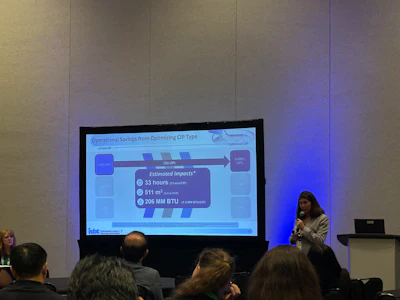
At the International Society of Beverage Technologists' BevTech 2026, Megan Malvey, Senior Industry Technical Consultant at Ecolab, walked through best practices for CIP optimization as part of a presentation of the Sanitation & Microbiological Control Technical Committee.
Here are the highlights in a quick primer on CIP optimization.
1. Fix problems first, optimize later
Before exploring ways to clean less frequently or use fewer resources through CIP, plants must be in a stable, high-performing state. Attempting to optimize during periods of microbiological or quality issues will make things worse, not better.
"If you've got micro-problems, or if you've got quality issues, that's not the time to clean less frequently, nor is the time to clean artificially or less aggressively,” says Malvey.
2. Know the three CIP types
By understanding the desired outcome of your wash, you know which washes should be a part of your optimization process. But not every CIP is the same, and knowing the distinct goals of each of the three main types is essential before any optimization work begins.
They are:
- a “clean and sanitation CIP,” which removes soil and kills microorganisms;
- a “cleaning-only CIP,” designed to remove soil but does not “reset the sanitation clock;”
- and a flavor changeover CIP, which can range from a simple water flush to a complex multi-step process depending on the products involved.
3. Changing CIP type or frequency adds value
There can be a real, measurable value in changing your CIP type or frequency, Malvey says. She walked through hypothetical annualized estimates using a variables matrix that illustrated just how significant the resource savings can be.
For example, moving from a 5-step hot-water-sanitized wash to a 3-step cold wash could yield 75 hours of production time, 1,500 cubic meters of water, and nearly 60 million BTUs of energy savings per year. But those savings also come with trade-offs: Switching to a 3-step hot wash will increase energy usage even while saving water and time.
4. The path to CIP optimization is iterative
Using a new production line with a daily (24-hour) clean-and-sanitation requirement as a baseline example, Malvey outlined four progressive steps to show how iteration might work.
A processor might begin by extending the interval between washes from one day to two, cutting time, water, and energy consumption by half; that interval might then be pushed to three days, provided micro-quality results continue to hold.
From there, the beverage maker might consider changing the CIP type itself. For example, a five-step wash might be swapped out for a three-step hot wash that achieves the same cleaning and thermal sanitation in fewer steps, saving significant time and water despite a relatively modest energy increase.
In this scenario, if the processor introduces a cleaning-only wash mid-week, reserving the full sanitation step for later in the cycle, it eliminates the need to cool the system down entirely.
Malvey says such an approach might lead to a leaner, more efficient schedule that still preserves microbiological integrity, though she was quick to note that requirements vary by brand and bottler, and no single approach is a universal fit.
"We know that it takes a lot of effort, time, work, and money to revalidate what you're doing,” says Malvey. “But the juice is really worth the squeeze."
5. Validate CIP for both conformance and performance
Remember the ultimate goal of a CIP optimization program. It is not simply to clean less, but to ensure that every wash is doing exactly what it should be doing, using exactly the resources needed to do it.
That means tracking quality results (conformance) alongside resource consumption (performance) at every step of the way on the CIP optimization journey.
ISBT is the only international society dedicated to the scientific and technical aspects of the beverage industry. It produces the BevTech conference annually, with conference content driven by members. Learn more about ISBT membership and BevTech.