Column: Should We Call it Advanced, Chemical, or Molecular Recycling?
What's in a name? It depends on who you ask, but "advanced" seems to be emerging as the preferred descriptor of a host of new recycling technologies. Let's find out how the public views them.
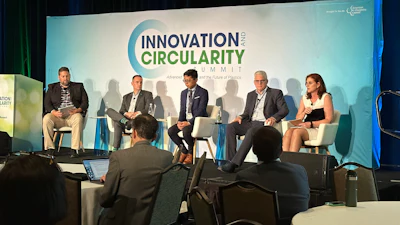
(from left) John Avolio of NOVA Chemicals leads a brand owner panel of LEGO's Drew Felz, Peapod and Ahold's Mike Roxas, Mars Petcare's Barnaby Wallace, and Adrianna Wolf of McCain Foods.
Editors at Packaging World have kicked around the idea of standardizing on one descriptor—among advanced, chemical, or molecular—to refer to a host of burgeoning recycling technologies that tend to revolve around (but aren’t limited to) depolymerization via pyrolysis, gasification, or solvents. My instinct was to default to “chemical” recycling, the earliest common descriptor. But “advanced” is an inclusive umbrella term that doesn’t carry the negative connotation baggage that some say the word “chemical” elicits. Meanwhile, “molecular” limits conversation to the depolymerization set of technologies, thus omitting methods like PureCycle polypropylene recovery. As PureCycle’s Matt Cripe explained to me at the recent MRP Solutions Sustainability Summit near Chicago, the tech cleans PP to virgin quality, but it doesn’t break it down to a monomer. Anyhow, PW will hold off on standardizing on a single descriptor for now.
This minor editorial conundrum is a microcosm of the public relations problem faced by advanced recycling (I guess I’m going with “advanced”). A big source of negative press has come from Senator Corey Booker (D-NJ) and other legislators who, in my opinion, have oversimplified pyrolysis and gasification (advanced recycling methods), labeling them as incineration instead of recycling to focus on CO2 byproducts. They aim to convince the Environmental Protection Agency (EPA) to keep considering these techs municipal waste combustion, and thus regulate them under the Clean Air Act. The experts tend to wear down non-expert legislators over time, so I’m hoping a course correction will occur. Or, as my buddy Eric Greenberg suggests in his column here, maybe agencies like the EPA won’t have such sharp teeth before long.
I heard advanced recycling’s PR travails laid bare in Orlando last month at the American Chemistry Council’s Innovation & Circularity Summit, in a panel discussion on the so-called mass balance approach, third-party certification for credibility, and ongoing consumer education.
Advanced recycling technologies often rely on the mass balance approach—a process of describing and accounting for the use of advanced recycled or bio-based feedstock in a final product when both recycled and virgin feedstock, or bio-based and fossil feedstock, have been used in the process. Since advanced recycling is a nascent tech, it’s not often practical for a usage figure to get even close to 100%, given chemically recycled PCR’s scarcity. So the approach is a matter of averages. Some of that chemically recycled material comes into a brand or producer facility, and some of it leaves the facility as packaging. The mass balance just accounts for how much of it is used as a part of the whole. This means the shampoo bottle with a claim that it is made from 30% advanced recycled PCR may not contain any, or perhaps more or less. But the company that produced it is indeed using that percentage of that material over a given product line.
But the mass balance approach and its traceability underpinnings require validation for credibility, said certification provider and converter panelists at the Innovation & Circularity Summit. Overcoming CPG skepticism of the tech while educating consumers is key, according to early adopter converters who were there, like Berry Global.
To the uninitiated, claims based on technical-sounding terms like the mass balance approach can seem like smoke and mirrors. But other industries have gone through the same rounds of skepticism long before advanced recycling’s (and bio-based plastics’) mass balance approach. Carbon credits and carbon offsets, for instance, or even clean energy credits in powering peoples’ homes, were once seen as a means of fudging the numbers to make unrealistic claims. But as consumers and their energy, travel, and brand suppliers became more acquainted with those concepts, they largely have come around. After some education- and understanding-borne confidence, these systems enjoy widespread credibility today. (from left) Susan Jackson of BASF Corporation interviews DC pollsters Cornell Belcher of Brilliant Corners Research and Brenda Gianiny of Axis Research about chemical/advanced recycling perception among consumers, and work to be done.
Also revealed at the Summit in Orlando, otherwise agnostic DC pollsters found high initial favorability for advanced recycling. Few Americans know what it is or how it works, of course. But when the basics are impartially explained to them, early public polling is wildly positive—upwards of 90% favorable across the political spectrum. But detractors exist, and that prior state of favorability is subject to quick erosion if proponents don’t actively control the public narrative. Click here to read about suggested messaging tactics to support advanced recycling’s public perception. I suppose it’s a sign of the times when the valuable science is only as good the PR campaign supporting it. PW
Filling speeds, seal integrity, contamination control — our editors found the liquid foods innovations that matter. See what's new and get ahead of the competition. Download your free report now.