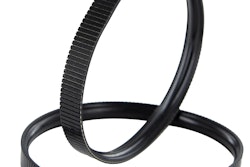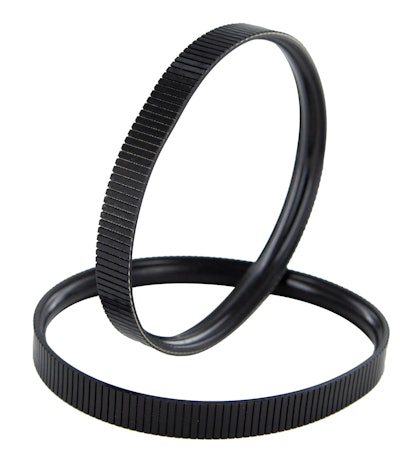
At PACK EXPO International, Fenner Precision Polymers, a Michelin Group Company and provider of reinforced polymer technology, launched its Eagle XLD Bimodulus O-rings. Most O rings are not reinforced and stretch out at fast rates. Depending on the weight of the load or the speed they’re running at, traditional O rings may last anywhere from three to six months, perhaps a little longer. This can result in significant downtime for a company, especially if it does not have the proper inventory.
“So, with Eagle XLD we were trying to take the performance attributes of a poly v conveyor which provides more load capability to help you achieve more long term life for relative weight and speeds, providing better performing product development,” said Derek Forney, senior product manager for Fenner’s belting division. “We added a reinforcement capability into the Eagle XLD which removed the stretch issue. So now it will last at least six to eight times longer. We estimate around two years at a very high load and at higher speeds, depending on the project.”
Forney further explains that traditional O rings are 90% efficient as they lose 10% of their capability overtime due to the stretch or tension factor. The Eagle XLD however is 99% efficient, thanks to its adoption of poly v conveyor performance attributes. This allows the Eagle XLD to provide four times greater roller-to-roller power transfer and tension does not decay over the life of the belt. The combination of higher power transfer and load capacity allow for a conveyor design that can carry more with less motors, which translates to cost savings in belting, maintenance, and energy costs.
In addition, the D-shape optimizes the contact area to take advantage of the strength of the higher-modulus material, which results in a belt that is quick and easy to install with no need for special tools. Another aspect adopted from poly v conveyors is the use of unique center distances, which limits the Eagle XLD to a dozen sizes, which will not have a wide range of tension. With this, companies can more easily determine the size of Eagle XLD O ring that they need.
“The hybrid reinforcement is something that we've worked on with Michelin, our parent company, with their high tech materials division to develop so that you can achieve that higher load, that longer life. And then as a result, the extra savings that come with it,” said Forney.
 | Yeaman Machine Displays Pouch Filling and Case Packing Solutions at PACK EXPO International |