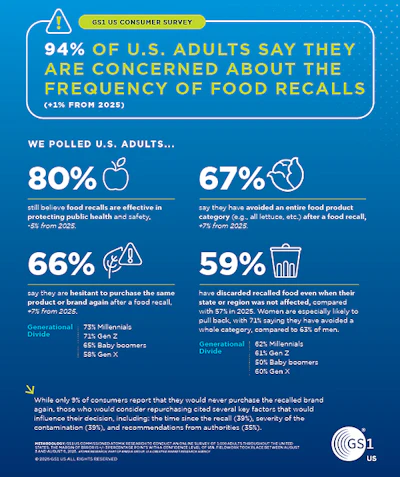
A new survey commissioned by GS1 US finds that 94% of U.S. adults are concerned about how frequently food recalls occur, while confidence in recalls as an effective public health tool is declining.
According to the survey, concern about food recall frequency increased from 93% in 2025 to 94% in 2026. At the same time, the percentage of consumers who believe food recalls effectively protect public health and safety fell from 85% to 80%.
The survey also found that food recalls are increasingly affecting purchasing behavior. Sixty-seven percent of respondents say they have avoided an entire food category following a recall, up from 60% in 2025. Meanwhile, 66% report hesitating to purchase the same product or brand again after a recall, compared with 59% last year. Additionally, 59% say they have discarded recalled food even when their state or region was not affected, up from 57% in 2025.
"Our annual food recall survey confirms consumers are paying attention to food safety and expecting more transparency from brands," says Bob Carpenter, President and CEO of GS1 US. "By improving traceability through globally recognized standards, the food industry can respond more quickly and precisely to recalls, helping to protect consumers while minimizing unnecessary product waste and business disruption."
GS1 US says broader adoption of standardized product identification and data-sharing practices can help manufacturers and retailers improve supply chain visibility, enabling faster, more targeted recalls that remove only affected products from the marketplace rather than broader categories.
The survey was conducted online by GS1 US through Dynata from July 31 to Aug. 4, 2026, and included responses from 1,029 U.S. adults age 18 and older. According to GS1 US, the survey has a margin of error of ±3 percentage points at the 95% confidence level.