Food and beverage companies are shifting toward lean automation investments that prioritize data standardization, industrial network upgrades, and AI-ready strategies rather than major production-line redesigns. This selective modernization approach delivers strong ROI through improved visibility, reduced commissioning time, and advanced sensing capabilities while maintaining lower overall capital expenditure.
- Food manufacturers ranked cost control first, with automation and capacity expansion gaining significant ground in 2026 priorities
- Selective modernization focuses on upgrading critical controls, industrial networks, adding condition monitoring, and creating secure data layers for future AI use cases
- Advanced sensors for clean-in-place (CIP) applications deliver 25% process cycle reclamation and $100,000+ ROI by replacing timed approaches with optical and spectral technology
- IO-Link networking solutions reduce assembly time by 20-25% and eliminate wiring errors while allowing retention of existing analog sensors
- Single-Pair Ethernet infrastructure reduces control-panel commissioning time by 10-20 times faster than traditional hardwiring while minimizing production disruption
Nestlé plans to eliminate 4,000 manufacturing and supply chain jobs—in addition to 12,000 white-collar positions—over the next two years. The reductions are expected to deliver approximately CHF 1 billion in annual savings by the end of 2026, while executives have said the company will direct investment toward growth priorities, including manufacturing capabilities.
However, in its February 2026 full-year results call, Nestlé said overall capex would normalize to 4% to 5% of sales, below 4.8% in 2025. “Capex will normalize within the range of 4% to 5% of sales going forward,” said Anna Manz, CFO at Nestlé.
The takeaway: Food and beverage companies are focusing on “lean automation” investments that prioritize data standardization and lay the groundwork for AI-based strategies.
Industrial networking and food producers’ shift toward Industrial Ethernet infrastructure over the last decade are creating smaller automation-investment opportunities, with strong ROI in some cases. Food processors are upgrading industrial networks in legacy plants to move data to middleware solutions, provide real-time line data, and support advanced sensing investments.
Automation and digital transformation
In an early-2026 survey, food manufacturers ranked cost control first, while automation and capacity expansion ranked third and fourth, respectively. Both automation and capacity expansion gained ground, with higher weighted scores and more first-place votes than the previous year.
Food manufacturers are asking for roadmaps with long-term digital strategies, says Geoffrey Clippinger, Technical Account Manager with Siemens. “The common pattern is selective modernization: upgrading critical controls and industrial networks, adding condition and energy monitoring, improving traceability, and creating a secure data layer that allows new analytics and AI use cases to be scaled over time.”
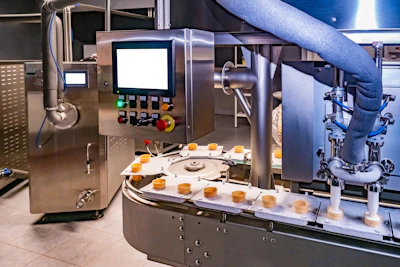
Coppenrath & Wiese, a manufacturer of frozen baked goods and desserts, modernized its industrial network and adopted an edge-networking architecture to process production information at the equipment level. The goal is to provide real-time data to operators through HMIs and tablets via Siemens’ Industrial Edge platform.
The data-sharing solution also includes Siemens’ Visual Inspection Cockpit app, which presents real-time data for process optimization and quality management and triggers alerts when deviations appear. The visual-inspection application combines traditional image processing with AI-based pattern recognition.
The aim is to improve quality by detecting shape deviations, evaluating baking color, detecting surface defects, and verifying the positioning of decorations and toppings. “By leveraging existing equipment and infrastructure wherever possible, the bakery gained greater visibility into its operations and established a foundation for future optimization initiatives without requiring a major production-line redesign,” Clippinger says.
The edge architecture supports a variety of industrial communication protocols, including OPC UA, MQTT, Modbus TCP, EtherNet/IP, and PROFINET, and it is equipment agnostic.
While this commercial-bakery investment could be categorized as a step-change improvement, Bauermeister, a subsidiary of PROBAT and a manufacturer of chocolate and coffee milling equipment, is offering customers more diagnostic data and reduced commissioning time through IO-Link technology. Bauermeister and ifm electronics srl, an automation specialist based in Germany, developed an IO-Link-based networking solution to enable data communication among sensors, actuators, and control systems.
 The stainless-steel rollers of the two-stage grinder.ifm electronics srl
This networking architecture allows food producers to retain existing analog sensors while adding real-time diagnostic data for middleware or enterprise databases. According to Bauermeister, the IO-Link solution eliminated wiring errors during installation and reduced assembly time by 20% to 25%.
“Low-hanging fruit usually starts with visibility rather than wholesale replacement,” says Clippinger. “Plants can add non-invasive or minimally invasive sensing for energy, vibration, environmental conditions, or process status; connect stranded machine data through secure gateways.”
Advanced sensors for CIP applications
Maintenance departments may not be adding personnel, but capex for advanced sensors and predictive strategies has made inroads. For years, the dairy and beverage segments have used “best-guess” or timed approaches for clean-in-place (CIP) applications, but data indicates strong ROI from replacing those approaches with optical and spectral sensors. The challenge in CIP cleaning is quantifying product concentrations in water and cleaning fluids.
 The signals from all sensors are combined through an IO-Link master and transferred to the machine controller through PROFINET.ifm electronics srl
Another sensor attracting attention is Laminar’s spectral technology. Formerly H2OK Innovations, Laminar uses spectral sensors that shine UV, visible, and infrared light through pipes to analyze liquids, including product, rinse water, caustics, and sanitizers. A 2025 Laminar case study with a global beverage customer reported that the company reclaimed an average of about 25% of each process cycle and reduced water and chemical usage.
According to Laminar, the customer realized $100,000 in ROI by reclaiming 50% of lost production uptime and reducing CIP cycles by 5% across three beverage production lines.
“Food and beverage plants should connect automation decisions to quality, traceability, energy, and resource efficiency,” adds Clippinger. “Improvements in these areas can support throughput and resilience at the same time, which strengthens the business case for modernization.”
Reducing wiring and commissioning for control panels
Traditional hardwired control panels are complex, and updates can be costly because of downtime and limited internal automation and engineering staff. Rockwell Automation introduced its Single-Pair EtherNet/IP In-Cabinet solution in 2025 to simplify control-panel wiring, reduce commissioning time, and facilitate networking upgrades.
Kelly Passineau, Product Manager for Single-Pair Ethernet at Rockwell Automation, described the solution as a gateway device that uses flat media cable and Single-Pair Ethernet (SPE) to reduce cabinet wiring. “We have this gateway, and it’s capable of attaching 40 devices to a network,” said Passineau in a networking webinar in 2025. “This creates a network of flat media-connected devices inside a panel.”
Real Pet Food Company adopted the networking solution when it replaced legacy PLC infrastructure for its chiller control panel. The EtherNet/IP system provides improved visibility into the chiller system’s motors and drives. The modernization also moved auxiliary functions—lighting and fan control—to a separate PLC, reducing complexity and risk.
The SPE installation reduced production disruption through controlled shutdown windows for the chiller system, according to Jack Walsh, Electrical Reliability Engineer at Real Pet Food Company. “Moving away from hard wiring and utilizing ribbon cables means the downtime was minimal while the electrical panel was upgraded,” says Walsh. “It’s around 10–20 times faster than if all wires had to be upgraded, while also reducing panel space requirements.”
The disciplines and technologies under the broad umbrella of automation are moving forward, helping food and beverage producers identify next steps for moving data and advancing data standardization and contextualization.