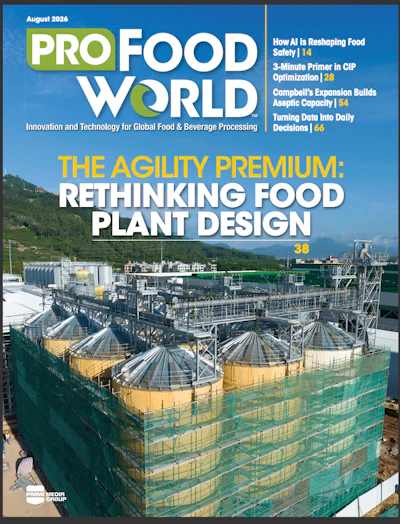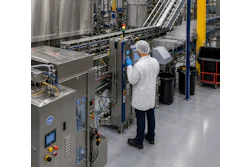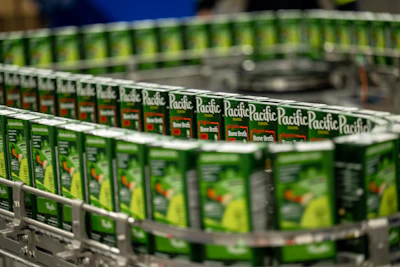
The Campbell's Company expanded its Maxton, N.C., facility with new aseptic processing technology to increase production capacity for Pacific Foods and Swanson broth and soup products, responding to growing consumer demand for home-cooked quality meals.
- The expansion includes 88,000 sq ft of new aseptic manufacturing space plus 28,000 sq ft of utility mezzanine space at the existing Maxton facility
- Two new aseptic processing lines were installed along with new quality labs, expanded incubation capacity, and ingredient storage to support shelf-stable product production
- The project created approximately 100 new jobs and was completed with zero recordable injuries across over 350,000 construction hours
- Campbell's partnered with Tetra Pak on filling technology and CRB as design-builder to optimize production efficiency and facility layout
- The facility supports production of both broth and aseptic soups, enabling continued innovation across Campbell's soup and broth portfolio
Consumers’ increasing demand for quality and consistency continues to shape food and beverage manufacturing. Producers like The Campbell’s Company are taking notice. Installing aseptic technology at its Maxton, N.C., facility for the company’s Pacific Foods and Swanson brands is just the latest example of The Campbell’s Company adapting to stay ahead.
For Campbell’s, the rationale starts with demand. “As more consumers cook at home, broth and soup continue to play an essential role, and this expansion helps us make even more Pacific Foods and Swanson broth,” says Jason Roethig, Sr Director, Engineering Services & Product Execution at The Campbell’s Company. The Maxton expansion is designed to increase production capacity, improve consistency, and support future growth in a category where repeatable quality matters to both the manufacturer and the consumer.
Aseptic processing drives the investment
Aseptic processing is not simply another filling format. For shelf-stable liquid foods such as broth and soup, it requires a coordinated system of processing, sterilization, filling, packaging, utilities, quality checks, incubation, and trained operators.
The value proposition is clear in consistent product quality, and the Maxton facility is a prime example. Roethig says the facility “incorporates state-of-the-art aseptic technology designed to support production of shelf-stable products while maintaining quality, freshness, and safety.”
Campbell’s partnered with Tetra Pak on the filling side, “to optimize our production line layout for peak efficiency and maximize our building and utility supporting infrastructure design,” Roethig says.
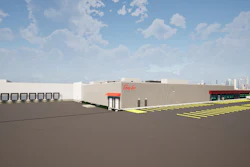
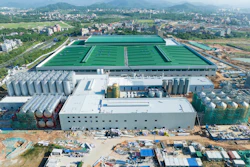
The project included an 88,000-sq-ft aseptic manufacturing expansion with another 28,000 sq ft of utility mezzanine space at Campbell’s existing Maxton facility. It added two new aseptic processing lines, new quality labs, a larger incubation room, and expanded ingredient storage, all aimed at capacity, consistency, control, and long-term flexibility.
 The project included an 88,000-sq-ft aseptic manufacturing expansion with another 28,000 sq ft of utility mezzanine space at Campbell’s existing Maxton facility.
Why Maxton made sense
Campbell’s Maxton site already had aseptic experience, which helped make it the right location for the investment. The expansion is comprised entirely of new equipment, but it builds on an existing manufacturing base and strengthens the plant’s role in Campbell’s broader network.
“The expansion reinforces the Maxton site’s role within Campbell’s manufacturing network, supporting ongoing production and innovation needs. It also reflects the strong partnership and support Campbell’s has received from the local community,” Roethig says. He adds, “The Maxton site has been an important part of our network since 1979, and this project is an investment for the future. The expansion will create approximately 100 new jobs, reflecting our long-term commitment to Maxton, North Carolina, and Robeson County.”
That local commitment extended beyond the plant walls. The project included a collaboration with Duke Energy on a new onsite 33MW substation, Robeson County support through economic development and infrastructure programs, and workplace training funds through the NC Community College System’s Customized Training Program.
 Campbell’s Maxton site already had aseptic experience, which helped make it the right location for the investment.
Designing around the aseptic system
AEC firm CRB was at the center of facility design, utility planning, equipment coordination, construction, and startup support.
“Our role was the design-builder on this project: designing the utility systems and facility layouts, serving as architect and engineer of record, and ultimately building it—from pre-construction to procurement to in-field execution,” says Colton Koncak, Director, Construction Operations for CRB.
 The expansion is comprised entirely of new equipment, but it builds on an existing manufacturing base.
“Aseptic manufacturing is highly automated and can be technical and complex,” Koncak says. Because of that complexity, the project required collaboration among Campbell’s, CRB, Tetra Pak, and other equipment partners. “We really don’t see lines or silos when it comes to partners; it’s more so just adding more chairs to the table,” Koncak says.
Building inside an active operation
Campbell’s expansion was not isolated from existing production. It had to be integrated into an operating manufacturing site without compromising safety or ongoing plant activity.
“The project required careful coordination to maintain ongoing operations while always prioritizing employee safety,” Roethig says. “Over 350,000 hours of onsite construction and installation were performed in Maxton with zero recordable injuries or lost time.”
 The fast-track structure meant design, construction, and equipment installation moved in parallel.
For CRB, that required close communication between design and field teams. Koncak says onsite engineering support helped reduce back-and-forth when questions came up in the field and allowed the team to get faster answers on discipline-specific issues. He also points to daily planning and safety communication as essential to keeping the work moving.
“What we did at Maxton was continue to talk about those things and reinforce that it doesn’t take much to put somebody in a situation where there’s a hazard or safety concern,” Koncak says. “Go slow to go fast was something we talked about a lot.”
Quality spaces support aseptic operations
The new aseptic lines may be the center of the expansion, but the support spaces are what help make the operation work day to day. New quality labs, incubation capacity, and ingredient storage were not treated as afterthoughts. They were part of the system needed to support aseptic production.
“These additions strengthen the Maxton site’s ability to support production, maintain product quality, and support food safety processes,” Roethig says.
Koncak says adjacency was a critical design consideration, particularly for lab work connected to production. “You can imagine getting a sample off a line and getting it into a lab, and then being able to release that product line for whatever the next step may be. Keeping the train moving is really important,” he says. “We didn’t want somebody having to walk a mile through the building to do what they needed to do.”
The same thinking applied to employee spaces and training. Campbell’s brought new employees in before the expanded area started up so they could train on existing aseptic lines and then support vendor, R&D, and engineering test runs on the new equipment. “New employees were brought in 4-6 months prior to the start of the new area to be trained on our existing aseptic lines. Once trained, the new operators were then able to help vendors, R&D, and engineering teams with test runs on the new equipment,” Roethig says. Campbell’s investment connects consumer demand, aseptic technology, quality infrastructure, workforce development, and local support into one manufacturing expansion.
Expansion supports future soup and broth innovation
The added capacity is aimed first at broth, but the implications are broader in supporting future product opportunities.
“The new aseptic lines increase production capacity for broth, improve product consistency, and support future growth. They also expand the facility’s capabilities by enabling production of aseptic soups in addition to broth, supporting continued innovation across Campbell’s soup and broth portfolio,” Roethig says.
For food and beverage manufacturers, the Maxton project offers a familiar lesson: capacity projects are rarely only about capacity. In this case, Campbell’s investment connects consumer demand, aseptic technology, quality infrastructure, workforce development, and local support into one manufacturing expansion.
“The project demonstrated the importance of strong collaboration, disciplined planning, and coordinated execution. The fast-track approach will help inform future investments as Campbell’s continues to strengthen our manufacturing network,” Roethig says.