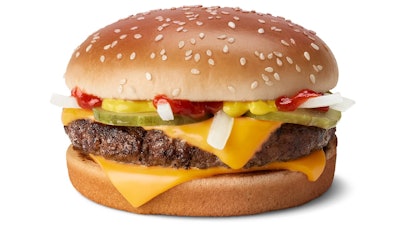
A deadly E. coli outbreak linked to McDonald's Quarter Pounder hamburgers has infected 49 people across 10 states, with one death reported. The CDC traced the contamination to slivered onions from a single supplier, prompting McDonald's to remove the affected ingredients from 12 states.
- The outbreak has infected 49 people across 10 states, with Colorado reporting the highest number at 26 cases
- One person has died and 10 others have been hospitalized due to E. coli infection
- Contaminated slivered onions from a single supplier were identified as the source of the outbreak
- McDonald's removed slivered onions and quarter pound beef patties from 12 states including Colorado, Kansas, Utah, and Wyoming
- E. coli symptoms include severe stomach cramps, diarrhea, and vomiting, typically appearing 3-4 days after exposure, with most people recovering in 5-7 days
Public health officials are investigating a deadly E. coli outbreak across several states, where most people say they had eaten a McDonald’s Quarter Pounder hamburger before becoming sick, according to a CDC notice.
The outbreak has infected 49 people, hospitalized 10, and killed one so far.
 Colorado has the highest concentration of E. coli illnesses, followed by Utah, Wyoming, and Nebraska.Photo provided by the CDC
Investigators are still determining which specific ingredient is contaminated, and whether contaminated ingredients went to other restaurants or stores.
McDonald’s response to the outbreak
McDonald’s in an October 22 announcement shared that the investigation’s initial findings point to slivered onions sourced by a single supplier that serves three distribution centers.
As a result of these findings, McDonald’s has removed the slivered onions, as well as quarter pound beef patties, in 12 states including Colorado, Kansas, Utah, Wyoming, and portions of Idaho, Iowa, Missouri, Montana, Nebraska, Nevada, New Mexico, and Oklahoma.
The quarter pound beef patties are only used on Quarter Pounder hamburgers, and the slivered onions are primarily used on Quarter Pounder hamburgers, the CDC says.
The fast-food chain says it is working with its suppliers to replenish its Quarter Pounder supply in the coming weeks, with exact timing varying by market. It says all other menu items, including other beef products, are unaffected by the outbreak and still available.
“Across the McDonald’s System, serving customers safely in every single restaurant, each and every day, is our top priority and something we’ll never compromise on,” Cesar Piña, McDonald’s North America Chief Supply Chain Officer, says in the announcement.
What are the symptoms of E. coli?
Most of those infected with E. coli experience symptoms including severe stomach cramps, diarrhea, and vomiting, according to the CDC.
Symptoms usually start three to four days after ingesting the bacteria, and most infected people recover after five to seven days without needing treatment.
Some of those infected may develop serious kidney problems including hemolytic uremic syndrome (HUS) and would require hospitalization.