Three major companies are replacing traditional plastic packaging with innovative plant-based alternatives, including edible forks, biodegradable polymers, and silphium fiber materials that reduce environmental impact while maintaining product quality.
- Nestlé introduced an edible plant-based fork made from wheat flour and salt for Maggi cup noodles in India, eliminating single-use plastic cutlery.
- Suzuki Motor Corporation replaced polystyrene foam with Green Planet biodegradable polymer, reducing annual plastic use from 43 tons to 6.3 tons between FY2020 and FY2023.
- Kaufland's natural cosmetics line features SilphieBoard packaging made from 35% silphium fibers, a sustainable plant grown in Germany that sequesters CO2 and supports soil health.
- All three initiatives align with UN Sustainable Development Goals and demonstrate how alternative materials can maintain product protection while reducing plastic waste.
The number of bio-based initiatives coming to ThePackHub's attention remains significant, encompassing everything from university developments to in-market launches.
Learn more about ThePackHub's Innovation Zone here.
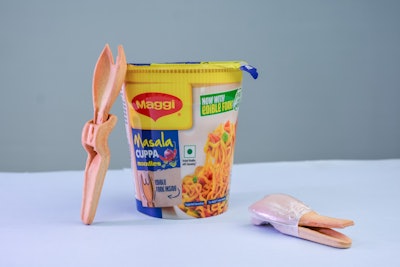
 Nestlé's new plant-based fork is made from wheat flour and salt, making it edible.ThePackHub
Nestlé has introduced a limited-edition edible plant-based fork for Maggi cup noodles in India. Developed in collaboration with a local startup, the fork is made from wheat flour and salt, ensuring functionality while maintaining the nutritional values and taste of the noodles. This initiative is part of Nestlé’s broader commitment to reducing plastic use in packaging, which includes redesigning accessories such as straws, cups, and cutlery, simplifying packaging materials, and exploring reusable and refillable systems. The edible fork reflects Nestlé’s desire to exploring alternative sustainable packaging solutions that ensure food safety, consumer experience, and product quality. This development aligns with Nestlé’s sustainability goals of reducing packaging and designing for recycling, leveraging novel materials and technologies to create packaging that is convenient, protects food, and benefits the environment.
 Suzuki Motor Corporation is packaging its outboard motors with biodegradable polymer cushioning that decomposes in seawater.ThePackHub
Suzuki Motor Corporation, based in Japan, has adopted “Green Planet,” a biodegradable polymer developed by Kaneka Corporation, as an alternative to polystyrene foam for cushioning in the final packaging of outboard motors. Green Planet, made from 100% biomass-derived polymers, decomposes easily in seawater. To maintain the cushioning performance required for packaging and transportation, Suzuki developed a two-layer board partition structure to supplement Green Planet. This change is part of Suzuki’s “Clean Ocean Project,” launched in 2020 to reduce plastic waste. As a result, the use of petroleum-based plastics in the packaging of outboard motors produced in Japan decreased from 43 tons annually in FY2020 to 6.3 tons in FY2023, with a goal of reaching zero by FY2026. Suzuki remains committed to reducing environmental impact and advancing sustainable initiatives in line with the United Nation’s Sustainable Development Goals (SDGs).
 Kaufland's new packaging for its natural cosmetics line uses 35% silphium fibers.ThePackHub
Kaufland, a retail company based in Germany, has introduced a new packaging initiative for its natural cosmetics line, featuring 35% silphium fibers. This packaging solution is produced by PreZero, an environmental services provider of the Schwarz Group, and branded under OutNature. The initiative begins with six products, including eye serum, day cream, and Men Hydro moisturizer, with expansion plans to extend the range. The silphium-based packaging, known as SilphieBoard, is notable for its sustainable production methods, using little water and energy and foregoing chemical treatments. The material’s natural brownish hue, a result of avoiding chemical bleaching, complements the natural ethos of Kaufland’s bevola naturals cosmetics line. Silphium, a robust perennial plant cultivated around Lake Constance in Germany, is chosen for its ecological benefits: it is insect-friendly, aids in CO2 sequestration, and protects soil from erosion, while also reducing transport-related CO2 emissions due to its regional cultivation. This move aligns with Kaufland’s ongoing commitment to enhancing product sustainability.
Learn more about ThePackHub's Innovation Zone here.