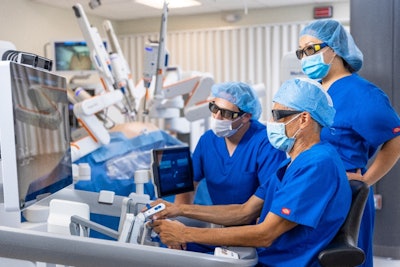
Medtronic's Hugo robotic-assisted surgery system received FDA approval for hernia repair after a clinical study showed 100% surgical success and minimal complications. The system enables surgeons to perform inguinal and ventral hernia repairs through small incisions with faster patient recovery.
- Hugo RAS system achieved 100% surgical success rate, exceeding the 85% performance goal in the Enable Hernia Repair study
- Safety results showed 0.0% surgical site event rate for inguinal repairs and 2.1% for ventral repairs, both significantly below the 30% threshold
- Nearly 1.5 million hernia repair surgeries are performed annually in the U.S., making this the most common adult surgery
- Robotic approach provides 3D visualization and small incisions, reducing tissue damage and postoperative pain with faster recovery times
- Study included 193 patients across multiple centers with mean hospital stays of 4.7 hours for inguinal and 6.7 hours for ventral procedures
Key takeaways:
- Robotic surgery, first introduced more than 20 years ago, is rapidly gaining traction in hernia repair procedures.
- It's estimated that every year, nearly 1.5 million hernia repair surgeries are performed in the U.S., making them one of the most common surgeries for adults.
- The study builds on the growing body of evidence for Hugo including the Expand URO U.S. clinical study, which also met safety and effectiveness endpoints, and nearly 300 independent publications by surgeons using the Hugo RAS system.
Medtronic plc announces results from the Enable Hernia Repair clinical study evaluating the performance of the Hugo™ robotic-assisted surgery (RAS) system in inguinal and ventral hernia repair procedures. Enable Hernia Repair is the first-ever Investigational Device Exemption (IDE) clinical study completed for robotic-assisted hernia surgery in the United States. According to the company, primary safety and effectiveness endpoints were met, supporting use of the Hugo RAS system in hernia repair procedures.
"The Enable Hernia Repair clinical study didn't just meet primary endpoints, it far surpassed them," says Dr. Jacob Greenberg, national principal investigator of the Enable Hernia Repair study and gastrointestinal surgeon at Duke University Hospital. "I am proud to have had the opportunity to advance clinical research in robotic-assisted surgery for the benefit of patients in the United States and around the world."
Robotic surgery, first introduced more than 20 years ago, is rapidly gaining traction in hernia repair procedures. Advances in the technology now provide surgeons with three-dimensional (3D) views of the abdominal cavity and the ability to operate through small incisions rather than the larger cuts required in traditional open surgery. This approach minimizes tissue damage, reduces postoperative pain, and promotes faster recovery for patients.
Enable Hernia Repair is a prospective, multi-center, single-arm pivotal study that included 193 patients undergoing either inguinal or ventral robotic hernia repair with the Medtronic Hugo™ RAS system. Key findings include:
- The study met the primary effectiveness endpoint: The surgical success rate† was 100%, surpassing the pre-specified performance goal of 85%. (p<0.0001)
- The study met the primary safety endpoint for both cohorts, which were analyzed independently: Inguinal: Among 92 patients available for analysis, the surgical site event‡ (SSE) rate was 0.0%, which is significantly lower than, and meeting, the pre-determined performance goal of 30% (p <0.0001). Ventral: Among 94 patients available for analysis, the SSE rate was 2.1%, which is significantly lower than, and meeting, the pre-determined performance goal of 30% (p <0.0001); two SSEs were recorded and resolved without complication.
"The addition of the Hugo platform to our field introduces exciting new opportunities to innovate and advance robotics in the best interests of patients, surgeons, and hospital systems while clearly offering the clinical results we expect from robotic-assisted surgery," says Dr. David Chen, a general surgeon at UCLA and lead presenter of the Enable Hernia Repair data at the American Hernia Society (AHS) meeting in Nashville, Tenn.
It's estimated that every year, nearly 1.5 million hernia repair surgeries are performed in the United States, making hernia repair one of the most common surgeries for adult men and women. Hernia repair addresses conditions where part of the intestine bulges through weakened abdominal muscles. Left untreated, hernias can lead to pain, digestive troubles, swelling, or infection. Surgical repair is currently the leading effective treatment, with innovation in minimally invasive approaches including mesh technology helping advance patient care.
In the Enable Hernia Repair clinical study, the mean length of hospital stay was 4.7 hours for inguinal patients and 6.7 hours for ventral.
"We're grateful for the opportunity to partner with clinical teams to treat this common and often painful condition for millions of patients around the world," says Rajit Kamal, vice president and general manager of Robotic Surgical Technologies within the Surgical business of Medtronic. "Adding a digitally-powered robotic-assisted surgery system to our laparoscopic and open surgery solutions for hernia repair gives surgeons more choice and patients greater access to the care they need — and we believe that's a win for everyone."
The study builds on the growing body of evidence for Hugo including the Expand URO U.S. clinical study, which also met safety and effectiveness endpoints, and nearly 300 independent publications by surgeons using the Hugo RAS system.
†Surgical success rate is defined as the procedure not going into conversion. Conversion is defined as the switch from a robotic-assisted approach using the Hugo™ RAS system to laparoscopy, open surgery, or the use of an alternative robotic-assisted system.
‡Surgical site event (SSE) is a composite endpoint of surgical-site occurrences and surgical-site infections related to the device or procedure from the first incision through 30 days post-procedure.