Precision cutting technology is essential for peach processors to maximize raw material utilization, maintain product quality, and meet strict dimensional specifications during the compressed harvest season. High-performance dicers that deliver clean cuts with minimal trim loss directly improve both profitability and end-product consistency.
- Peach processors operate under extreme time pressure, with harvest seasons typically lasting only mid-July to mid-August, requiring 24/7 production and zero room for error
- Every imprecise cut results in lost yield and byproducts—in high-volume operations, these losses compound rapidly and directly impact profitability
- Global demand for processed fruit is growing at approximately 8% annually, with convenience foods and industrial applications driving market expansion
- Advanced cutting equipment must process 6-7+ tons of peaches per hour while maintaining cutting accuracy, reducing juice loss, and minimizing byproducts
- Local technical support and rapid spare parts availability are critical to preventing downtime during the short, intensive production season when equipment failure is not an option
"Observe due measure, for right timing is in all things the most important factor." The Greek poet Hesiod wrote that roughly 2,700 years ago about the discipline of working within nature's calendar. At Agrophoenix's processing facility in modern Greece, Hesiod's words read like an operations memo.
The peach harvest in Imathia doesn't negotiate; when it comes, it comes fast. And for the processors who supply international canned fruit markets, the season runs hard and leaves little room for error. Plants need to operate around the clock, with raw material moving continuously. And the cutting line, where soft, juice-laden peaches are transformed into dimensionally consistent dice, halves, and slices, has to perform from the first hour of the season to the last.
Agrophoenix, established in 2018 in the Macedonian heartland of northern Greece, is one of the processors carrying that weight. The company operates two specialized processing plants in Imathia producing a range of peach products, including canned peach halves, diced and sliced fruit, aseptic fruit dice, and aseptic purees and concentrates. It supplies both industrial and retail markets across multiple export destinations, where product quality, texture, and dimensional consistency, along with full traceability from orchard to delivery, are non-negotiable.
Greece, one of the world's leading exporters of canned peaches, is supplying product as global demand for processed fruit is climbing too; the market is projected to grow at close to an 8% compound annual rate in the coming years as convenience foods, ready-to-use formats, and industrial applications expand. That growth raises the stakes on raw material utilization, product consistency, and throughput, especially during a short production window (typically from mid-July to mid-August.) Getting the cutting operation right isn't optional for processors who want to win the game.
Soft fruit, hard challenges
Peaches are a delicate raw material. Unlike harder produce, they bruise, they "weep" (or leak) juice due to damage, over-ripeness, or high temperatures, and they generate small-piece byproduct if the cut isn't clean. Every imprecise cut represents lost yield, and in a high-volume seasonal operation, those losses can compound quickly.
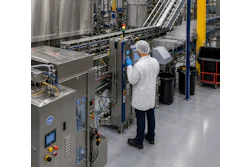
 Technical Operations Director Konstantinos Ineglis at the Agrophoenix facility.Agrophoenix
When Agrophoenix developed its new fruit processing plant in 2019, cutting performance was identified as a critical priority, and the company's requirements were specific.
"Our main challenge was to achieve high-precision cutting with minimal trim loss, so we could maximize utilization of the raw material," says Konstantinos Ineglis, Technical Operations Director at Agrophoenix. "Our customers are among the most demanding internationally, with strict specifications for both the quality and the dimensions of the final product."
Clean cuts and minimal byproducts were equally important. "It was critical to ensure clean cuts, with as few small pieces as possible ending up as byproduct," says Ineglis. "It was equally important to reduce juice loss during cutting, so the fruit's natural sugars are retained, and the quality of the end product is improved."
Underpinning all of this was a capacity requirement that left no room for compromise: each machine needed to process more than 6 to 7 tons of peaches per hour.
The machine that made the cut
Agrophoenix began collaborating with FAM STUMABO during the early stages of development of its new processing facility. The plant manager's prior familiarity with FAM STUMABO equipment influenced the decision, along with several operational priorities: ease of use, dedicated cutting tools, proven industry experience, and reduced cleaning workload. A particular emphasis was placed on combining throughput, product quality, and operational reliability from the very beginning.
Because this was a new project, Agrophoenix went directly to the most advanced option available. "As this was a new project, they started immediately with the most advanced equipment available: the Tridis 240," explains Sven Boen, Senior Sales Manager for Europe at FAM STUMABO. "For peach processors, achieving the right balance between cutting quality, throughput, and operational efficiency is essential, particularly during the short and intensive production season."
Peach perfect dicing
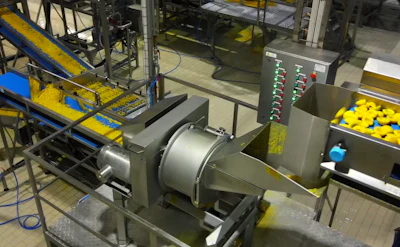
Agrophoenix installed two FAM STUMABO Tridis 240 dicers at the facility. Designed for high volumes and continuous product flow, the Tridis 240 accepts products up to 240 mm in any dimension and enables processors to produce a wide range of cut sizes and formats, including dice, strips, and slices.
The machine's flexibility allows cutting tools and cut sizes to be adjusted to the peak season, which was an important feature for Agrophoenix given the natural variability in peach size, growth, and condition the processor sees from one harvest to the next. (The manufacturer notes that the machine is also used for processing other types of fruit product, including mango, apples, pears, and strawberries, as well as harder vegetables, including carrots, onions, potatoes, and beetroot.) Agrophoenix uses the dicers to produce a wide range of cut sizes and formats, including dice, strips, and slices.Agrophoenix
Keeping the line moving during peak season
Equipment performance is only half the equation during a harvest this compressed. FAM STUMABO and its Greek partner, SIVVAS S.A., support Agrophoenix with services including operator and maintenance training, preventive inspections, startup assistance for the season, and local availability of key spare parts and consumables. During the intense harvest season, technical support is available within 24 hours.
"Fast local service support through our partner Sivvas is extremely important in an industry that depends on a very short production season, where nothing can be allowed to disrupt production," says Boen.
Ineglis says that throughout the year (and especially during production season) their service partners are ready to provide quick response, be it with spare parts or technical support. "This gives us confidence and minimizes downtime," says Ineglis.
Day-in, day-out workhorses
Today, the two Tridis 240 dicers operating at maximum capacity have become a core part of Agrophoenix's production process, says Ineglis.
"Tridis 240 has made a substantial contribution to improving the quality of our products. Cutting accuracy, combined with reduced trim loss, leads to better utilization of the raw material. In addition, the high throughput and stable operation of the machine contribute to the overall efficiency of the line."
With high performance comes the need for steady support. Fast turnaround on parts and service, backed by FAM STUMABO's Greek partner SIVVAS S.A., is part of why the plant keeps running.
"We would recommend FAM STUMABO to other fruit processors," says Ineglis. "We are very satisfied both with the equipment's performance and operation, as well as with the fast support for spare parts and after-sales service."
Writing in 700 BC, Hesiod never could have imagined a Tridis 240. He just knew that right timing was of the utmost importance. It's a lesson Agrophoenix is putting into practice during each harvest season more than twenty-seven centuries later.