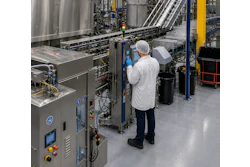
Welcome. I'm Andrea Sassetti. I'm part of the Siemens Digital Enterprise team. Today, I'm going to show you our proof of concept of pop-up factory that has been done in collaboration with PepsiCo. So first of all, the concept of pop-up factory, it means that it's a temporary factory that are movable, so that can be delivered close to a specific big event.
In order to satisfy the peak of demand for a specific type of product. So in this case, we are going to make a Pepsi product. So imagine that, in this case, for a World Cup, there is a peak of demand. Instead of ship direct the product, we are going to deliver this temporary factory close to this big event in order to supply the demand. The factory, in this case, it's it's what you call pipeless. It means that without pipe, multiple AGV are capable to move across the factory in order to make, in parallel, completely different type of batch of products.
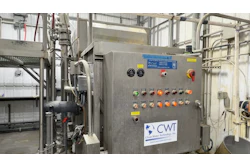
So like for example, Pepsi regular zero diet, and this case also cherries. As you can see, there are multiple AGV in the back that are moving, each one with a different color. It represent a different batch of the product. This concept, it's very unique also for the point of simulation because behind my shoulder, as you can see, there are a full factory that has been simulating using the full Siemens Accelerator product. So that we have multiple simulation tools that are all connected with... in our industrial metaverse, in connection with the automation that you can see in the rack on my side, that are able to let's say, simulate the full execution of all the different recipe.
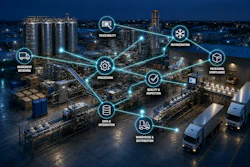
Starting from the journey from the PLM environment, using our portfolio, we are able to design all the different recipe and then execute through the MIA system that is running on the industrial edge. In this case, we are also have the full compressive, let's say, IoT data analysis, because in the automation, we are also able to get, using industrial edge, all the KPIs, all the information in order to understand what is happening in case there are fault or system anomalies. From the screen that you can see on this side, we are able to to have what we call single pane of glass. That is our optic that allow to see all the different contribution of all the different software together, including... Those are the order of the execution system.
But it's interesting that we are also able to enable an AI chatbot that the operator can start to ask question. For example, using the keyboard and mouse, we are able to ask to show me, for example, the detail of a specific order, and the AI, with all the different CP that are running behind the scene, are able to gather the right information from all the different system and plot directly all together.
From the iPad, we are also to have also the portable view of the same screen, where you are able to see the full let's say, what we call our industrial metaverse, and this case, we are following with one of the MR that is moving around the factory that is making the order.
And this is very interesting, because in this way, we are able to not only to have a full 100% replica of a full plant, but we are also able to simulate all the possible issues and non-conformities, and see how the system can react from the automation, from the execution system, as well as to the cloud. This is one of very interesting, because it's a full let's say, combination of all the entire Siemens accelerator portfolio in one single pane of view.