Klondike Cheese Company is investing in wastewater treatment infrastructure, including a third CWT GEM system, to support its expanding feta and Greek yogurt production. The company treats wastewater on-site through primary treatment systems and lagoons, then reuses the treated water to irrigate 200 acres of alfalfa surrounding its Wisconsin facility.
- Klondike is increasing feta capacity by roughly 66% with a second continuous coagulator expected to come online December 2026
- The company uses approximately 170,000 gallons of water daily and is investing in further wastewater expansion
- Two CWT GEM systems perform primary treatment by injecting air and polymers to separate solids, with a third unit planned for future growth
- Treated wastewater is reused to irrigate roughly 200 acres of company-owned alfalfa, creating a circular system that feeds back into dairy operations
- About 80% of milk is sourced from nearby farms within 30 miles, keeping much of the operation locally integrated
Klondike Cheese Company is facing a problem every dairy processor would hope for: Its feta business keeps growing.
At its Monroe, Wis., plant, the dairy processor can currently produce up to 150,000 lbs of feta per day with the help of a large ALPMA continuous coagulator in lieu of vats. But that operation has reached capacity, prompting Klondike to install a second continuous coagulator, expected to come online around December 2026 and increase feta capacity by roughly 66%. That’s not to mention several capacity upgrades underway in the Greek yogurt operation, where Klondike is working to get more throughput from its existing tanks and equipment.
More product, however, means more than adding processing equipment. It also means more cleaning, more water use, and ultimately more wastewater to manage.
“As a cheesemaker, a solid third of your life is cleaning,” says Luke Buholzer, Vice President of Sales at Klondike Cheese. In the feta operation alone, cleaning includes washdowns of the ultrafiltration and reverse-osmosis systems, daily scrubbing of conveyors, and pre-rinse, caustic, and acid washes for the coagulator belt. Similar sanitation demands extend throughout the various products processed at the facility.
“Basically, everything that goes down the drain is what goes up to our wastewater treatment plant,” Buholzer says.
 Klondike’s ALPMA continuous coagulator helps the processor produce up to 150,000 lb of feta per day, with a second coagulator installation underway.ProFood World
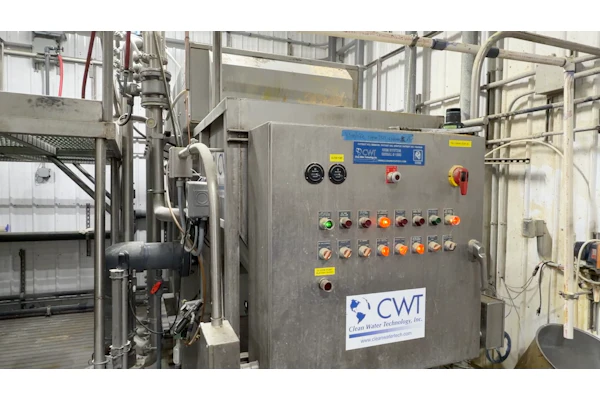
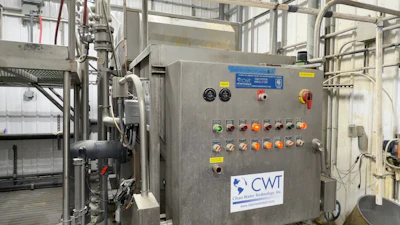
At the center of that effort are two Clean Water Technology (CWT) GEM Systems (Gas Energy Mixing), with a third unit planned for installation as Klondike prepares its wastewater operation for further growth.
“[A third GEM System] is going to be overkill, so we have plenty of time to grow into that,” says Buholzer. “In one way, wastewater expansion is always reactive, since it’s because we did something in the plant, but we’re never behind the eight ball on it.”
A century of growth in cheesemaking
Klondike’s latest expansion continues a pattern that stretches back more than a century.
“My great grandpa came over in 1925 from Switzerland and became a cheesemaker,” Buholzer says. “Grandpa took over from great grandpa when he came back from World War II. My dad and both my uncles got into the business.”
 Four generations of the Buholzer family have helped build Klondike Cheese, with the company’s cheesemaking roots in Monroe dating back to 1925.ProFood World
The family business has grown into what Buholzer describes as “three plants under one roof,” one for feta, another for brick, Muenster, and Havarti, and a cultured-products operation built around Greek yogurt that also produces products such as sour cream.
Klondike added feta to its portfolio in 1988 and opened its current feta plant in 2001. More recently, the company built its Greek yogurt plant in 2016 and a new brick, Muenster, and Havarti plant in 2018. The new feta coagulator also took up about two-thirds of the company’s existing dry storage space, prompting Klondike to build a new cooler and dry-storage warehouse across the street.
Beyond its feta output, Klondike currently produces roughly 60,000 to 65,000 lbs per day from its brick, Muenster, and Havarti operation, while its cultured-products plant produces more than 100,000 lbs per day across Greek yogurt, sour cream, and other products.
Klondike’s growth has remained closely tied to the surrounding dairy community, with about 80% of its milk purchased directly from farms.  Klondike Cheese’s operation has expanded repeatedly over the decades, including newer feta, cultured-products, and storage capacity.ProFood World
“We try to source it as close as possible. We don’t make money off trucking the milk, but we do expect the highest quality,” Buholzer says. “Most of it comes within about 30 miles. And we [buy from] farms of all different sizes. We have a father and son milking a hundred cows, and then we have another farmer up the road milking about 720 cows.”
Klondike’s steady expansion is backed by a family that has long been comfortable working with, and investing in, new equipment. “We’ve always done all of our own maintenance,” Buholzer says. “As a family, we’re very mechanically inclined. Technology doesn’t scare us; new equipment doesn’t scare us.”
From production to treatment
Not everything leaving Klondike’s production areas becomes wastewater. Whey, for example, has value; the company filters out cheese fines, separates cream for sale, and further processes the whey through ultrafiltration and reverse osmosis.
The wastewater stream is driven much more heavily by sanitation across the plant. Klondike reduces that load where it can. In its CIP operation, Buholzer says, “We try to grab as much of the final rinse as we can and use that as our pre-rinse.”
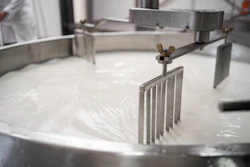
 Muenster cheese moves through production at Klondike’s Monroe plant, one of several product areas contributing to the facility’s overall sanitation and wastewater load.ProFood World
“If we tried to send it to the city, we're looking at a pipeline of over seven miles, so we have to do it ourselves,” Buholzer says.
Instead, Klondike has built out its own treatment infrastructure in stages as the plant has grown, with CWT’s GEM Systems serving as a key primary-treatment step.
Inside Klondike’s primary wastewater treatment
Klondike already had wastewater treatment infrastructure in place when it added CWT’s GEM Systems around 2015. The systems were another step in expanding that capacity as production grew.
“[The GEM Systems] were just additional. As we were growing, they got us through not having to add more lagoons at the time,” Buholzer says.
Klondike worked with CWT and engineering firm Applied Science on the installation. The treatment process begins with two CWT rotary drum screens that remove larger solids and debris from the wastewater before it reaches an underground equalization tank.
“The equalization tank is underground, and it’s used to homogenize the flow that comes out of their plant,” says Linda Englander Mills, Vice President of Sales and Marketing at CWT. With different products and cleaning processes contributing to the wastewater stream, equalization helps create more consistent conditions before treatment.
From there, the flow moves through CWT’s D-loop for pH adjustment.
“The D-loop keeps the operator from having to adjust a chemical during the day, because adjusting chemical during the day is kind of a full-time job,” Mills says. The system monitors pH and adds acid or caustic as needed while the wastewater travels through the loop.
Following the pH adjustment, the wastewater reaches Klondike’s two GEM 150 Systems, each capable of processing up to 150 gal/min or 216,000 gal/day, according to Mills. She explains that the technology performs a role similar to dissolved air flotation (DAF) but shifts much of the mixing and particle-separation work out of the flotation tank itself.
“In a DAF, you’re making everything happen in the tank,” Mills says. With the GEM System, by contrast, “we’re injecting air into 100% of the waste stream under pressure,” using a series of liquid-solid-gas mixing heads before the wastewater enters the flotation tank.  As solids rise to the surface in the GEM System, a scraper removes the sludge and directs it for further handling.ProFood World
As pressure decreases through those mixing heads, CWT introduces positively and negatively charged polymers that help capture waste particles. The resulting floc—a combination of air bubbles, polymer, and contaminants—rises to the surface once the pressure drops, allowing the GEM System to skim the solids away from the treated water.
That approach is what gives the GEM System its more compact footprint compared with a conventional DAF, where much of the treatment process takes place inside a larger flotation tank. The separated solids move into sludge tanks, where they continue to dewater before being removed from the site and ultimately applied to farmland.
The GEM System’s process and further dewatering result in especially dry sludge, which can also translate to fewer truckloads and lower disposal costs for processors that truck it offsite, Mills says.
 Klondike’s GEM Systems separate solids from the wastewater stream, with the resulting sludge transferred to adjacent tanks for continued dewatering.ProFood World
“The GEM Systems, they’re very, very cost effective for the amount of treatment that you get out of them, for their footprint, the electricity that they use,” he says. “They’re a super efficient way for not complete treatment, but for the treatment that they do provide.”
That distinction is important: Klondike’s treatment standard adequately serves the water’s eventual use. After primary treatment, the water still has another journey ahead through the company’s lagoons before it can be used on the surrounding farmland.
Klondike puts treated water to work
After primary treatment, Klondike’s wastewater moves through two anaerobic treatment lagoons before reaching larger storage lagoons, where aeration helps maintain water quality until the company is ready to use it for irrigation. From there, the water is pumped to irrigators serving roughly 200 acres of company-owned alfalfa surrounding the plant.
Klondike’s surrounding farmland gives a practical alternative to treating the water further for discharge into a nearby creek.
“To get it to discharge to the creek, it would just cost more money, and since we have all this land readily available, there’s no reason for it,” he says. “The soil around here sucks up any moisture, so we don’t have to worry about runoff or anything else.”
The treated water still contains nutrients including nitrogen and phosphorus that can be taken up by the alfalfa. The irrigation operation is permitted by the Wisconsin Department of Natural Resources, and Klondike monitors groundwater around its spray fields through a network of wells sampled quarterly.  Klondike Cheese irrigates roughly 200 acres of company-owned alfalfa with treated wastewater from the plant.ProFood World
The alfalfa also creates a circular link between Klondike’s wastewater operation and the dairy farms surrounding it. “That alfalfa gets harvested and fed back to cows to make more milk to come back here,” Buholzer says.
For Klondike, the circular loop is an added sustainable benefit to a wastewater treatment approach driven first by operational necessity.
Building wastewater capacity for what comes next
Klondike’s next round of wastewater investment is already taking shape. Buholzer says the company has allocated about $5 million toward wastewater expansion, with plans that include additional equalization and pre-treatment aeration capacity as well as the third GEM System.
“Every time that we’ve done an expansion, we’ve overdone it,” he says. “We never built it for what we’re doing right now. We’ve built knowing we’re going to do something more, so we over-engineer it and grow into it."
That philosophy is becoming increasingly important as Klondike adds feta capacity and increases throughput in its cultured-products operation. More production means more cleaning and more wastewater, making treatment capacity another part of the infrastructure Klondike must expand alongside its cheese and yogurt operations.
At Klondike, wastewater treatment may happen out of sight from the production lines, but it has become every bit as necessary to maintaining growth.