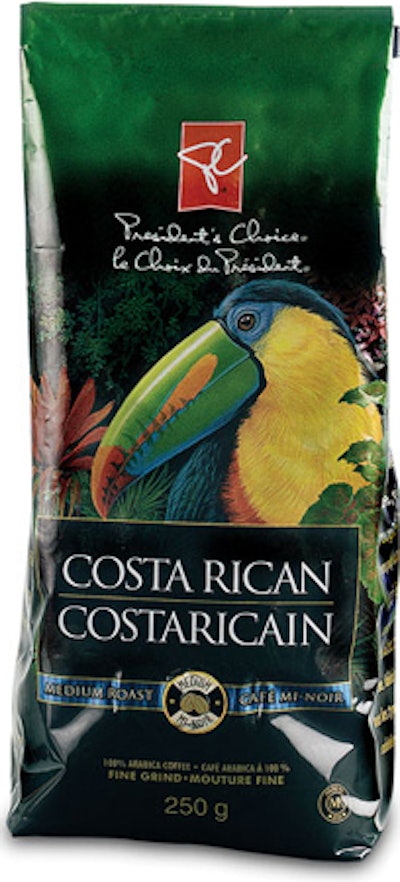
The new packaging is the recipient of an FPA Gold Award for Printing Achievement.
Supplied in preprinted rollstock form to Loblaw’s co-packer for forming, filling and sealing, the packaging material is a 3-ply structure of reverse-printed polyester/foil/ polyethylene. It is flexo-printed in 8 colors using Genpak’s Opaltone system. As Frank Gottvald, Loblaw’s vp of design, explains, “The new Opaltone printing process eliminates the need to print in gravure, thus enabling a cost savings of approximately $3ꯠ per SKU on etching of rotogravure cylinders.”
The Opaltone process also allows the printing of three different graphic packaging designs side by side for improved production cost efficiencies and reduced ink and solvent waste. The process produces vibrant colors and excellent gradations from dark to light shades.
Pouch-packed President’s Choice Costa Rican, Special Occasion, and Columbian Supreme Coffee varieties were introduced in November 2005. Gottvald notes, “The new packaging has good shelf impact, and the early consumer reaction seems to be favorable.” —Judy Rice