Wasabröd’s plant is the biggest crisp bread factory in the world, with a yearly production of more than 37,000 tons. Considering that crisp bread is very light, that corresponds to about 6,000 trailers leaving Wasabröd’s factories every year for world markets, or about 24 per day.
But Wasabröd’s fortunes have not always been so bright: In the late ’80s and early ’90s, it saw its sales plummet by several percentage points per year. Key to the company’s turnaround was finding efficiencies in production and developing new, higher-value products. Today, crisp bread is produced 24/7.
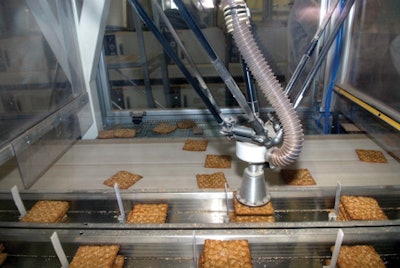
One new product, Solruta Quinoa crisp bread, is stacked and packed 10X10 by a bank of seven ABB IRB 340 FlexPicker™ robots. The solution for the new crisp bread was developed for the Barilla Group in Italy and delivered by the Italian integrator Technopack. The robotic arms’ vacuum pads guarantee less waste when stacking compared to other methods.
Wasabröd also uses one IRB 340 FlexPicker robot on the packaging side of its existing crisp bread and cream cheese-sandwich line, delivered by integrator FlexPack Robotics. While this product has been around since 1965, it was recently redesigned with new packaging and a new filling.
Before being packaged, the bank bill-sized sandwich gets cut lengthwise to make it easier and less messy to eat. On the conveyor system, the FlexPicker robot stacks 90 crackers/min into three-pack stacks.
Says Wasabröd head of production Per-Inge Eriksson, “With the FlexPicker robot, which has an availability of 99.5 percent, we’ve reduced waste by 50 percent, from 30 sandwiches per minute to 15, and at the same time, we have increased productivity by 10 percent in our existing sandwich line. This is important, considering that with only 5 percent to 8 percent water content, crisp bread is a very brittle and fragile product.”
According to Eriksson, production of sandwiches was 7.7 tons per week two years ago. Today, with the improvements in the product and the trend of convenience food, close to 38.5 tons are produced per week.