Craft breweries are modernizing operations by extending workforce capabilities and prioritizing safety through targeted equipment investments. Highland Brewery exemplifies this trend by implementing a pressurized hop cannon system that eliminates dangerous manual work at height, reduces processing time from two hours to 30 minutes, and improves product quality while supporting sustainable growth.
- Highland Brewery's new hop cannon system eliminates the need for operators to work at heights of 20+ feet, reducing a two-person, two-hour job to a 30-minute automated process
- The pressurized hop cannon uses compressed air and CO2 to transfer hops from the plant floor directly into fermenters, improving shelf life and flavor stability
- Equipment modernization drives improved quality consistency, operational efficiency, and workplace safety across the craft brewing industry
The craft brewery industry's wild ride in the U.S. continues in 2026. The number of U.S. craft brewers reached 9,578 in 2025, a 4% decline from 2024. Over the past decade, regional craft brewers have invested heavily in equipment, software, and automation. Today, however, many brewers are tightening their belts by focusing on operating margins, extending the capabilities of their existing workforce, and reducing safety risks.
The push for higher margins is driven by intense competition from ready-to-drink spirits, other craft brewers, and even cannabis beverages. During the past decade, craft brewers added canning lines en masse to improve margins and compete on retail shelves. Now, rising aluminum prices and other market pressures are squeezing profitability.
Highland Brewing Company in Asheville, N.C., is the largest independent brewer in the Southeast and has produced craft beer since Oscar Wong established the company in 1994. Today, the brewery is focused on improving operating margins, continuously refining batch production, and expanding its product portfolio.
"The biggest challenges in scaling product are always quality and consistency," says Kevin Kellar, Cellar and Filtration Manager at Highland Brewing Company. "As companies scale, some things get easier to produce more consistently, so you can make great strides in improving quality batch to batch."
Increasing production volumes and the introduction of new products have placed additional demands on Highland Brewing Company's operations team. According to Kellar, the company has prioritized promoting employees from within while supplementing that growth with new talent. Continuous improvement extends beyond brewing operations. Highland Brewery operates the second-largest solar array among independent U.S. craft breweries, generating up to 324 kW DC under peak conditions.Highland Brewery
"Growth eventually leads to needing a larger and stronger team, with greater knowledge and capabilities," Kellar says. "We have worked hard to grow and promote from within, but we also have brought on new talent with fresh perspectives over the years."
Fresh ideas have also shaped Highland Brewing Company's equipment strategy. The company recently partnered with Cross Company, of Greensboro, N.C., a certified member of the Control System Integrators Association (CSIA), to develop a hop cannon that doses hops directly into fermenters from the plant floor. The system eliminates the need for operators to manually add hops from the top of fermentation vessels.
"There are always new equipment challenges that come with growth. Either you evaluate new ways to make existing equipment stretch to your needs, or you look at expanding into new technologies or additional processing equipment," Kellar says.
Highland produces up to 1.55 million gallons of beer annually and introduces new recipes each year at its 40,000-sq-ft facility. The company built its reputation during the India Pale Ale (IPA) boom of the 2000s and typically uses between one and four pounds of dry hops per barrel, depending on the beer's design and flavor profile.
"Typically, we stick to around two pounds per barrel," Kellar says. "Considering our tank and batch sizes can mean a charge of up to over 400 pounds of hops per batch."
Unlike traditional hopping methods that add hops during the boil, dry hopping introduces hops into the fermenter while the beer is fermenting or cooling before filtration. The challenge is safely adding hops to fermentation vessels that stand roughly 20 ft tall.
The previous process required operators to work at height, according to Andrew Klosinski, Brewery Operations Director at Highland Brewing Company.
"An articulated boom lift had to ascend more than 20 feet to the top of a vessel, prepare the tank, and perform the dry hop," Klosinski says. "This was a two-person job, with one in the boom lift and another on the ground acting as a safety spotter, as well as assisting with the process."
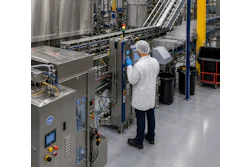
 The hop cannon doses hops directly into fermenters from the plant floor, reducing dry-hopping time from as much as two hours to approximately 30 minutes.Cross Company
The new pressurized hop cannon uses a vessel built by Feldmeier Equipment of Syracuse, N.Y. Connected to Highland Brewing Company's TransAir gas piping system, the cannon uses compressed air and CO2 to transfer hops from the plant floor directly into the fermenter. What once required as much as two hours now takes approximately 30 minutes.
"Specialized pipes with a smooth 180-degree bend lead into the top of our fermenting vessels and allow the hops to be transferred in without getting stuck," Kellar says. "Hop suppliers have increasingly designed their products around the process of dry hopping so that the pelletized hops more readily break apart and disperse into the beer."
The hop cannon injects hops into the beer while reducing oxygen ingress into the fermenter, helping improve shelf life and flavor stability. Large-diameter ball valves also provide smooth, uninterrupted passage for the hops during transfer.
The process includes the following steps:
- Clean, sanitize, and fully dry the cannon
- Purge oxygen from the cannon vessel with CO2
- Connect the cannon to the fermenter
- Manually load the cannon with the required hop charge
- Purge the loaded hops with CO2 for 5 to 10 minutes
- Charge the cannon with high-pressure CO2
- Open the "shooting" valve to propel the hops into the top of the fermenter
The modular Transair piping system also reduces downtime by making sanitation and maintenance easier for operators.
"There is a high level of sanitation and quality control points throughout the process, from the Quality Lab at Highland all the way to yeast additions in the brewhouse," Kellar says. "If there are gaps in the process, or a lapse in cleaning and sanitation, the process can be compromised, and a great deal of time and work can be wasted."
Delivering the goods
The distinctive bitterness and aroma of hops remain central to craft beer's appeal. Delivering those hops efficiently requires hoses and components capable of withstanding abrasion from pressurized material, elevated temperatures of approximately 120° F, high-pH cleaning conditions, high pressure, and the vibration generated when the hop cannon is fired.
Working with Cross Company, Highland Brewing Company implemented high-pressure tri-clamps and PTFE gaskets to reduce wear and friction within the transfer system.
Collaboration drives modernization
For many craft brewers in 2026, innovation is closely tied to improving profitability. Highland Brewing Company modernization efforts demonstrate how targeted equipment investments can improve safety, increase operational efficiency, and support production growth.
Says Keller, "Cross Company has allowed us to grow while achieving higher levels of sophistication in the brewery and has allowed us to have reliable equipment that gives us a clean and safe environment.”