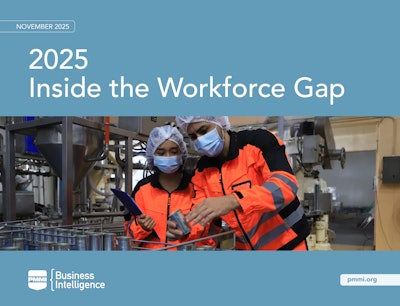
When 95% of consumer packaged goods (CPG) companies surveyed by PMMI, The Association for Packaging and Processing Technologies, say they are struggling to hire skilled operators and technicians, it confirms they are facing a major challenge.
In fact, nearly 60% expect hiring issues to become somewhat or more demanding in the future, according to PMMI’s research report entitled 2025 Inside the Workforce Gap.
“The CPG firms interviewed said the labor problem is exacerbated by the retirement of experienced staff, high turnover among new hires, and intense competition for technicians, leaving many companies unsure how the labor pool will improve,” states Jorge Izquierdo, vice president, market development at PMMI.
Training and knowledge retention issues also must be addressed. Many CPG companies believe operators consistently learn best by doing, which makes shadowing and hands-on repetition the most relied-on training methods. But these approaches have risks because training can vary by shift, and tribal knowledge disappears when experienced staff leave.
When it comes to training new staff, printed materials and employee shadowing are currently the most widely used methods. Currently, digital and embedded tools are underutilized. However, many end users see automation as a solution to workforce challenges and plan to concentrate its use on loading/unloading, inspection, and changeover operations, despite barriers to its implementation, including return on investment (ROI), small plant footprints, and potential downtime due to installation and training.
OEMs Play a Vital Role in Conquering the Labor Dilemma
When the PMMI researchers asked original equipment manufacturers (OEMs) how often their customers discuss workforce challenges with them, close to two-thirds said they discuss the topic often or always.
Consequently, OEMs that modernize equipment design and training/support models will be best positioned to help close workforce gaps and meet evolving customer expectations. In addition, educating end users on underutilized tools and demonstrating ROI on training investments can drive stronger adoption of automation.
But OEMs must do more than that. Currently, end users report that although sophisticated machines are available, they can be difficult to troubleshoot and maintain in real-world conditions. Additionally, operators frequently struggle with complex or customized machines, outdated manuals, and the lack of built-in guidance. In fact, only 14% of CPG respondents rank printed standard operating procedures (SOPs) or manuals as the most effective method for onboarding or upskilling operators.
CPG companies are requesting more training by video content, which many view as a flexible, accessible format that could support operators on demand — signaling an opportunity for OEMs to expand their offerings.
End users also believe that scalable complements, such as short training videos, human-machine interface step-throughs, or picture-driven manuals, could help capture expertise and reduce dependence on undocumented knowledge.
In addition, to reduce risk and improve training outcomes, companies may need to pair hands-on shadowing with documented, digital formats that make knowledge more consistent and transferable across the workforce.
OEMs can bridge the gap by implementing practical design features and embedded tools that can reduce errors, cut downtime, and empower less experienced staff. Machine builders also should provide training tools that are clear, consistent, and accessible, including multiple languages, picture-driven manuals, short, task-based videos, and digital libraries linked to each machine. Training could also be improved through skilled trainers and follow-up support after installation.
PACK EXPO East, Feb. 17–19, 2026, at the Pennsylvania Convention Center, is an excellent opportunity for CPG companies to develop and empower their plant-floor employees. Located in Philadelphia, the show can help end users find ways to:
- Motivate and mentor younger employees by immersing them in real-world innovations.
- Foster leadership development and inspire the next generation of packaging professionals.
- Build a stronger, more engaged team while shaping their company’s future.
OEMs can bridge the gap by implementing practical design features and embedded tools that can reduce errors, cut downtime, and empower less experienced staff. Machine builders also should provide training tools that are clear, consistent, and accessible, including multiple languages, picture-driven manuals, short, task-based videos, and digital libraries linked to each machine. Training could also be improved through skilled trainers and follow-up support after installation.
Learn more and register now for PACK EXPO East.