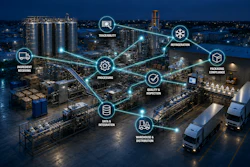
Machine learning combined with lean principles helps food manufacturers eliminate waste and improve efficiency, but only 10-15% of U.S. companies systematically use both approaches. Success requires data standardization, organizational alignment between IT and operations teams, and embedding AI insights into daily workflows rather than just building models.
- Only 10-15% of U.S. companies systematically apply lean principles and reap competitive benefits, according to the 2023 State of Lean Manufacturing report
- Data standardization is critical—most food producers invested in automation over 15-20 years but rarely standardized data across systems
- IT and operations silos remain the biggest organizational challenge; these teams have different goals, reporting lines, and risk perspectives
- 60-80% of project time is spent on data cleaning, extraction, and alignment from disconnected sources like historians, MES, and ERP systems
- Predictive maintenance shows the fastest ROI with 52% of CPG leaders prioritizing predictive analytics for measurable downtime reduction and spare parts savings
Machine learning initiatives are eliminating waste and preventing bottlenecks in food manufacturing. However, the State of Lean Manufacturing report in 2023 revealed that only 10 to 15% of U.S. companies systematically use lean principles and reap its competitive and financial benefits. An essential component of lean practices and Six Sigma is attention to processes, people, and problem-solving, not necessarily to capital investments.
Today’s food and beverage producers continue to invest in automation, pursue standardized plant data to future-proof enterprises, and adopt AI-based strategies. With investments in place, machine learning technology in packaging, predictive maintenance, and Clean-In-Place (CIP) are currently finding waste and providing quick resolutions.
“Lean in the machine learning era is not just about building models; it is about embedding insights into daily workflows,” says Markus Guerster, Founder and CEO, MontBlancAI. “AI must connect to production meetings, maintenance routines, and continuous improvement cycles. Without operational adoption, even technically strong models fail to generate sustained impact.”
The long-term challenge for food producers is to synchronize operational data across business units, such as batch-process information and time-series data in production.
“Most food and beverage producers have invested heavily in automation over the past 15 to 20 years, but data standardization was rarely part of the original charter,” says John Oskin, Senior VP, SmartSights.
Machine learning and AI gain traction
In 2024, Michael Warter, SVP and CIO at Ruiz Foods, announced the frozen food giant was working on a data standardization project for its research and development business unit. "Data is in disparate systems, and integration is vital in getting the systems to work together and move away from spreadsheets," said Warter during the 2024 IFT FIRST conference. "The first step provided regulatory, compliance, and track-and-trace benefits."
According to Warter, the Ruiz Foods board didn’t understand all of the AI implications for the food producer. The connection between lean principles, reducing waste, and an AI future is now more apparent to upper management and boards.
“Lean and Six Sigma gave us the discipline to eliminate waste and control variability in physical processes,” says David Ariens, Founder at the IT/OT Insider. “What we're doing now is applying that same discipline to data—eliminating waste in how we find, clean, and contextualize information, and building the infrastructure so that every new use case doesn't start from zero.” The IT/OT Insider’s Academy delivers training and education to companies worldwide.
 Skyline Graphics/Adobe Stock
However, a data-first approach doesn’t mean machine learning models for the entire plant. “Very few companies have adopted a full manufacturing ontology: a machine-readable model that explicitly defines how equipment relates to processes, how processes consume materials, how batches follow recipes, and so on,” adds Ariens.
According to Guerster, current challenges with data projects for ML include organizational alignment. “Many companies struggle with where to begin: historian data, MES data, lab data, or ERP integrations,” says Guerster. Signal naming, units, sampling frequencies, and contextual metadata (such as production state or batch context) are frequently inconsistent across lines or plants.
 David Ariens says IT and OT departments work in “different worlds” and if those two worlds don't cooperate, no amount of technology will save your data strategy.IT/OT Insider
To be successful, companies need to start small and focus on wins. “Another challenge is defining a clear business case before starting a data initiative. Companies that succeed typically begin with a narrowly scoped use case tied directly to measurable operational KPIs [key performance indicators],” says Guerster.
“With AI, starting small and growing from there seems like it has proven benefits across the board,” adds Oskin. “Picking a good place to start, such as a key asset, production line, or metric, and picking a couple of AI projects to do this week or this month.”
A recent webinar, “Optimizing Production with AI and Machine Learning,” with Marc Betrand at SmartSights, revealed how a customer reduced waste by using feature importance or prescriptive analytics in diagnosing a packaging line bottleneck. Feature importance identifies the most impactful features, leading to more efficient, interpretable, and high-performing models.
The objective for this customer was to identify the appropriate KPI, such as mean time between failures (MTBF) or a machine center value for a packaging line bottleneck. In this example, SmartSights’ ABLE technology conducted a root cause analysis of a bundler, a wrapping unit, and a tray packer, and identified the highest-impact machines based on potential root causes.
In parallel, a prescriptive analytics approach also modeled the packaging line. The essential KPI for this bottleneck was called the effective rate, which multiplies availability by the average rate for the line to produce a units-per-minute metric.
“Both of the algorithms were correct, but what was misleading was that the root cause is saying operators should be focusing on this tray packer. However, the focus should be on the bundler,” said Bertrand. The ML modeling enabled the packer to increase overspeed capacity and speed (rate) on both machines, resolving the machine center bottleneck.
How to Scale Lean Data Across the Enterprise
The most important challenge is not technological—it's organizational. IT and OT still operate in silos in many companies. They have different goals, different reporting lines, and they genuinely speak different languages about risk, time, and success. If those two worlds don't cooperate, no amount of technology will save your data strategy.
Once you address the people dimension, you hit two data bottlenecks that must be solved in sequence. The first is the absence of reusable data infrastructure. Every data project starts with weeks of finding, extracting, aligning, and cleaning data from disconnected sources—historians, MES, CMMS, LIMS, ERP—none of which were designed to work together. We estimate that 60 to 80% of project time is consumed by this plumbing work. And the next project repeats it all from scratch.
The second bottleneck is context and governance. Even when you've connected the data sources, if every plant defines asset hierarchies differently and uses its own naming conventions, you haven't built reusable infrastructure. You've built neater silos. Scaling requires agreed standards—ideally grounded in ISA-95—that make context portable across sites.
Whether you start with historian data, lab data, or MES data matters far less than whether you're building infrastructure that compounds or building point solutions that dead-end.
—David Ariens, IT/OT Insider
Predictive maintenance success stories
In Veeva’s "2026--The State of AI in Consumer Goods" report, the software provider surveyed 150 CPG senior quality and IT leaders and found that “predictive analytics carries the most interest, with just over half (52%) saying predictive analytics are the top priority for AI.” In addition, 9 in 10 respondents say their companies are actively using AI or are conducting trials, pilots or evaluations.
Predictive maintenance “failure events are concrete and measurable, which simplifies labeling,” according to Guerster. “From a business standpoint, maintenance ROI is easier to quantify: reduced downtime and spare parts savings,” he says. “In contrast, broader process optimization requires deeper integration with quality data, lab results, and production state modeling.”
“Production assets have a variety of sensors, including vibration, temperature, current, pressure and flow,” says Oskin. “Structured, high-frequency data is ideal for machine learning.” SmartSights offers solutions that trigger maintenance work orders, issue alarms when SCADA anomalies are detected, and provides a holistic view of the full life cycle of a maintenance issue.
While successes in predictive maintenance are well documented, scaling across multiple plants remains a challenge. “The proof of concept that predicted bearing failures on one packaging line works brilliantly—until winter turns into summer and the ambient conditions change, or someone adjusts a setpoint, or the model just quietly degrades because nobody owns its ongoing maintenance,” says Ariens.
Ariens adds, “scaling predictive maintenance across an entire asset fleet demands exactly the same reusable data infrastructure and governed context models that every other data initiative needs.”
Standardizing data and ML pilots will pose challenges, but many industry analysts are pointing to AI-based tools for formulation as a promising area for early growth. Bottom line, corporate managers and boards are learning more about AI and the challenges in scaling across the enterprise.
“AI was this nebulous thing and is now a real thing. So, people are making that leap of faith that maybe they weren't even doing two years ago,” says Oskin. “In food and beverage, specifically, companies have a lot of cost pressures.”