A major ready-to-eat food processor recovered from a contamination event by prioritizing sanitation in its equipment rebuild and facility improvements, aligning with USDA-FSIS standards that require food-contact surfaces and equipment to be designed and maintained for thorough cleaning and contamination prevention.
- RTE Compliance Challenge: Ready-to-eat products receive no additional preparation before consumption, making sanitation design and maintenance critical under FSIS regulations.
- FSIS Standards Require: Equipment must be built to facilitate thorough cleaning, and food-contact surfaces must be cleaned and sanitized as often as necessary to prevent product adulteration.
- December 2024 Enforcement: USDA-FSIS strengthened Listeria monocytogenes measures for RTE facilities, including weekly verification of physical plant conditions and sanitation indicators like condensation, roof leaks, and damaged equipment.
- Recovery Sequence: Effective remediation follows three steps: stabilize affected areas, rebuild critical equipment with sanitation in mind, and maintain sanitation priorities in all subsequent installations.
- Long-Term Partnership Result: Emergency response evolved into ongoing support, demonstrating that sanitation-first approaches during recovery enable sustained compliance and operational continuity.
A contamination-related event at a major packaged ready-to-eat (RTE) food facility created two intertwined priorities: Remediate the affected areas and restore production without compromising the sanitation principles that would guide the rebuild. According to ProFab, the processor’s legacy infrastructure reflected older design approaches, and some critical systems needed more than cleaning—they needed to be rebuilt or replaced with cleanability and contamination prevention in mind.
The stakes are high for RTE meat and poultry given their USDA Food Safety and Inspection Service (FSIS) definition as edible without additional preparation by the consumer. That public-health priority reaches into the physical details of a plant—from the condition of equipment to whether food-contact surfaces can be thoroughly cleaned.
The challenge: Recover without compromising sanitation
The processor needed a partner that could respond quickly, support cleanup, and rebuild equipment for the facility’s next phase. Downtime mattered, of course, but sanitation was the overriding concern.
The project’s priorities align with FSIS sanitation performance standards, which require equipment used to process edible products to be built to facilitate thorough cleaning and maintained in sanitary condition. The standards also require food-contact surfaces to be cleaned and sanitized as often as necessary to prevent insanitary conditions or product adulteration.
The response: Mobilize, remediate, then rebuild
The processor called ProFab, part of the Grote Family of Brands, to support the recovery. ProFab provides protein processors with installation management, process piping, mechanical and millwright services, and custom stainless-steel equipment. The company says its team mobilized quickly, beginning with cleaning and remediation in the affected areas before turning to equipment reconstruction and system improvements.
“Food safety concerns are top of mind for processors, as cases of illness due to foodborne pathogens repeatedly make headlines,” says Ein Harris, ProFab General Manager. “Because ProFab has decades of experience working with meat and poultry producers, we understand the need to respond quickly with solutions to get these plants back up and running.”
An expanding installation scope
As the recovery progressed, ProFab’s work extended beyond the initial cleanup and rebuild. The processor added new production equipment, including fryers and dumpers, and ProFab supported the installation. The broader scope required the team to coordinate new machinery with the plant’s existing process and physical constraints while keeping sanitation performance central to the work.
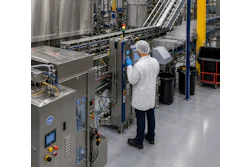
 ProFab technicians oversee equipment installation.ProFab
Why equipment details matter in an RTE environment
The regulatory focus on RTE facilities has sharpened. In December 2024, USDA-FSIS announced stronger measures addressing Listeria monocytogenes in RTE meat and poultry plants. The agency said weekly verification would examine risk factors that include physical plant modifications and signs of sanitation problems such as condensation, roof leaks, damaged equipment, or cracked floors.
That context helps explain why a recovery project can’t stop at restarting a line. Equipment construction, installation access, inspection access, cleanability, and maintenance all influence the plant’s ability to sustain sanitary conditions. In this project, ProFab says those considerations informed the rebuilt equipment and subsequent installations.
Fabrication and field work
The work drew on ProFab’s custom stainless fabrication and onsite services. Field welding allowed the team to execute installation work within the facility, while mechanical and millwright capabilities supported the broader equipment scope.
 A ProFab technician performs onsite welding, one of the services the company provides as part of its installation management.ProFab
Planning the fit
Installation preparation included field measurement and coordination around the plant’s equipment footprint. This planning stage connected the processor’s operational needs with the practical demands of placing and integrating new equipment in an active food-production environment.
 A ProFab technician measures during installation preparation.ProFab
The result: An emergency response becomes a continuing partnership
ProFab’s rapid response, sanitation-first approach, and ability to adapt the project scope helped the processor complete the recovery and return to operation. What began as an urgent remediation and rebuild developed into a longer-term relationship, with ProFab continuing to support additional equipment installations and upgrades.
The central lesson is less about a single machine than about the sequence of work: Stabilize the affected area, rebuild critical equipment, and carry the same sanitation priorities into every later installation. For an RTE processor, where product may receive no additional preparation to make it safe, that continuity matters.