Payne's Pecans installed an X-ray inspection system that detects internal defects and kernel fill invisible to the human eye, increasing their average pecan grade from 40 to 44 and generating an extra 8 cents per pound while reducing dependence on manual labor.
- X-ray inspection identifies internal defects and insufficient kernel fill that hand sorting cannot detect, revealing hollow or underfilled pecans only visible when cracked open
- Payne's average pecan grade increased from 40 to 44, translating to 8 cents per pound additional profit at 2 cents per grade point
- Production throughput increased by 2,000 to 3,000 lbs/hr after eliminating manual sorting bottlenecks, requiring only one person for final inspection instead of six to eight
- A-grade pecan lots now contain less than 1% lower-grade contamination compared to industry standard of 2-3%, delivering consistent quality every time
- The system is simple to operate and maintain, requiring only daily belt cleaning and no technical specialists, making it practical for small family operations
Payne’s Pecans has built its business on a simple but demanding task: helping local growers move clean, market-ready pecans through the supply chain.
The family-owned pecan cleaning business in Rich Hill, Mo., handles as much as 2 million lbs of in-shell pecans annually. Founder Jay Payne has been around pecans since childhood, when he picked nuts from his family’s grove for Christmas money. Since opening Payne’s Pecans in 2004, however, the work has changed. Labor is harder to find, buyers have become more particular, and inspection remains one of the most difficult parts of the operation.
“Inspection has always been one of the hardest parts of this business,” Payne says. “Finding several people to stand at a table and sort pecans by hand for hours is difficult enough, but there’s also only so much a person can catch by eye. We needed a better way to identify internal product defects.”
For Payne’s Pecans, the challenge wasn't just removing what could be seen. It was determining what was happening inside the shell before the product reached buyers.
That need led to the installation of WECO’s Multiscan MXV-Bulk X-ray inspection system last year, making Payne’s the first operation in North America to install the system for pecan inspection. The goal wasn't technology for technology’s sake, though. Instead, it was to solve a practical plant-floor problem: raise product value, keep the line moving, and reduce dependence on manual inspection.
Previously, pecan inspection occurred at the end of the line by six to eight people. That process helped remove visible defects, but it depended heavily on the availability and consistency of people standing at a sorting table for long stretches. It also left the operation with limited visibility into kernel fill, one of the most important quality factors in an in-shell product.
The MXV-Bulk gives Payne’s another way to evaluate each pecan. While optical sorters identify external characteristics such as color, size, shape, and surface condition, the X-ray system analyzes density differences inside each nut to identify hidden defects and insufficient kernel fill. It also detects dense foreign material, including stones, adding another layer of product protection before pecans leave the facility.
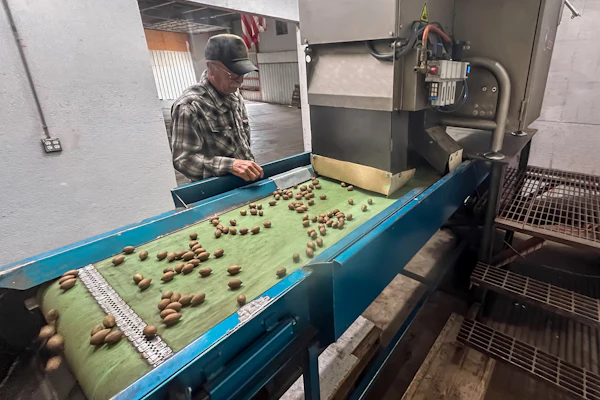
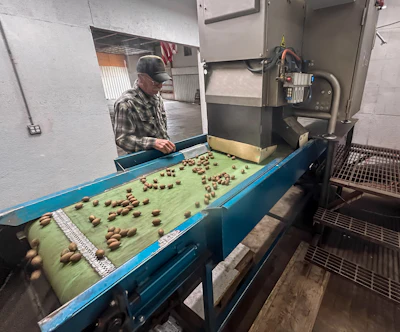
At Payne’s, the system sits near the end of the line after pre-cleaning equipment has removed much of the lightweight debris and obvious foreign material. As pecans pass through the inspection zone, a channel belt keeps them stable and evenly distributed for scanning. The system analyzes the X-ray images and triggers air valves to eject out-of-tolerance product.
“What surprised me most is what the system can detect that we simply couldn’t see before,” Payne says. “You can pick a pecan out of the reject stream, look at it and think there’s nothing wrong with it. Then you crack it open and find there’s little or no good nutmeat inside.”
That capability matters because buyers sample each lot, crack representative nuts, and calculate the percentage of edible kernel. After installing the MXV-Bulk, Payne’s average grade reportedly increased from 40 to 44.
“Buyers pay for what is inside the shell,” Payne says. “At 2 cents a point, going from a 40 to a 44 is another 8 cents a pound. On a big load, that adds up in a hurry.”
The system also has helped Payne’s deliver more consistent lots. Its A-grade pecans now carry less than 1% lower-grade contamination, compared with the 2% to 3% the industry generally accepts.
“A machine evaluates every pecan the same way every time,” Payne says. “People get tired, and different people catch different things. Now, with our X-ray system, we’re getting much more consistent inspection. Buyers who have bought from me for years told me it was the best product they had seen come out of here.”
The operational impact has been equally important. With inspection no longer constraining production, Payne estimates throughput has increased by 2,000 to 3,000 lbs/hr. The company also has changed how labor is used at the end of the line. Instead of six to eight people sorting by hand, one person now handles final inspection immediately after the X-ray system, with very little left to remove.
The technology also had to be practical. Payne says that once the pecan settings were established, he has rarely needed to adjust the system. Daily cleaning consists primarily of wiping down the accessible belt.
“A lot of people hear X-ray and assume it’s going to be complicated, but we just turn it on and go to work,” Payne says.
That ease of use is important for an operation without technical specialists on staff. Payne’s needed a system that could strengthen inspection without creating a new operational burden.
Support from WECO also played a role in the installation and ongoing use of the system.
“WECO has been great to partner with. It’s nice knowing I can pick up the phone and they’ll help me get things figured out. It feels like they’re part of our team,” Payne says.
For Payne, the larger point is that inspection technology has helped address one of the central pressures facing the business. As labor remains tight and buyer expectations continue to rise, hand sorting alone is no longer enough for what Payne’s needs to accomplish.
“With labor being what it is, I’m not sure I would have stayed in the pecan cleaning business if we hadn’t found a better way to handle inspection,” Payne says. “That’s how much of a difference this system has made for us.”
At Payne’s Pecans, X-ray inspection is being used to solve a specific production problem. It helps identify internal defects, improve lot value, reduce manual sorting, and increase throughput. For a family-owned cleaning operation handling millions of pounds of in-shell pecans each year, the value of the technology is measured less by the sophistication of the system and more by what it allows the business to keep doing.