Food manufacturers continue investing in traceability technology and data standardization despite the FDA's 30-month delay of FSMA 204, driven by strong retailer requirements and regulatory uncertainty that motivates proactive compliance efforts.
- The FDA delayed FSMA 204 by 30 months from its original January 2026 deadline, which aimed to enable food safety incident identification within 24 hours through digital records and lot-level tracking.
- Major retailers like Walmart and Sam's Club require suppliers to comply with advanced shipping notice (ASN) and packaging requirements, and confirm FSMA 204 eligibility regardless of regulatory delays.
- Food manufacturers are upgrading legacy equipment with sensors, communication hardware, and middleware solutions to capture and standardize data across supply chains.
- The FDA held a limited comment period in March 2026 exclusively with the Partnership for Food Traceability, raising concerns about transparency and stakeholder access to regulatory guidance.
- Thirty percent of food manufacturers report that digital technologies are significantly affecting operations, with processors replacing paper records with electronic systems for traceability compliance.
The FDA paused FSMA 204, but traceability technology, innovations and applications are moving forward in food manufacturing. Retail customers’ requirements for lot tracking aren’t slowing, and companies are pursuing continuous improvement amid regulatory uncertainty.
The state of West Virginia banned petroleum-based food dyes in 2025 via HB 2354. However, just seven days into 2026, a federal court delivered a preliminary injunction in favor of the International Association of Color Manufacturers due to a lack of definition around the words “poisonous” and “injurious” in the bill. In essence, the court said there was insufficient scientific support for the state ban.
While unexpected state laws emerged in 2025, the Food and Drug Administration (FDA) delayed Food Safety Modernization Act (FSMA) Rule 204 by 30 months, a move announced in March 2025. Rule 204 is intended to enable identification of food safety incidents within 24 hours through digital records and lot-level tracking throughout the supply chain.
“I don’t believe the staff changes at the FDA had much to do with the 30-month extension,” says Dr. Jennifer McEntire, Founder of Food Safety Strategy. “The FDA realized it would be impossible to enforce the rule if the Jan. 2026 date had stood.”
Despite shifting federal and state regulations, food manufacturers continue investing in advanced traceability equipment and technology. Customer requirements for lot tracking remain strong, data-standardization initiatives continue to advance, and companies are pursuing continuous improvement regardless of regulatory uncertainty.
Secrecy around FSMA 204
The FDA announced a comment period for the Food Traceability Rule in February 2026. However, the comment period did not include the public and was limited to the Partnership for Food Traceability (PFT), an organization of approximately 10 food companies.
Congress added the new comment period through the 2026 appropriations bill. McEntire highlighted the development in February and raised concerns about the limited access to stakeholder feedback opportunities:
“FDA’s February 2026 announcement related to food traceability contained a concerning, and to the best of my knowledge, unprecedented statement indicating that the only listening session scheduled prior to the close of the comment period for the draft guidance will be limited to paying members of the Partnership for Food Traceability.”
On March 6, the PFT and FDA held the meeting and established a framework focused on lot-level tracking. Objectives included:
- Identifying points in the supply chain where lot-level tracking has the potential to break down;
- Examining the challenges those breakdowns create for establishing traceability;
- Identifying and discussing specific potential solutions to those challenges, including potential regulatory flexibilities, to comply with the lot-level tracking requirements in the Food Traceability Rule.
“In addition to several supportive comments on my related LinkedIn post, I also heard from several others individually, including a few involved in PFT,” says McEntire. “I don't think anyone likes the idea of secrecy.”
The uncertainty continues to create challenges for the industry.
“There still seems to be a limited understanding of how to comprehensively comply with the upcoming regulations,” says Stuart Thomas, Head of Sales at Mettler Toledo.
Via Walmart: “As of August 1, 2025, Walmart and Sam’s Club require suppliers of all food and beverage items to comply with ASN and packaging requirements. Food suppliers must confirm the FSMA 204 eligibility of their products in the item catalog, if not already completed.”
Even without definitive answers on FSMA 204, manufacturers are moving forward.
“Traceability expectations are high among customers, and the level of discussion has significantly increased,” says Craig Lorei, Global Marketing Manager, Light Industry, at Eriez. “Smaller producers may be more hesitant because they’re unsure how the rules will ultimately be interpreted or enforced.”
“Larger manufacturers often act proactively and create their own internal expectations while waiting for more regulatory clarity,” says Molly Dohm, Quality Lead at Industrial Magnetics.
A traditional public comment meeting titled Challenges and Solutions in Lot-Level Food Traceability took place on June 15, 2026.
Market leaders driving traceability
The January 2026 Manufacturing Outlook Study indicates that traceability remains a priority for food manufacturers. Thirty percent of respondents say digital technologies are affecting operations, and processors continue replacing paper records with electronic systems.
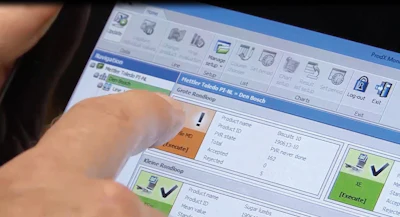
 Mettler Toledo’s ProdX data-management software provides real-time monitoring and uses Microsoft SQL Server 2022 Express Edition.Mettler Toledo
“There’s still non-stop discussion and work being done to understand and implement the rule despite the delay,” McEntire says. “The Food Safety Preventive Controls Alliance just began offering FDA-recognized training. Although the rule doesn’t require training, interest in the training is high.”
Major retailers are also continuing to push suppliers toward stronger traceability capabilities.
In October 2025, Walmart and Sam’s Club reiterated the need for advanced traceability from suppliers:
“As of August 1, 2025, Walmart and Sam’s Club require suppliers of all food and beverage items to comply with ASN and packaging requirements. Food suppliers must confirm the FSMA 204 eligibility of their products in the item catalog, if not already completed.”
“While the FDA has recently proposed a 30-month extension to the compliance date for the Food Traceability Rule, we strongly encourage all suppliers to maintain momentum in their compliance efforts.”
OEMs meet the moment
While retailer requirements continue to drive investment, food manufacturers are also accelerating data-standardization initiatives that support enterprise AI strategies across processing, manufacturing, and product development.
As a result, equipment suppliers are upgrading data-communication capabilities to support both legacy and new equipment.
“Food producers are looking for more data from our equipment,” says Lorei. “We’re developing our software to not only capture that data, but also log it in a way that is useful for manufacturers.” Eriez recently upgraded its Quality Retail Compliance (QRC) software to provide audit-ready documentation.
“The conversation is shifting toward how magnetic separation equipment is applied within food processing systems and how producers can use those control points to gather more meaningful data,” says Dohm. “Food producers are responding to regulatory uncertainty by requesting higher-strength or higher-Gauss magnets in an effort to improve capture performance.”
Legacy-equipment upgrades increasingly include added sensors, communications hardware and middleware solutions.
“Customers are looking to gather data from older devices by adding communication components and pursuing middleware solutions,” says Thomas. Mettler Toledo’s ProdX data-management software provides real-time monitoring and uses Microsoft SQL Server 2022 Express Edition.
Food manufacturers are already seeing benefits from data-standardization initiatives, and continued compliance investments are expected to strengthen traceability programs even amid regulatory uncertainty. As retailers, regulators and customers continue pushing for greater visibility, manufacturers appear committed to advancing traceability regardless of when FSMA 204 ultimately takes effect.