FSMA 204 compliance should serve as a starting point for building supply chain intelligence, not merely a regulatory checkbox. By treating traceability data as a strategic asset rather than a filing system, food brands can gain real-time insights into product freshness, supplier performance, and waste reduction while meeting FDA requirements.
- Compliance is the foundation: FSMA 204 requires digital traceability across high-risk food categories, but most brands treat it as a minimum requirement rather than an opportunity for competitive advantage.
- Data creates visibility: GS1 standards and EPCIS event tracking capture harvest timing, pre-cooling decisions, and transit conditions that reveal true freshness scores and prevent waste.
- AI-powered insights: Walmart's TRACE platform uses harvest weather, computer vision, and temperature data to predict outcomes, recommend markdowns, and answer supply chain questions in real time.
- Performance rewards: Suppliers with accurate data receive reduced inspections and better placement, while brands gain access to lot-specific feedback on waste, customer ratings, and field-level performance.
- Scalable beyond produce: The same digital infrastructure benefits shelf-stable goods through reduced claims, better inventory accuracy, and improved receiving efficiency across all product categories.
Last fall (and notably long before today’s Cyclospora scare) Walmart’s Ed Bonin ate a salad in Salinas, Calif. The lettuce crunched and the tomatoes tasted like tomatoes. He asked the server when the produce had come in, and she told him it was probably picked that morning, an hour up the road and twelve hours from field to plate.
“What should bother all of us is that not all food gets to make that journey,” said Bonin, director of enterprise traceability and compliance at Walmart. Most food takes days or weeks, moving through trucks, distribution centers, and stores, and along the way the signals that describe it get crossed or lost. When they do, food that could have been someone’s best salad ends up in the trash. The culprit, as Bonin frames it, is a broken thread, the digital record that’s supposed to stay tied to the physical product from harvest to shelf.
His GS1 Connect talk, “Precision Traceability with AI: The Art of the Possible,” was pitched at an audience of brand owners and CPGs staring down FSMA 204, the FDA rule requiring digital traceability across the highest-risk food categories. Most brands, he said, are approaching it as a compliance issue, and that’s the lowest possible bar to clear. He thinks they should see it as an opportunity instead. Ed Bonin, director of enterprise traceability and compliance at Walmart
Compliance as the starting line
FSMA 204 spans thousands of food suppliers across multiple continents, from the most sophisticated operations in the world to generational family farms, all being asked to build the same data foundation. The risk of getting it wrong isn’t one dramatic failure. “It’s death by a thousand cuts,” Bonin said, or small data gaps scattered across a massive system that add up to enormous waste. That’s an expensive, if nearly unnoticeable, blind spot.
Traditional supply chain documents like the advance ship notice (ASN), the invoice, and the bill of lading (BOL), are all static. They’re good for getting brand suppliers paid, Bonin said, but they don’t tell you what’s happening with the product right now. And every point solution that patches one gap tends to create another silo. The fix, in his telling, isn’t another silo but a shared standard.
The industry has spent years treating traceability as a filing system where the data is captured and stored to satisfy the audit.
“Compliance shouldn’t be the finish line here, compliance should be the starting point,” Bonin said. Standardize on GS1 and “you stop recording, and you start seeing.”
The same data that satisfies the FDA can tell a grower how their pre-cooling* decisions affect the shelf line three weeks later. The companies that stop at compliance build the minimum viable system. The ones that treat the data as an intelligence layer build something that gets smarter every day.
*Per Google Gemini AI: Pre-cooling is the vital first step in post-harvest handling that rapidly removes "field heat" from freshly harvested crops. The main methods used are forced-air cooling, hydro-cooling, and vacuum cooling. Doing this quickly slows down ripening, stops bacteria growth, and keeps fruits and vegetables fresh.
Clock starts at harvest
An ASN acts as a digital twin of a shipment that arrives before the truck does. A retail destination, most likely a distribution center (DC), will know the product, the lot, and the origin before it hits the dock.
“Digital signals move at the speed of light. Physical trucks, well, they move at the speed of a truck,” Bonin said. Wait for the truck and the freshness window is already closing.
For a produce brand, the first practical move is one it already controls: instrument the front end so the data exists at all. For produce, biological time is the only time that matters, and it starts ticking the moment the crop leaves the field, often days before a purchase order even exists. Walmart uses EPCIS, the GS1 event-data standard, to capture a hidden age that factors in harvest timing, field conditions, and whether the product was pre-cooled fast enough. Greens that weren’t cooled quickly enough after being harvested arrive already compromised, with nothing in a traditional system to track that reality.
The 2D label earns its keep at the brand’s own dock
The label plays a key role in keeping that digital thread tied to each physical case. An SSCC-18 (Serial Shipping Container Code) links the pallet to its digital record. A GS1-128 on the case carries the GTIN and batch/lot dates directly on the box, so the data doesn’t only exist in a far-flung system at a brand or retailer’s headquarters.
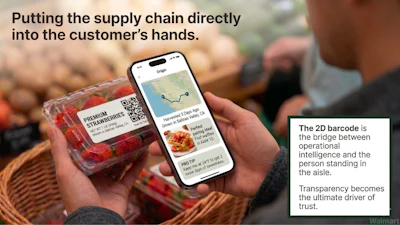
Meanwhile, that label is evolving. Ahead of Sunrise 2027, GS1’s target for retailers to process 2D barcodes at point of sale, Bonin said brands are already moving to 2D datamatrix on the case for purely operational reasons. It provides directional reads, built-in error correction, and a smaller footprint. The digital thread doesn’t just remain intact; it gets fortified with deeper data and thus harder to break.
That upgrade pays off on the brand’s own side of the dock, not only the retailer’s. Clean labels and consistent case condition mean faster throughput, fewer exceptions, and less manual intervention, Bonin said, which for a supplier translates into accurate receiving and faster payment. What looks like a compliance standard, in his framing, is “actually a performance advantage.”
The receiving end proves the point. When a truck reaches a Walmart DC dock, the ASN has already set expectations. Robots feed cases into high-intensity racking while computer vision reads the GS1 case markings in real time, validating what’s actually there vs. what was promised (see this article for an interesting pilot to that end, also from Walmart). Vision also flags defects, like open flaps, crushed cases, or damaged labels, before they reach storage. Quality control is woven into the automation rather than bolted on as a separate checkpoint. At scale, with a 2D datamatrix on every case, that same vision system can capture GTIN, batch/lot, expiry, and serial number in a single pass, with better tolerance for the label damage that a linear scanner might reject or misread. The clearer the data a brand sends, the faster and cleaner its product moves through all of it.
What the data gives back
All of it converges in an AI-enabled platform Bonin calls Walmart TRACE (he didn’t divulge the acronym). It doesn’t just record what happened, it also senses, predicts, and acts, he said. Pulling in harvest weather, computer-vision reads, transit temperatures, and carrier performance history, it calculates what Bonin called a true freshness score for every lot in the network. That’s not per truckload or per brand/producer, but per lot. It then cross-references brand/supplier data against Walmart’s own physical signals. If a pallet had a rough journey, the system can recommend a markdown or a reroute before the product is even graded.
Anyone in the chain can ask TRACE a plain question, like “what’s shortening shelf life this week?”, and get an actionable answer rather than a report due Friday from the analytics team. “It’s asked and answered,” Bonin said, “so question and insight in the same conversation.”
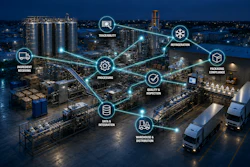
The reward for a brand is more than goodwill. Every pallet teaches the model, Bonin said, like which brand suppliers pre-cool well, which carriers hold temperature on long hauls, or which routes struggle in summer. That turns into supplier and carrier scorecards built on real performance, and suppliers whose data holds up get rewarded with reduced inspections. Getting the data right, in other words, stops being a cost of doing business and becomes a competitive standing. It also lets the network practice true first-expired, first-out at scale: the freshest produce goes to the farthest customer, and product that needs to move fast goes to the closest. Bonin's "living ecosystem": growers tune harvest practices to downstream feedback, carriers and DCs gain thermal-compliance and receiving efficiencies, stores cut markdowns, and consumers get transparency, with GS1 standards as the interoperable language connecting every node. Slide courtesy of Walmart.GS1 US/Walmart
The grower who never saw past the dock
The project stopped being a systems problem for Bonin on his Salinas, Calif. trip, sitting with a third-generation berry grower. The farmer knew his harvest windows, his pre-cooling specs, and his soil better than anyone. But all that visibility ended the moment the freight left his dock.
Bonin told him Walmart could now hand back how much of his product got thrown away, by lot and by field, and how customers in 10 different states rated specific harvests. That’s not averages, rather specific lots and specific decisions.
“I’ve been farming for 30 years. Nobody’s ever told me this,” the grower told him. “The data didn’t exist or if it did exist, it wasn’t connected.”
For 30 years the thread had broken at the loading dock. Two days after the visit, Bonin said, the grower called and asked how to get in. He’s now building the EPCIS integration that will feed his harvest signals into TRACE and send the downstream insights back. For a brand, that is the whole argument in one anecdote: the same data collected for the regulator becomes a view of its own product it never had before.
Not just for the produce aisle
Bonin's examples were all produce, where the payoff is measured in shelf life. But most of the machinery underneath, like the ASN as an early-warning signal, the label as a data carrier, verification at receiving, and the shift from compliance to intelligence, is indifferent to what's inside the case. For shelf-stable goods, the same item-level data pays off in a different currencies, by way of fewer claims disputes, better on-shelf availability, cleaner inventory, and proof of authenticity. Oh, not to mention a better connection to what may be one of your biggest retailer customers. Walmart made that case on apparel in a separate GS1 Connect pilot (with Hanesbrands, now part of Gildan), where the goods never spoil and the value showed up as claims recovery and receiving accuracy instead. Freshness is just produce's version of the return.
Bonin emphasized that adoption beyond mere compliance will result in competitive advantage. The FSMA 204 regulation is the forcing adoption of this functionality, and Sunrise 2027 is the industry choosing to move faster than it needs to. But the pieces a brand needs are largely in hand. It already generates the ASN. It’s already required to collect the packaging and harvest data. The same GS1 standards that keep the thread intact, what he called “the grammar that lets every farm, every carrier, every retailer, every register speak the same language,” scale globally, so the barcode a packaging team is already adding for the checkout lane can pull double duty as a supply-chain data carrier. The only real question, Bonin argued, is whether that data sits in a filing cabinet, or if it starts thinking for you and delivering actionable, money-saving insights.