This content was written and submitted by the supplier. It has only been modified to comply with this publication’s space and style.
Corrugated tube heat exchangers are reliable and efficient, offering a number of advantages over plate and smooth tube heat exchangers. However, for some products and applications, scraped surface heat exchangers are required to prevent fouling or maximize heat transfer. The HRS R Series has been designed for situations where products are extremely viscous or need thorough mixing.
The HRS R Series uses a rotary scraper bar which features a helical screw which rotates at high speed. This enhances product flow, prevents fouling and minimizes the pressure drop and back pressure. It can also aid mixing and blending of certain types of product. The design also means that, when configured correctly, the screw can be run in reverse, helping to empty the heat exchanger tubes of product.
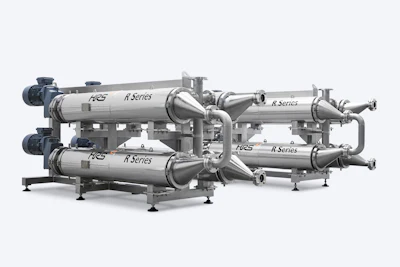
Available in single and triple versions and two standard lengths, the R Series can be configured horizontally or vertically and offers heat transfer areas between 0.35 m2 and 4.2 m2. The multi-tube version uses a uniquely engineered gearbox system to transfer the energy from a single electrical motor to the scraper rods in each individual tube.
 The HRS R Series can be configured vertically or horizontally.HRS
In addition, removable inner tubes ensure easy inspection, maintenance and replacement, while baffles in the service fluid side of multi-tube models maintain heat transfer and allow for counter-current flow if required. One advantages of the R Series’ design is a unique sealing system removing the need for product end mechanical seals, reducing complexity, and maintenance and servicing costs.
Although the R Series has been purposely designed for extremely viscous materials, some very solid products like low temperature peanut butter are too thick for the standard unit, resulting in undue strain on the scrapers, gearbox and mounts. To overcome this, HRS developed the HRS RHD Series for heavy duty applications. The RHD Series features a larger motor (7.5 kW compared to 4 kW on the R Series), as well as a larger scraper rod with additional supports, and heavy-duty bearings and seals to accommodate increased torque. An extra external support at the motor end supports the extra weight.
The R and RHD Series have been developed for both hygienic and industrial applications, including heating, cooling, pasteurization and evaporation of everything from concentrated dairy products and nut butters to sauces, minced meat and viscera, pet food, as well as thick cosmetics like creams and gels.