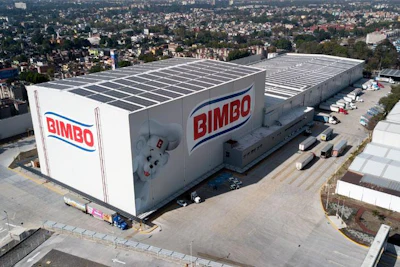
Grupo Bimbo implemented a fully automated warehouse system designed and implemented with Stoecklin Logistics to handle high-velocity fresh food distribution across 249 bakeries in 39 countries, improving throughput, order accuracy, inventory rotation, and reducing logistics costs while maintaining product freshness.
- Grupo Bimbo operates 249 bakeries across 39 countries, requiring a distribution system capable of handling fresh products with limited shelf life and tight delivery windows
- The company partnered with Stoecklin Logistics as a general contractor to redesign warehouse operations from the ground up rather than applying incremental upgrades to legacy systems
- The automated facility features automated storage and retrieval systems combined with advanced material handling to create continuous product flow and improve inventory visibility
- Results include increased throughput, improved order accuracy, reduced waste, and lower cost per case while ensuring products reach customers at peak freshness
- The system was designed for scalability without requiring additional distribution centers, supporting future growth while reducing capital and operational costs
For Grupo Bimbo, speed isn’t just a competitive advantage—it’s a requirement. With fresh products moving daily across a global network of 249 bakeries in 39 countries, even small inefficiencies in distribution can quickly scale into larger operational challenges.
As the company expanded its product portfolio and market reach, those challenges became more pronounced. Increasing SKU complexity, rising logistics costs, and growing pressure to maintain freshness pushed Grupo Bimbo to rethink how its warehouses operated. The solution was not incremental improvement, but a full-scale shift to automation.
Scaling a fresh-food supply chain
High-velocity food distribution presents a unique set of constraints: products have limited shelf life, delivery windows are tight, and order volumes fluctuate constantly. For Grupo Bimbo, these factors were compounded by growth.
The company needed to move more product, more quickly, while maintaining strict control over inventory rotation. At the same time, inefficiencies in transportation and fulfillment were driving up costs, with extra delivery trips and underutilized loads eroding margins.
Legacy warehouse systems, built for a different scale, were no longer sufficient. Without a new approach, they risked becoming a bottleneck to future growth.
Rather than layering new technology onto existing processes, Grupo Bimbo partnered with Stoecklin Logistics to redesign its warehouse operations from the ground up. The goal was to create a fully integrated system capable of synchronizing production, storage, and distribution in real time.
Stoecklin’s role extended beyond equipment supply. Acting as a general contractor, the company led planning, design, and implementation, using detailed operational data to ensure the system would meet performance requirements from day one.
This approach allowed Grupo Bimbo to focus not just on automation, but on building a scalable platform aligned with long-term growth.
Designing for throughput and freshness
At the core of the project is a fully automated warehouse built to handle high product velocity without sacrificing accuracy. Automated storage and retrieval systems, combined with advanced material handling, create a continuous flow of goods through the facility.
The system improves visibility into inventory and enables tighter control over product rotation, which is critical for minimizing waste in the fresh-food environment. Automated picking and order fulfillment reduce manual handling to shorten lead times and improve consistency.
Equally important, the facility was designed with scalability in mind. The system can expand without requiring additional distribution centers, helping the company avoid future capital and operational costs as demand grows.
The impact of automation has been both immediate and measurable. Grupo Bimbo has increased throughput and improved order accuracy, allowing it to meet demanding service levels more consistently.
Logistics efficiency has also improved. By optimizing loads and reducing unnecessary delivery trips, the company has lowered its cost per case while improving overall network performance. At the same time, enhanced inventory management has reduced waste and helped ensure products reach customers at peak freshness.
These gains translate directly into stronger operational performance and a more resilient supply chain.
What it means for food manufacturers
Grupo Bimbo’s approach reflects a broader shift among food processors toward fully integrated automation strategies. The project highlights the importance of designing systems around real operational data, rather than assumptions, and reinforces the value of end-to-end integration over isolated upgrades.
It also underscores the need to plan for growth from the outset. In high-volume food environments, scalability is not optional, it’s essential to maintaining efficiency over time.
With its automated warehouse now in place, Grupo Bimbo has created a distribution model that can keep pace with both current demand and future expansion. The system delivers the speed, accuracy, and flexibility required in today’s food supply chains, while providing a foundation for continued global growth.