Liz Cuneo: Hello, everyone, and welcome to another End of the Line video podcast, where the PMG editors get together on a Friday and talk about what we’ve been working on all week.
I’m Liz Cuneo, editor-in-chief of Healthcare Packaging. I’m here with Derrick Teal from ProFood World, Sean Riley from OEM Magazine, and Matt Reynolds from Packaging World. Hello, everyone. Thanks for joining.
Matt Reynolds: Hi.
Sean Riley: Hi. Glad to be here.
Liz Cuneo: Yay! Two of you are joining us after traveling this week. Why don’t we start with you, Matt? You were at a local event covering labels and RFID news.
Matt Reynolds: Yes, and it was strange to attend a trade show where almost everyone else was rushing off to O’Hare to catch a flight and worrying about delays, while I could simply jump on the Blue Line and be home in 25 minutes. It was a revelation. PACK EXPO will be similar because I’ll be home for that as well.
This is the former Labelexpo, which Sean and I have both attended over the years. Now it’s owned by LOUPE, so it has an international flavor. There are events in Barcelona and various places around the world under the same banner, discussing the same topics.
The event is primarily directed at converters—the people taking raw materials and turning them into labels or, in some cases, flexible packaging. It covers printers, digital printing, adhesives, embellishment, decoration, and all sorts of related technologies.
It can be a little difficult for me because my readers are slightly downstream from converters, but they’re putting labels on everything. They’re also caught in the middle of retailers driving the push toward smart packaging through RFID.
We know Walmart is the 800-pound gorilla when it comes to requiring RFID on products down to the individual item level, including things like batteries. For fast-moving consumer goods, however, we’re not quite there yet because the margins are so tight.
Even adding an inexpensive RFID tag can be prohibitive for a low-margin product. The average price of an RFID tag has dropped dramatically—by something like a factor of 300 since the technology emerged in the 1990s—but adding five or seven cents per label or tag can still be significant.
The bigger picture is that RFID can make sense at the lot or case level. If you’re Procter & Gamble and you have cases containing 24 bottles of shampoo, for example, putting RFID on the cases won’t significantly affect the price.
I spoke with several people about that. Liz, there’s a strong crossover into the medical and pharmaceutical markets. I talked with Gwen Volpe at Fresenius Kabi. The company primarily supplies medicines and pharmaceuticals to hospitals rather than retail pharmacies.
Fresenius Kabi has a huge range of products and medications, but it selected only about 20 to 25 products for RFID. That provides a microcosm of how the technology can work. It can operate at volume and in a variety of packaging situations, including ampoules and vials, where it can be extremely valuable.
RFID has a specific lane, though. It’s not going to work across every company’s entire portfolio. It will likely be used for selected products where the economics make sense and the technology provides enough value to both the brand owner and the end user.
For a retailer such as Walmart, RFID offers value through inventory visibility. For a hospital or hospital chain, it can help staff locate and track valuable drugs. Different pieces of value accrue to different stakeholders.
RFID is currently in a kind of limbo between widespread adoption and first-mover implementation. Companies such as Fresenius Kabi are selecting specific product lines where RFID will work especially well. It isn’t being used for everything, but companies can evaluate their products and determine where the technology fits.
Liz, you’ve covered Fresenius Kabi a few times, haven’t you?
Liz Cuneo: Yes, we’ve talked with them about some of the initiatives they have underway. I’ve also heard about other companies using RFID in similar ways for inventory management.
They can quickly scan their inventory to see what they’re running low on and which products are about to expire, allowing those products to be used first. It can help with inventory rotation and shipments.
Those are interesting use cases that go beyond the patient level. RFID can provide value within hospitals by saving money and helping staff keep track of medications.
Sean Riley: RFID is advancing slowly but surely, and at such a steady pace. We’ve been hearing about it for 15 or 20 years. It finally seems to be gaining traction, as Matt said, but it’s still caught in that limbo between broad adoption and the groundbreaking technology everyone predicted it would become when it first emerged.
Matt Reynolds: That’s everything in packaging, isn’t it? Sometime in the late 1990s or early 2000s, we were told all these changes were about to happen. We still haven’t reached a tipping point, whether we’re discussing sustainability or smart packaging.
We’re on a gentle slope toward the inevitability of these technologies, but it is a very gentle slope.
Liz Cuneo: You also brought up price, Matt. I really see RFID bringing the most value to high-end products such as medicines. Maybe perfumes or spirits would be other examples. The product has to be valuable enough to justify the cost, and there has to be a compelling reason to track it.
You’re probably not going to put RFID on something like a box of cereal. The stakes just aren’t high enough.
Matt Reynolds: I agree. There’s probably a floor—a lower limit below which it will never make sense to use RFID at the individual unit level.
There are also sustainability implications. If you have an all-paperboard package and add a small piece of metal, that can raise questions. Those concerns are being addressed over time, and I think most RFID tags are now compatible with recycling streams, but it’s still a consideration.
Once you reach the case level—say a 24-pack or a case of products—the Walmarts and hospitals of the world are beginning to ask for RFID. That means brands have to comply, whether or not they immediately derive value from it.
Forward-looking brand owners will say, “If we have to put a chip or tag on these products, what can we learn about our own supply chain? Can we track what leaves our dock and what doesn’t?” That’s where brands can derive their own value.
There’s currently a gap between when a company such as Hanes—now owned by Gildan—ships a case containing 100 pairs of socks, and when that case passes through distribution and arrives at a Walmart dock.
What happens if Walmart says, “This was supposed to be a 100-count case, but we received only 98”? If Hanes or Gildan has RFID scanners confirming that exactly 100 units left its dock, it can demonstrate that the discrepancy occurred somewhere else in the supply chain.
There’s value available for companies that seek it. The directive may be coming from retailers, and for some companies, RFID will simply be a compliance requirement: “What do I have to do to get my products on the shelf?”
More forward-looking companies will look for ways to extract their own value from the tag. RFID can give a brand owner or distributor evidence to challenge a retailer’s chargeback for an allegedly incomplete order.
Another limitation involves metals and liquids, which are more difficult to scan. With something such as socks, you can scan through the outside of a case and know exactly what’s inside. With metals and liquids, you have to consider where the RFID tag is placed on the product.
One interesting solution for liquid products is placing the tag on the bottle’s neck using a shrink sleeve. I spoke with Innovia about that technology. When the tag is on the neck of a bottle containing something such as dairy, no liquid sits between the scanner and the RFID tag.
I’m sorry—I’ve been talking like crazy. I was at an event all week. But this also brings us to the sustainability side of shrink sleeves, which have developed a somewhat negative reputation because of recyclability concerns.
We’re likely to see increased demand for shrink sleeves, particularly with dairy products from brands such as Chobani or fairlife. We’ve had fairlife on this program before.
These are light-sensitive products. They’ve traditionally been packaged in opaque HDPE containers because the material limits the amount of light entering the package. Companies may also use a shrink sleeve to prevent light exposure that could spoil the milk or dairy product.
Brand owners are increasingly turning toward PET, which is transparent and allows consumers to see the product. PET also has a strong recyclability profile. As a result, brands such as fairlife and Chobani may need to use more shrink sleeves.
The question then becomes: Which shrink sleeves are recyclable? Do they need to be removed by consumers? We know we can’t always count on consumers to do that.
There are some interesting solutions. Innovia, for example, has a polyolefin-based shrink-sleeve material rather than PETG, which can become a contaminant. During recycling, the shrink sleeve material can be ground up and then separated in a float tank.
The question is whether the shrink sleeve or label travels through the recycling system with the PET or HDPE and is present at such a low volume that it doesn’t contaminate the bale, flake, or granulate—or whether it is separated entirely.
Regardless, labels and shrink sleeves are technologies to watch within conversations about sustainability, extended producer responsibility, and recyclability.
Sorry I spoke for so long, but that covers what I worked on this past week.
Liz Cuneo: You heard it here first: Shrink sleeves are back.
Matt Reynolds: They’re back!
Liz Cuneo: Who knew? I didn’t even realize they had left, but they are fully back.
Matt Reynolds: They never left, but I think we’ll see more shrink sleeves that are compatible with recycling streams. They might be separated during recycling, or they might be chopped up with the plastic and enter the recycling stream at levels low enough to avoid contaminating the flake.
Anytime you need to keep light out of a transparent PET bottle, a shrink sleeve is your friend.
Liz Cuneo: All right. Derrick, I don’t know whether soy sauce containers use shrink sleeves, but perhaps we can segue into your interesting story.
Matt Reynolds: Before we get there, they do. I spoke with a woman named Ambra from Taghleef Industries. She lives in Italy and has noticed soy sauce increasingly using shrink sleeves because it is often packaged in clear bottles.
A product such as Kikkoman soy sauce benefits from preventing light from reaching the briny product inside.
Derrick Teal: Thanks for the segue, Matt, because Kikkoman is exactly who I’m going to discuss.
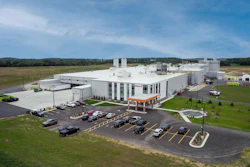
Construction on Kikkoman’s new plant in Jefferson, Wisconsin, began in April 2024, and production started in May of this year. The company recently held the facility’s official opening. It’s a plant we’ve been tracking for a while.
It’s Kikkoman’s third plant in the United States. The 240,000-square-foot facility sits on 100 acres, so there’s plenty of room for expansion. It’s a good-sized plant—not enormous—but the available property gives the company room to grow.
Kikkoman expects to expand because consumers throughout North and South America really like soy sauce. You have to keep those shrink sleeves coming.
I’m still working on getting inside the plant because it has some interesting features. Kikkoman wants to maintain the same recipe, quality, and consistency across all its operations. What works in Japan also has to work here in the United States.
That means the company shipped large fermentation vats from Japan to Wisconsin, possibly through the Great Lakes, to ensure that the soy sauce produced here has the same quality as the product made in Japan.
The plant began manufacturing in May, but it doesn’t expect to begin shipping until October because the soy sauce has to sit and ferment. I’m not a soy sauce aficionado, so I want to learn more about the exact production process.
People at Kikkoman, if you’re listening, please invite me. You can reach me at [email protected].
I want to get inside that plant, see how everything is done, and learn how long the process takes. Like coffee and some other products, there’s a traditional process that must be followed to get it exactly right.
Food manufacturing is often about speed: How quickly can we get a product out the door? If you want more product on the shelves, you have to speed up production. But some recipes and processes simply can’t be rushed.
Sean Riley: You definitely can’t rush fermentation.
Derrick Teal: Yes, thank you. That’s the word I was looking for.
Matt Reynolds: That’s also why we’re talking about it as a light-sensitive product. Light can affect the contents after the soy sauce has been bottled.
If and when you get into the plant, you’ll have to see what shrink-sleeve equipment or materials they’re using. There are several shrink-sleeve providers, and I’d be interested to know which solution appears on the Kikkoman packages.
Derrick Teal: Definitely. As I said, I’m still working on that story. The Kikkoman contacts I’ve been speaking with are also focused on future projects. They’re excited about the plant that just launched, but they’re already looking ahead to what comes next.
It’s interesting that so many companies focus on speed, yet some processes simply can’t be rushed. Sean, I don’t know if that sets you up to discuss some of the things you’ve been seeing.
Sean Riley: That’s a very interesting point, Derrick.
I also spent some time traveling this week. I wasn’t able to take the train because I was in Montreal for the PMMI Annual Meeting.
There was a lot of good information and, obviously, plenty of conversation about tariffs since we were in Canada. Everyone was nice to me even though I’m an American, which was good.
The point that stuck with me came from a CPG panel featuring representatives discussing what they’re seeing in the industry. A lot of PMMI data from Top to Top, Vision 2030, and other research still identifies speed as the top priority—the thing everybody wants most.
As soon as that information appeared on the screen, a representative from Old Dutch Foods’ Calgary facility said speed should be lower on the list, while changeover and flexibility should rank higher.
That points directly to what you were discussing, Derrick, with companies needing to accommodate many different products. Old Dutch Foods has something like 170 SKUs, so it needs to be able to switch among products efficiently. Speed isn’t the be-all and end-all.
I found it surprising that both CPG representatives pushed back against the focus on speed. But based on what you all said before we started recording, it sounds like you’ve been hearing the same thing across the industry. Is that true?
Matt Reynolds: For me, it’s SKU proliferation—and that’s difficult to say. Companies are dealing with multiple varieties, multipacks, and sizes ranging from one ounce to 12 ounces.
Whether the product is food, beverage, personal care, or something else, machines need to be flexible enough to handle huge ranges of formats and different run lengths.
I imagine flexibility is even more important for contract packagers. When they purchase a piece of equipment, they need it to remain functional in their facilities for 20 years, even if they only have a one-year contract to use it for a particular private-label customer.
Flexibility is the new speed.
Derrick Teal: Absolutely. In many of the plants I’ve visited, everything is about flexibility.
Liz, you’ll love this: Many of the meat companies I’ve visited use manual labor instead of machines because people can adapt more easily to different processes and cuts of meat based on customer requirements.
One plant I’m thinking of had a lot of open floor space. The company explained that it might need to rearrange the area when a new SKU or customer request comes in. It needs the ability to move machinery around and create an entirely new line.
I’ve seen that in multiple plants, not only meat-processing facilities. As Matt said, companies aren’t always producing long runs of one product. They’re dealing with different flavors and SKUs.
Matt Reynolds: They’re also dealing with different channels. A company may need one package for Amazon, another for physical retail, and another for direct-to-consumer sales. Each channel requires something slightly different from the same product.
Even if it is only one product, it might need to appear in 12 different packages or bottles. What you heard definitely resonates with what I’ve encountered.
Sean Riley: Interesting. So, flexibility and ease of changeover are increasingly important. If you’re constantly switching among products, you have to be able to change quickly and respond deftly.
As an old hand at this, I’m used to hearing “speed, speed, speed”—running the same product as quickly as possible. Those days seem to be in the past.
Derrick Teal: I think we’ve also talked about modular systems in a previous episode. You can have an entire system on casters, allowing you to move it to a different location, assemble different pieces, and begin running something new in hours instead of the days or months a major changeover might otherwise require.
Liz Cuneo: Yep. I apologize for my cat friend bumping into things. We’re all out of sorts here because we’re dog-sitting for my mom. It’s a full house, and everyone is acting a little crazy, as usual.
To close, I want to bring up the fun topic of drones.
We covered a Florida hospital network that is preparing to pilot the use of drones to deliver medications, laboratory samples, and other items to patients or affiliated facilities.
The company is called Zipline. I don’t know whether it manufactures the drones, but it’s the drone-delivery company involved in the project.
I explored what the program could mean for cold chain logistics. There’s an eight-pound limit for the entire package, so that restricts what the drones can carry. But they can still accommodate cold chain products with the proper temperature sensors, ice packs, and other components.
It’s interesting to consider where this technology could be heading. I can’t imagine waiting for a prescription and then seeing a drone land on my porch.
From a cold chain perspective, the service raises many questions. A package traveling by drone might be more exposed to outdoor conditions than something transported by truck or train.
One interesting point is that customers can select their delivery time, which isn’t always possible with today’s e-commerce shipments. Allowing patients to choose the delivery time helps ensure the package doesn’t sit on the porch any longer than necessary.
Derrick, you mentioned that you’ve seen Amazon drones—not from this particular company, but drones in general. I think they’re coming.
Derrick Teal: Yes. I was heading to a soccer game and watched one fly over the road and land in a neighborhood where some of my friends live. It didn’t drop the package from a distance. It landed right at the front step.
It’s interesting to see something like that flying overhead. It wasn’t a drone, but you know those Chinese lanterns? I almost shot one down with a mortar over the Fourth of July. That was fun.
Liz Cuneo: That’s very fun. I had to let you bring it up because it sounds like an international incident, which we don’t condone at all.
Derrick Teal: It was an accident.
Sean Riley: It’s interesting that when we talk about cold chain, we might now be talking about delivering it through the air with small drones. The drones are sizable, so I wouldn’t be surprised if they can carry dry ice or another cooling solution.
Liz Cuneo: Eight pounds is more capacity than I initially thought. When we talk about delivering someone’s prescription, the medicine generally won’t weigh eight pounds. The drones can carry more than I expected.
The Cleveland Clinic is also using drones to deliver medicines to patients’ homes. Right now, the program operates within a five-mile radius, so it has a limited scope. But it’s exciting to see more drone deliveries emerging.
I don’t know why I find healthcare and pharmaceutical drone delivery so surprising. It seems as if it would be more tightly regulated, but I suppose it isn’t that different from a truck dropping off a prescription. You just have to wrap your head around the idea of it flying through the air.
Derrick Teal: There might actually be fewer hands touching the package in that situation.
Liz Cuneo: That’s true. You’re eliminating the delivery driver. The package goes directly from the person loading it into the drone to the consumer.
Matt Reynolds: One thing I think about is how drone delivery will work in dense urban environments. There are tests underway in suburban Chicago, but I live in the city of Chicago. Drones could have trouble navigating around very tall buildings and through narrow corridors.
Those tall buildings may contain hundreds of residential units. The footprint of Liz’s house might accommodate one family and, apparently, a dog. That same footprint in Chicago could contain 20 families because it’s a 10-story building.
A drone would have very little room to land while potentially delivering packages to 20 families in one small area. That could lead to a proliferation of drones.
There are some interesting urban considerations. If it’s working in Florida, there may be more sprawling, open land than in some of these tight urban environments.
Liz Cuneo: For sure. The woman I spoke with from BayCare said traffic is particularly bad in that part of Florida. Drone delivery could help ensure that patients receive their medicines faster because the packages won’t be sitting in traffic.
The drone can bypass those delays. In inner cities with tall buildings, however, it may not be an ideal solution.
We’ll see what happens, but it’s exciting to hear about something unique and different happening in healthcare.
Derrick Teal: Different areas have different airspace considerations. The area where I live is pretty open, but you still can’t fly drones there because you have lunatics trying to shoot things down.
Matt Reynolds: Well, it takes one to know one, Derrick.
Thank you all for sharing what you’ve been working on, writing about, and seeing during your travels this week. And thank you to everyone at home for tuning in to another episode of End of the Line.