Schneider Electric and Siemens have integrated AI co-pilots directly into their PLC programming suites, allowing engineers to write production code by describing requirements in plain language instead of manual coding.
- AI Code Generation: Both vendors' co-pilots generate structured text and function blocks for PLCs based on natural language prompts, with automatic code commenting for easier understanding.
- Quality Assurance: Schneider Electric runs all generated code through a simulator and Intent Engine to eliminate errors before deployment, ensuring safe, maintainable code.
- Extended Capabilities: Siemens Industrial Co-Pilot also generates HMI screens, tests code on digital twins, and acts as a knowledge expert for service departments using machine manuals and documentation.
- Broader AI Vision: Both companies are expanding AI beyond engineering to include predictive maintenance, operations optimization, and root cause analysis across their industrial platforms.
- Availability: Siemens Industrial Co-Pilot for Engineering is available now through the Siemens Marketplace with additional licensing costs for advanced features.
Today, anyone can go to ChatGPT, Google’s Gemini, or any other AI chatbot and ask it to write PLC ladder logic. But at PACK EXPO International and the PMMI Annual Meeting, Schneider Electric and Siemens demonstrated generative AI capability built directly into their software suite for programming those vendors’ PLCs.
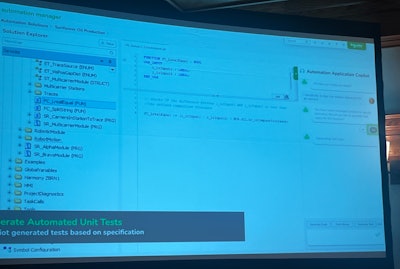
At the Annual Meeting, Schneider Electric’s John Partin demonstrated how one might go about interacting with the tool to write code for a liquid filling application for olive oil to prevent sloshing during the fill. The programmer can type into a chat box in plain language about encountering sloshing during the fill at a certain speed, and ask it to suggest code that would prevent the undesired behavior. The AI chatbot first asked clarifying questions about the application. After some simple back-and-forth, the AI generated structured text in a pasteboard area on the screen. (It also automatically comments the code for easier understanding.) From that staging area, one can simply copy and paste into the actual code tree on the same screen.
While Partin said that the AI tool is specifically trained on Schneider Electric’s entire library of code, he admitted that right now the tool is limited to the more basic machine handling and isn’t yet ready for advance control functions such as servo motion control or robotic control. But still, it has the potential to save hours of valuable electrical engineering time.
To take advantage of generative AI, Schneider Electric set up an AI team last year, and the company’s VP of AI strategy, Juergen Weichenberger, gave a demonstration of this functionality at PACK EXPO to a capacity crowd. Weichenberger said that they engineered the system so that the same code results from different prompts, eliminating variability, important for maintainability. Weichenberger did show a robotics example for a pharmaceutical application, but it was unclear whether that represented a new development vs. what Partin stated in September.
Weichenberger took questions, one of which was about whether the system mitigates the propagation of bad code. He explained that all code goes into a simulator first to flush out any unintended consequences. He also alluded to something called the Intent Engine, which checks the intent of the code that is generated by the system.
Currently Schneider Electric is utilizing Open AI for its underlying model, but Weichenberger admitted that it was costly and that the company was investigating other models, including small language models which are designed to run locally, bypassing the need to pay for cloud-based compute time. "It needs to run on the controller" said Weichenberger. "It can't run in a data center somewhere."
The new functionality was expected to launch after PACK EXPO but a detailed timeframe wasn't released.
 Siemens's AI co-pilot also allows for natural language conversation with the PLC programmer, and can create not only PLC code snippets but also HMI screens. It also has the ability to test the code.
Trinko also explained how Siemens Industrial Co-pilot can act as an internal knowledge expert for the service department. OEMs can load all of their machine manuals, documentation related to all of the components and subsystems into the system, which incorporates a large language model. Then, when a question is received from a customer about, say, a particular fault code on a particular machine, a service tech can type in the question using natural language, and the system will return an answer, sparing the tech of combing through those manuals and documents.
Finally, Trinko touched on the ability to automatically and seamlessly roll out code updates, bug fixes, even new HMI screens, to customers.
At PACK EXPO International, Siemens's Bernd Raithel, Director of Factory Automation, presented more details on Co-Pilot and on the company's AI strategy. Most of the presentation focused on Co-Pilot for engineering, where the user asks for functionality in plain language and the system outputs code for the PLC, as described in this article. Raithel said that PLC code can be created by copying process steps out of a static PDF process description document. PLC programmers still need to fill in the gaps, he said, but it's faster than starting from scratch and allows engineering departments to react more quickly to new requirements. Co-Pilot also works for programming and creating HMI screens.
Because the system is integrated into the company's platform, it allows users to interact with and ask questions of the company's documentation using chat, allowing users to get at the right answer more quickly.
Siemens Industrial Co-Pilot for Engineering is available for download now through the Siemens Marketplace. There is an extra cost associated with the functionality.
 At PACK EXPO Intl. 2024 in Chicago, Siemens demonstrated generative AI functionality built into its predictive maintenance tool, Senseye.
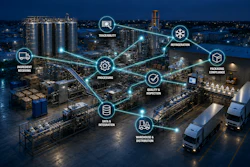
 At PACK EXPO Intl. 2024 in Chicago, Siemens demonstrated broader vision for bringing generative AI functionality to its suite of applications across the engineering value chain.
Editor's Note: Rockwell Automation also presented on its AI strategy both at PACK EXPO and at its Automation Fair in Boston at the end of November 2024. Packaging World's Matt Reynolds covered that here.