Sam Goldberg, chief operating officer at Econocorp Inc., is fairly certain he won’t ever hire a robot to build his machinery or fill a truly intuitive role. Even the most advanced robots will keep performing tasks that are, at best, monotonous and, at worst, the kind of dangerous or “dirty” work humans prefer to avoid. But when someone like Elon Musk floats the idea of mass-producing humanoids for consumers at roughly $30,000 by 2027, Goldberg can’t help but wonder how much more headroom there is for what robots can offer OEMs.
“You’re seeing a lot of today’s robot manufacturers look at what really differentiates their robots,” Goldberg said. “You’re starting to see people use robots in different ways than they traditionally have.”
As innovation accelerates and component standardization drives costs down, industry leaders see widening options for integrating robotics beyond traditional cells and end-of-line solutions. Artificial intelligence (AI)-guided vision, mobile capabilities, and software-driven systems are making robots more productive, safer, and more comprehensive.
AI adoption and other advancements
One prevailing concern about robotics has long been that the technology would erode the value of human workers. There’s growing evidence of a collective change in perspective as the industry struggles with lingering workforce shortage issues, particularly among skilled employees.
According to Dillon Sego, vice president of engineering and sales at CRG Automation, a shift in how today’s robots are being applied has been born out of those challenges.
“When robotics really kicked off, many people saw it as something that would take jobs away,” Sego said. “But we’re not seeing that. Most of our customers are struggling to fill the roles they already have open. Automation may reduce a position on paper, but in practice, it shifts people away from repetitive, non-value-added, and physically demanding work into more skilled, higher-value roles.”
 CRG Automation has implemented a Cognex vision system for quality control on a line that automates the packaging of a global consumer brand’s product.CRG Automation
“You can send in new SKUs that the robot hasn’t been taught, and it can dynamically adjust to pick and place that specific product,” Sego explained. “I’m teaching them what they need to do, and to some extent the robot is figuring out the most optimal path.”
At Econocorp, which has specialized in secondary packaging machinery since the 1960s, a recently earned FANUC-authorized system integrator status is opening new opportunities to design, build, and install custom robotic automation systems, Goldberg said.
“Traditionally, we would sell standalone equipment to an integrator that would take responsibility for the customer,” he said. “But more customers today don’t want to buy machines from an integrator. End users prefer that OEMs build sophisticated, complex equipment and handle all the work involved.”
As vision-guided robots become more robust, Goldberg expects engineered lighting to grow in importance, improving contrast and visibility while eliminating shadows that can interfere with object detection. He also thinks vision systems on robot applications will become the norm.
“We’ve learned that the conveyor color matters as well as the lighting color,” he said. “You’re looking to be on the opposite side of the color spectrum of what you’re picking up. That way, the vision system has the best shot of seeing the product as it comes through and being able to identify the correct orientation to be placed in.”
Expanding effective use cases
Although historically difficult to automate due to varying product types and small, inconsistent batch quantities, kitting has become one of the more intriguing examples of how robots are extending their reach, said Greg Berguig, president at PAC Machinery. PAC has partnered with MSD Sales to integrate its Rollbag automatic baggers with MSD’s KitAmatic system—a vision-guided solution that replaces manual, multi-part assembly. The KitAmatic combines a circular flexible feeder with a 6-axis robot that picks, inspects, and places disparate parts into bags.
“It’s a rotary table and a robotic arm that uses vision to pick the correct items and put them into a bag that it seals,” Berguig explained. “Where we see robotics really playing a bigger role is in our bagging lines—putting something into a bag, sealing that bag, and then labeling it. Most kitting applications can’t run for five minutes without a changeover, but robotic arms do a nice job when you have small batch runs and you’re changing kit counts frequently.”
Changeovers, he added, are an easy transition with this setup, which is built for accuracy rather than raw speed—a tradeoff he said is increasingly common as shipments become more specialized. Berguig also pointed to warehouse logistics and outbound mailing as areas worth investing in.
Another emerging area is e-commerce logistics and outbound shipping. With a robot and advanced vision, changeover is usually just software-based and extremely short, further improving the ROI,” he said.
Pairing robotic arms with automatic baggers has also been a strong way for customers to increase output while reducing labor costs, Berguig said. “They’re able to set up systems to run without operator intervention, which allows packaging to be done outside of regular shifts and increases output,” he said. While a robot may not bag as fast as a human, it reduces the error rate—and serves as a strong alternative to other feeding systems such as bowl feeders and weigh scales when packaging the same item repeatedly.
When it comes to cobots, Goldberg sees palletizing as the most rapidly expanding application because of their effectiveness at slower speeds.
“Cobots are not necessarily fast enough to do a lot of the industrial pick-and-place that you’d see at the front end of secondary or primary packaging operations,” he said. “On the palletizer, the cobot can move up to roughly 2,000 millimeters per second. It’s a great solution when trying to reduce labor dependency.”
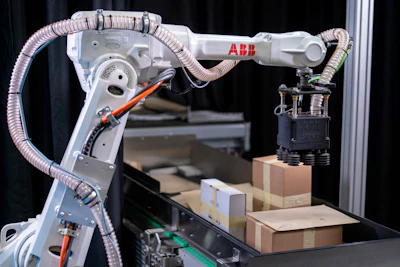
 ABB Robotics’ PoWa cobot lowers the barrier to automation for both SMEs and large enterprises.ABB
“The more advanced, forward-looking OEMs are embedding robotics directly into their standard machine offerings rather than treating them as bolt-ons,” he said. “Customers get a productized system from a single supplier with validated cycle times and unified controls. That turns what used to be a multi-vendor juggling exercise into a cohesive, repeatable product.”
Sense of safety and investment return
Despite the technological gains, Sego believes safety and operator training will remain significant challenges as the industrial robotics footprint grows.
“If you’re going to invest in robotics, you have to invest in your people to be able to maintain it,” he said. “I can build the best robot on the planet, but if your maintenance staff doesn’t know how to interface with it or recover when there are potential issues, it’s going to be a significant uphill battle.”
Robot suppliers, he added, owe end users a level of foolproof fail-safes.
“We’re always going to have to think about the staff member who’s never seen this before and walks onto the floor with no training,” he said. CRG’s case packers and other systems are being designed with that in mind.
“We chose a robotic solution because it’s more cost-effective and faster to deliver,” Sego said. “Designing a fully mechanical system takes significantly more time than mounting a robot, developing the end effector, and teaching the motion. End users can be trained to interact with the robot and resolve issues, rather than understand a custom one-off.
The technology itself is also progressing toward predictive action rather than This Fanuc robot features a CRG Automation-designed end-of-arm tool with a custom shroud that enables the picking of products with different sizes and weights.CRG Automation
“Without turning a wrench or picking up a screw, we can build an entire line, write all the program, and test it in real time on a single computer,” Fadool said. “The ability to do that at the machine builder level is just unmatched.”
Not the answer for everybody
That said, robotics won’t always deliver sufficient ROI, Perlson cautioned.
“Robotics is not a silver bullet for a broken or unstable process,” he said. “It tends to amplify whatever is already there, good or bad. If variability or poor upstream control exists, automation will highlight them quickly. Customers also often underestimate the operational readiness required. This is where strong OEMs differentiate themselves — by challenging assumptions early, aligning on realistic operating conditions, and preventing projects from slipping during execution.”
Going forward, Berguig anticipates that OEMs will need to encourage customers to pilot advancing robotic systems as machines evolve quickly.
“You’re not going to get anywhere without that,” he said. “If you’re not piloting these types of systems, you’re going to be very far behind. You’re not going to have any sense of what works well, what doesn’t, or what you need to do as an organization to understand this technology.”