Food and beverage processors are moving away from single-refrigerant solutions toward application-specific cooling strategies, combining ammonia for large-scale efficiency, CO₂ for sustainability, and nitrogen for rapid freezing where speed is critical. Rather than one technology replacing another, modern facilities use a portfolio approach that integrates refrigeration with overall process design to optimize throughput, energy efficiency, and product quality.
- Ammonia remains the benchmark for whole-facility refrigeration in high-throughput environments like meat processing and seafood operations due to superior thermodynamic efficiency and reliability.
- CO₂ systems have gained significant traction in new construction projects, offering negligible global warming potential and reduced regulatory burden, though they require higher operating pressures and are less efficient than ammonia.
- Nitrogen-based freezing provides ultra-rapid cooling at specific process points (boiling point of -320°F) without replacing plant-wide refrigeration, making it ideal for delicate or high-value products.
- Modern food processors are adopting a portfolio approach, combining multiple refrigeration technologies to optimize different stages of production rather than relying on a single system.
- Refrigeration design is shifting from temperature-focused to process-integrated, requiring tight coordination between freezing systems and upstream operations to prevent bottlenecks and ensure product consistency.
Pressure to improve efficiency, meet sustainability targets, and handle increasingly complex production demands is mounting. Rising to the occasion are refrigeration and freezing systems, which are undergoing a quiet but significant evolution. What was once considered a background utility is now central to plant design, product quality, and overall operational performance. From traditional ammonia systems to rapidly advancing CO₂ architectures and emerging nitrogen-based freezing technologies, processors today have more options than ever. Rather than a clear winner, however, the trend is toward application-specific solutions.
“CO₂ is another tool in the toolbox,” says Bob Almon, President of Innovative Refrigeration Systems. “The technology has evolved significantly, and it’s now viable for a wide range of industrial applications—from processing to cold storage.”
At the same time, processors operating at massive scale are increasingly focused on how refrigeration integrates into production itself. “Freezing cannot be treated as a standalone step,” says Andrii Kalinichenko, Platefreezer Lead at Silver Bay Seafoods, who works with high-volume seafood freezing operations in Alaska. “It has to be tightly integrated with upstream processing lines so the freezing step does not become a bottleneck during peak production.” That perspective reflects a broader industry shift: Refrigeration is no longer just about maintaining temperature, it’s a core part of process engineering and throughput optimization.
Ammonia: the benchmark for whole-facility refrigeration
Ammonia has been the dominant refrigerant in industrial food processing for decades, and it continues to set the benchmark for large-scale, whole-facility refrigeration. Its staying power comes down to a combination of thermodynamic efficiency, scalability, and familiarity among engineers and operators. Particularly in facilities with high refrigeration loads—such as meat processing plants, dairy operations, seafood processors, and large cold-storage warehouses—ammonia systems offer unmatched performance when designed and maintained properly.
“Some companies will always prefer ammonia. It’s highly efficient and familiar,” says Almon. That familiarity is not insignificant. Many processors have decades of experience operating ammonia systems, along with established safety protocols and trained personnel. As a result, ammonia continues to dominate in applications where energy efficiency and reliability are paramount.
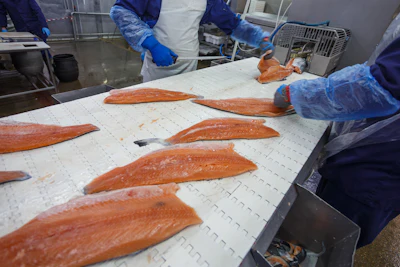
In high-throughput environments, the advantages of ammonia become even more pronounced. Kalinichenko emphasizes that in seafood processing, for example, the refrigeration system must respond immediately to incoming product. “From the moment the fish is landed, temperature control becomes the priority,” he says. “The goal is to reduce product temperature as quickly as possible to preserve texture, color, and overall quality. In seasonal seafood operations, that also means designing the freezing process around sudden peaks in volume rather than around average daily load.” This rapid pull-down requirement aligns well with ammonia’s ability to deliver consistent, high-capacity cooling across large systems.
Beyond freezing, ammonia systems also support the broader facility ecosystem. Refrigeration is deeply embedded in every stage of the process, from initial intake to storage and distribution. “Cold storage, staging, and transport all depend on stable, controlled temperatures,” Kalinichenko explains. “Even small deviations can impact final product quality, especially when the product moves through several temperature-controlled zones before distribution.” In this context, ammonia’s ability to provide centralized, plant-wide cooling becomes a major advantage, ensuring uniform conditions across multiple zones and processes.
Despite these strengths, ammonia systems come with challenges that influence their adoption. Because ammonia is classified as a hazardous substance, facilities must comply with strict regulatory requirements, including Process Safety Management (PSM) and Risk Management Plans (RMP). These requirements add complexity in both system design and day-to-day operations, often necessitating specialized personnel and robust safety infrastructure. “Some companies avoid ammonia due to perceived risk or lack of in-house expertise,” Almon notes. Even so, for large-scale processors that can manage these requirements, ammonia remains the gold standard for efficiency and performance.
CO₂: a natural refrigerant gains ground
While ammonia continues to anchor many facilities, carbon dioxide (CO₂) refrigeration systems have gained significant traction in recent years, particularly in new construction projects. Advances in system design and equipment capabilities have enabled CO₂ to move beyond niche applications and into full-scale, facility-wide refrigeration.
“For us, it’s system-wide,” says Almon. “We use CO₂ as the primary refrigerant for the entire facility—typically a transcritical CO₂ system.” These systems are designed to handle the full range of refrigeration needs within a plant, from processing areas to cold storage, making them a viable alternative to ammonia in many cases.
Several factors are driving this shift. Regulatory pressure on synthetic refrigerants has pushed companies to consider natural alternatives, while corporate sustainability goals are encouraging the adoption of low global warming potential (GWP) solutions. “We’ve seen significant adoption over the past three to five years,” Almon says, noting that even as regulatory timelines evolve, companies are planning ahead. CO₂, with its negligible GWP and non-synthetic nature, aligns well with these long-term strategies.
Technological improvements have also played a key role. “Equipment has improved significantly—larger compressors, valves, and gas coolers—making large-scale industrial CO₂ systems viable,” Almon explains. These advancements have addressed earlier limitations, allowing CO₂ systems to operate efficiently at the scale required by modern food processing facilities.
CO₂ offers particular advantages in low-temperature applications. “It performs very well at -20°F to -60°F,” says Almon, making it especially well-suited for blast freezing and cold storage. Additionally, CO₂ systems operate at positive pressure in these ranges, which can improve system stability compared to ammonia systems that may operate under vacuum conditions.
However, the adoption of CO₂ is not without tradeoffs. The systems operate at significantly higher pressures, requiring more robust piping, components, and overall design considerations. Retrofitting existing facilities is typically not practical. “You’d need to rebuild the system from the ground up,” Almon says. As a result, CO₂ is most commonly implemented in new builds.
Energy efficiency is another consideration. “CO₂ is slightly less efficient than ammonia,” Almon notes, though the difference may be offset by other benefits such as reduced regulatory burden and simpler safety requirements.
That reduced complexity is a key advantage. CO₂ systems do not carry the same regulatory requirements as ammonia, making them more accessible for facilities without specialized expertise. “CO₂ offers a safer alternative that’s energy efficient and comparable to traditional freon systems,” Almon says. For many processors, that balance of performance, sustainability, and reduced risk is driving increased adoption.
Nitrogen-based freezing: speed at the point of process
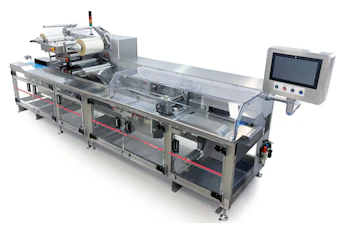
While ammonia and CO₂ systems are designed to cool entire facilities, nitrogen-based technologies such as Messer’s KwikChiller serve a fundamentally different role. These systems are not intended to replace plant-wide refrigeration but instead provide targeted, high-speed cooling at specific points in the process.
"Bakers and processors have long sought a reliable way to maintain product quality while scaling up their operations," says Don Smiley, Director of Food and Beverage at Messer. "With the continuous operational design and a compact footprint of the KwikChiller, processors can now rapidly cool or freeze delicate or texture-sensitive products while simultaneously boosting throughput."
 Messer's KwikChiller allows processors to rapidly cool or freeze delicate or texture-sensitive products while simultaneously boosting throughput.Messer
That capability makes nitrogen particularly valuable in applications where speed is essential. With a boiling point of approximately -320°F, liquid nitrogen enables ultra-fast freezing, which can help preserve product structure, reduce ice crystal formation, and maintain overall quality. This is especially useful for high-value or delicate products, as well as processes like crust freezing or individually quick frozen (IQF) production.
In high-throughput environments, nitrogen systems can also help address process bottlenecks. Kalinichenko notes that achieving both speed and consistency is a constant challenge. “The challenge is balancing speed with consistency at high throughput,” he says. While nitrogen excels at rapid cooling, it must be carefully integrated into the broader process to ensure uniform results. “Rapid freezing alone is not enough; the process has to be controlled so that product freezes consistently across batches and does not create quality variation.”
Because nitrogen systems do not require the same level of infrastructure as traditional refrigeration systems, they offer a high degree of flexibility. They can be deployed in targeted areas, integrated into existing lines, and used to enhance specific process steps without major facility modifications. This makes them an attractive option for processors looking to improve performance without committing to a full system overhaul.
However, this flexibility comes with tradeoffs. Because nitrogen is consumed rather than recirculated, operating costs can be higher over time compared to closed-loop systems. As a result, nitrogen-based freezing is typically used as a complementary technology rather than a primary refrigeration solution. It fills a specific role within the process, particularly where speed and responsiveness are critical.
Designing around process, not just temperature
Across ammonia, CO₂, and nitrogen systems, a common theme is emerging: Refrigeration is increasingly being designed around process flow and throughput rather than temperature alone. This shift reflects the growing complexity of modern food processing where everything is tightly connected.
“You can’t treat freezing as a separate step,” Kalinichenko reiterates. “It has to be synchronized with upstream processing.” This integration becomes especially important in industries with significant variability, such as seafood processing, where seasonal peaks can dramatically increase production volumes. “During peak season, volumes increase dramatically,” he says. “Systems must be able to scale up without sacrificing performance. For plate freezing operations, that means coordinating freezing capacity, labor, product flow, and storage availability as one connected system.”
Meeting these demands requires a combination of system design, redundancy, and real-time monitoring. It also requires the careful management of tradeoffs. “There is always a balance between speed, energy use, and product quality,” Kalinichenko explains. “If that balance is wrong, the facility can lose capacity during the busiest production windows or create inconsistency in the finished product.” Faster freezing can improve quality, but it may require greater energy input or system capacity, while efficiency measures must be weighed against performance requirements.
A portfolio approach to refrigeration
No single technology can address every need. That’s why facilities are increasingly adopting a portfolio approach, combining multiple systems to optimize performance across different parts of the process. Ammonia may provide the backbone for large-scale cooling, CO₂ may offer a sustainable alternative for new builds, and nitrogen may deliver targeted performance improvements where speed is critical.
Looking ahead, refrigeration systems will continue to evolve alongside broader industry trends, including decarbonization, automation, and increasing demand for throughput and flexibility. While the technologies themselves may differ, the goal remains the same: to deliver consistent, efficient, and reliable temperature control in an increasingly demanding production environment.
In that sense, the future of refrigeration is not about replacing one system with another. “The story isn’t about one system being better,” says Almon. “It’s about what works best for the application.”