Food manufacturers must engineer flexibility directly into processing systems through disciplined design, modular thinking, and clear operational rules rather than treating it as a downstream packaging problem. True adaptability emerges from process design, sanitation strategy, and infrastructure that enable frequent changeovers while maintaining food safety and workforce stability.
- Flexibility in food processing must be designed upstream in tanks, pipes, valves, and sanitation systems, not just in packaging formats
- Product sequencing rules and clear allergen-based cleaning triggers reduce cross-contamination risk and eliminate operator guesswork under time pressure
- Extreme flexibility without reliable execution creates fragility and cascading failures—modular systems with clear boundaries outperform over-engineered designs
- Well-designed flexible systems reduce cognitive load for operators and sanitation teams through standardized patterns, repeatable building blocks, and consistent rules
- Adaptable plants feel calm because change is engineered as a controlled, predictable exercise rather than an operational emergency or workforce stressor
(Other articles in The Adaptable Plant Series: Part 1, Part 3, Part 4, Part 5)
Food and beverage manufacturers are operating in an environment that rewards speed, variety, and responsiveness, often with processing systems that were never designed for constant change. Product portfolios continue to expand, run lengths are shrinking, allergen profiles are multiplying, and many plants are being asked to adapt faster than their equipment, infrastructure, and operating models comfortably allow.
In this environment, flexibility is no longer a “nice to have.” It has become a core requirement for protecting food safety, maintaining throughput, and supporting the people responsible for running the process day to day. Yet too often, flexibility is treated as a downstream problem, something to be solved with packaging formats or scheduling workarounds rather than a system-wide design challenge that starts deep inside the process itself.
What does it really mean to design for change in food and beverage processing? Drawing on real-world examples, we’ll look at how disciplined process design, sanitation strategy, and modular thinking can enable frequent changeovers without sacrificing stability. We’ll also examine where the pursuit of extreme flexibility can backfire, and why the most adaptable systems are often those that place clear boundaries around complexity.
The goal is not to build plants that can do everything. It’s to build plants that can change confidently, safely, and repeatedly, with both product and people at the center of the design.
The myth of the “stable recipe”
 Dr. Bryan Griffen is the President of Griffen Executive Solutions LLC. He was previously Senior Director of Industry Services for PMMI: The Association for Packaging and Processing Technologies, and he held a number of roles for Nestlé during his many years there.Griffen Executive Solutions
That assumption no longer holds.
Today’s processing environments are defined by volatility. Premium products drive short runs. Consumer preferences shift faster than capital cycles. Regulatory scrutiny continues to rise. In many plants, the primary challenge is no longer how fast the line can run, but how often the process can change safely and predictably.
Much of the industry’s conversation around flexibility has focused on packaging. While important, that focus can miss where the real complexity lives. In food and beverage operations, adaptability is constrained upstream in tanks, pipes, valves, fillers, and sanitation systems. It shows up in color carryover, fat and protein residues, particulates, and allergens. If change is now a permanent operating condition, adaptability must be designed directly into the process itself.
Redefining “good engineering” in processing environments
None of this means that traditional definitions of good process engineering no longer matter. Throughput, yield, uptime, and waste still matter. What they often fail to capture, however, is change friction.
In processing plants, friction appears when transitions are slow, risky, or disruptive. It shows up when sanitation becomes a bottleneck, when operators debate whether a partial clean is acceptable, or when schedules unravel because a changeover took longer than expected. These moments are not just operational challenges—they are food safety risks and workforce stressors.
In this environment, flexibility becomes a systems property rather than an equipment feature. It emerges from the interaction of process design, sanitation philosophy, utilities, and scheduling discipline. Plants that struggle often try to manage change operationally. Plants that succeed tend to engineer clarity into the system itself.
A premium ice cream facility in Europe provides a clear example.
Designing for change in the process itself
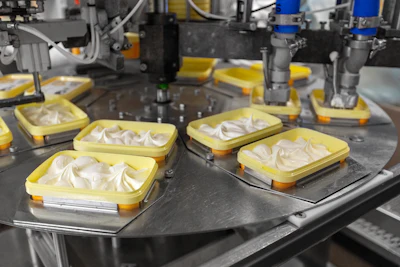
This facility produced single-serve ice cream tubs for a premium brand. Volumes were modest, margins were high, and variety was a defining characteristic. The plant ran approximately 17 flavors with plans to expand beyond thirty. Many of these products introduced real complexity, including nuts, dairy and non-dairy bases, alcohol-based inclusions, and highly visible color differences.
Run sizes were intentionally small, and the plant often changed over two or three times per shift. The primary challenge was not speed. It was managing cross-contamination risk while keeping the system predictable for operators and sanitation teams.
One of the most effective design decisions involved product sequencing. The team recognized that not all transitions carried the same risk. Running vanilla after chocolate, for example, created immediate color contamination issues that required a full washdown. Running in the opposite direction posed no such concern. Similar logic applied to fruit flavors, caramel, and inclusions.
Sequencing rules became a formal part of the operating model rather than an informal scheduling practice. True allergens, such as nuts, triggered a complete clean-in-place (CIP) cycle, regardless of color or formulation. These decisions were engineered into the process, not left to operator judgment under time pressure.
The CIP systems serving this bank of lines were centralized, with multiple centralized systems supporting different areas of the factory. Rather than trying to eliminate cleaning, the design focused on making it clear when cleaning was unavoidable and minimizing unnecessary cleaning elsewhere. Operators understood the rules, sanitation teams trusted the system, and flexibility emerged through disciplined design rather than heroics.
When flexibility becomes fragility
Not every attempt at flexibility produces these results.
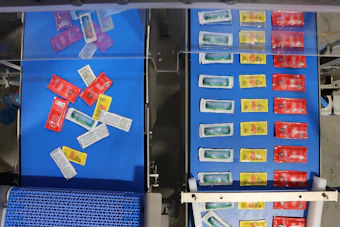
In another project, I worked on a high-speed powdered beverage system designed to run more than 2,000 single-serve pouches per minute. The system was intended to handle single, dual, or four-flavor configurations, with or without inclusions. Downstream packaging was designed to support nearly 40 different carton sizes.
On paper, the system was remarkably flexible. In practice, it was unstable.
Even minor inconsistencies became catastrophic very quickly at those speeds. A small feed issue or timing deviation cascaded into massive waste. By the time an operator could react, the system was already producing unusable product at an alarming rate. Even a brief interruption meant operators were literally standing knee-deep in ruined product and packaging before the line came to a stop. There was simply no way to synchronize that many variables reliably.
Simplification was the solution. The system was reduced to running one product at a time, with or without inclusions, and limited to three common carton sizes. Once the complexity was stripped away, performance stabilized. The line ran consistently, recovered quickly, and could be operated with confidence.
The lesson was unmistakable: Flexibility that cannot be executed reliably is not flexibility—it’s risk disguised as capability.
Modular thinking in processing environments
This distinction highlights the importance of modular thinking in processing environments. Many of the most effective modular strategies live upstream, not in packaging.
Modular processing design shows up in standardized process skids, repeatable valve clusters, clearly defined CIP circuits aligned with allergen zones, and utility distribution systems with clear isolation points. Infrastructure matters as well. Hygienic flooring, proper drainage, and well-designed washdown access directly affect how confidently a plant can adapt to frequent sanitation cycles.
The goal is not to enable every conceivable future configuration, it’s to create repeatable building blocks that behave predictably when recombined. When systems are consistent, change becomes a controlled exercise rather than an operational gamble.
Designing systems that support people and the future
Well-designed flexible systems reduce cognitive load rather than increase it. Operators understand which transitions require full cleaning and which do not. Sanitation teams know what “clean” means in each context. Maintenance teams see consistent patterns rather than one-off solutions.
This clarity accelerates training, reduces stress, and improves decision-making under pressure. It also positions plants to adapt to products that have not yet been imagined. Engineering for uncertainty does not require infinite optionality. It requires platform thinking, clear rules, and respect for how people actually work.
The most adaptable plants are not those with the most features. They are the ones with the simplest patterns, the clearest boundaries, and the strongest alignment between design and execution.
The adaptable process is a calm process
Truly adaptable processing plants feel different. Change happens often, but it doesn’t feel disruptive.
That calm is the result of deliberate design choices that respect product behavior, sanitation realities, and human limitations. In food and beverage processing, flexibility isn’t about speed or optionality, it’s about protecting consumers, supporting the workforce, and allowing the plant to evolve without tearing itself apart.
When adaptability is engineered into the process, change stops being an emergency. Instead, it becomes part of how the plant operates, learns, and grows.