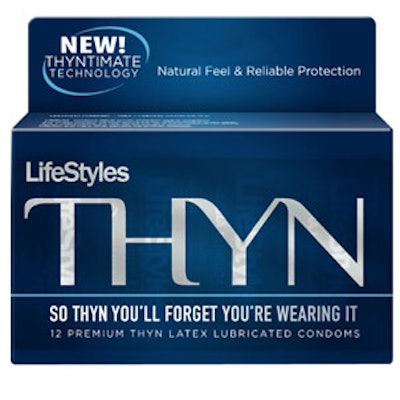
Printed chipboard boxes represent the typical outer package for condoms. But Red Bank, NJ-based Ansell Healthcare Ltd., introduced its LifeStyles THYN condoms in May in what the company considers a state-of-the-art transparent box that allows consumers to see the foil pouch inside that carries the non-latex, polyisoprene condoms, said to be 21% thinner than standard latex LifeStyles condoms.
The recyclable amorphous polyethylene terephthalate (APET) box is supplied by Pharma Packaging Solutions, a division of Carton Service, Inc. Ansell reports that the supplier uses a unique four-color digital printing process to print the cartons, saying the process can print plastic and various paperboard at production speeds on stock as thick as 24-pt. The inner foil pouch is sourced from Thailand.
“The plastic box is a significant change in the condom category,” says Carol Carrozza, vp of marketing for LifeStyles Condoms. “Most condoms are packaged into chipboard cartons, so this box allows our graphics to display the foils inside, inspiring a ‘sheer’ imagery and suggesting the thinness of the product itself. In consumer testing, category users thought the packaging was contemporary and relevant to their lifestyle,” she says.
Packaging is done at Ansell’s plant in Dothan, AL, using an Oystar Jones cartoning machine. “It’s done with some modification to accommodate the tuck-flaps. In the future, the box will be modified to include glued flaps,” Carrozza adds, “Ansell has found ways to improve efficiencies in the packing operation.” Ansell designs, develops, and manufactures hand and arm protection solutions, clothing, and condoms.
“The change to the plastic box was made as a means to better communicate to potential purchasers the benefit of a thin, sheer product,” notes Carrozza. “This plastic connotes sheer and thin by virtue of its transparency. It is also a sustainable package in that it’s recyclable.” She admits, “The plastic box is more expensive, but it is expected the costs will come down as volumes grow and efficiencies in purchasing and packaging are realized.”