Modern robots powered by AI and autonomous systems are becoming more intelligent and flexible, but manufacturers must develop stronger integration strategies, training, and digital infrastructure to successfully deploy them in real-world production environments.
- Autonomous Versatile Robots (AVR) can plan, adapt, and execute diverse tasks in real time without pre-programming, enabling automation in non-deterministic environments
- Advanced mobile robots (AMRs) provide dynamic mapping, traceability, and hygienic capabilities critical for life sciences and healthcare packaging operations
- Unified Robot Control (URC) technology eliminates dedicated controllers and enables faster integration through digital twins and virtual simulation before physical installation
- AI-powered vision systems support label verification, defect detection, and intelligent material movement while improving line clearance and product traceability
- Industry success requires collaboration between developers and manufacturers to manage integration, optimization, training, and digital infrastructure for reliable operational outcomes
Mike Wilson still remembers reading Isaac Asimov’s robot book series as a young boy and thinking that those humanoid-type machines were the ultimate embodiment of what robotics could become. The stories also cultivated his fascination in their conceptualization and fit among humans, a development that has essentially been brought full circle with how they're advancing and becoming more ingrained industrially since being introduced by the automotive industry in the early 1960s. He says it’s of no real surprise that robots have grown into an increasingly more omnipresent status, including within healthcare packaging, as organizations seek better methods of efficiency and versatility.
“Given all of the issues that we have in the world today, we need our manufacturing to be much more resilient,” says Wilson, chief automation officer at the Manufacturing Technology Center, an organization that seeks to bridge academia and industry by fostering innovation, collaboration, training, and education. “We have the capability now to have smaller batches, lower volumes, and more flexible solutions using robot-based systems that enable more customization. We can then produce systems that can accommodate a greater range of product or more frequent changes in the products they're processing.”
But it will remain important among those designing the machines and those ultimately utilizing robots to manage integration and optimization reliably if operational intent will successfully produce optimal outcomes.
Those on the development side appear to be up to the task of building robots that can function in ways that are more collaborative with their human counterparts while enhancing performance in workspaces that are constantly adapting to industry changes. “What we're doing is trying to change automation from being just mechanical and operating in a silo to a more intelligent orchestration of smart systems that are capable and equipped to handle dynamic and inconsistent environments, which is how we see these systems providing the most value,” says Ben Perlson, segment manager of consumer industries at ABB Robotics, a supplier that specializes in artificial intelligence (AI)-powered robots, cobots, and autonomous mobile robots (AMRs). “We're not just talking about better robots when we talk about selling robots and putting robots in manufacturing and packaging environments. It's looking at how to manage a smart environment or entire workstream, rather than just a step of it.”
As robots become enabled by smart systems, Perlson and others throughout the industry expect more autonomous, versatile machines to replace fixed, deterministic automation, with robots displaying more flexibility and adaptability to accommodate changing regulatory requirements, product specifications, and other nuances.
Advancing With Autonomous Versatile & Mobile Robots
Perlson says ABB has created a platform called Autonomous Versatile Robotics (AVR™), where robots move beyond fixed, pre-programmed automation and instead plan, adapt, and execute a variety of tasks autonomously in real time. At ABB, Perlson says he and his colleagues see AVR as a key lever to closing one of the last automation gaps that challenge industry today—logistical variability and the overall “randomness” that comes with managing specialized product offerings, SKU variability, and anti-counterfeit measures. With AVR, mobile robots can more seamlessly switch between assignments in real time without human intervention and can perform a diverse range of tasks autonomously by following instructions and having the ability to plan and independently perform tasks. They can also be integrated into existing workflows through the assistance of generative AI. “The idea of AVRs enables automation in non-deterministic environments,” says Perlson. “The AVR sits between the robotic hardware, the vision software, and whatever warehouse management system or packaging enterprise software that our customers are using to make sure these systems are dynamic, flexible, and resilient.”
 OTTO is designed for material handling and transporting stacked items, lifting pallets, and towing carts.Rockwell Automation
From the life science perspective, Perlson says the needs can be similar to other packaging environments related to such things as SKU mixes and process changes that bring high demand for throughput and efficiency. “But some of the key differences are around traceability, cleanliness, and hygienic ability."
At Rockwell Automation, a company that’s reportedly the largest organization in the world that develops industrial automation and digital transformation technologies, the majority of life sciences AMRs are being deployed in warehouses for the transporting of finished goods for medical devices. “They are usually bringing materials to and from people, or to and from racks, or connecting islands of automation within the manufacturing process,” says Vivian Huynh, global industry technical consultant.
Among the company’s AMR portfolio is the OTTO, which is designed for material handling and transporting stacked items, lifting pallets, and towing carts. “They’re also able to understand and do dynamic mapping of locations and continuously updating if something changes within the environment and be able to live alongside humans in that space,” says Huynh. “We're seeing technology that enables autonomy and an understanding of the facility landscape, such as the aisle width, flooring, and lighting conditions while being integrated into existing automation systems, manufacturing execution systems, and enterprise resource planning.”
As life sciences moves more to modular design and packaging that function through flexible open spaces and individually interchangeable modalities for labeling and other tasks without replacing entire lines, Huynh says Rockwell’s “plug and produce” solutions leverage AMRs and other robots to create harmonized automation that integrates modular into plant-wide production. “Plug and produce adapts the module-type package standard to allow faster integration and changeover based on open standards for integration,” she says. “We're seeing the desire to have the flexible ballroom facility design concept and having space that is dynamic to the changes of the facility and that’s able to change the production line to meet demand. It's a space that's changing in these concepts and AMRs are fitting into that space.”
Vision Guidance & Robotic Control
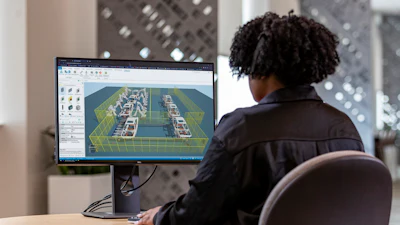
The evolution of automated packaging robotics at Rockwell is also present in the expanding deployment of machines that feature unified robot control (URC), a transformative technology that removes the need for a dedicated robot controller and software by incorporating motion sensors to help directly control robots as part of a platform that configures, programs, and deploys AMRs. The company’s Emulate3D tool is a key component of URC digital twin and virtual simulation software that is used to design, simulate, and virtually commission robot cells before they are physically installed for opportunities to test designs of automated systems offline earlier in the project lifecycle. The technology is commonly employed to simulate and validate vision-guided robotic systems.
 Developers can simulate robots in digital twins and generate synthetic data to train their physical AI models, enabling the deployment of AI-driven robotics for various workflows. ABB
A recently announced partnership between ABB and NVIDIA, a full-stack computing infrastructure company based in Santa Clara, CA, is also expected to help accentuate the presence of enhanced robotics control while scaling industrial-grade physical AI through an integration of ABB’s RobotStudio® suite and NVIDIA’s Omniverse libraries to help manufacturers deploy physical AI in real-world robotics applications.
The collaboration will reportedly focus on combining RobotStudio with the physically accurate simulation power of Omniverse to close a long-standing “sim-to-real” gap. Developers can simulate robots in digital twins and generate synthetic data to train their physical AI models, enabling the deployment of AI-driven robotics for various workflows. The resulting RobotStudio HyperReality will provide physically accurate simulations and foundation models that are optimized with real-world data feedback to improve the system ongoing. Models can then be used with ABB robots for better reliability and accuracy. “We're able to model, emulate, and predict how robots are going to perform in dynamic or complex environments in a far more accurate and robust manner than any automation company has been able to do previously,” says Perlson.
Impact of Vision Systems & AI
The push toward more intelligent automation solutions for med-tech and the life sciences is also what is currently driving product identity from a packaging process-level standpoint at Benchmark Electronics, a global provider of electronic manufacturing services and original design manufacturing services based in Tempe, AZ, says Justin Blair, global automation manager. “The impact for vision guidance inspection, intelligent material movement, and digital traceability are playing critical roles,” he says. “From an automation standpoint, packaging and vision inspection systems are two areas where we've really progressed over the last year. And those are the variables that tie into which systems we're automating and which packaging solutions make more sense.”
The AI-supported systems assist with label verification, defect detection, and line clearance. “These camera systems and traceability solutions observe what the environment is putting out from a data standpoint and what the cameras are translating from the environment of how the robots are interacting with products and parts. The goal is that by speeding up how easily we can upgrade, change, modify, and expand to the workstream, the more we will help customers to further expand their automation.”