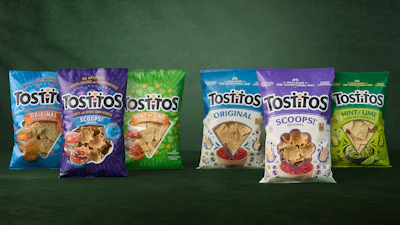
Tostitos redesigned its packaging to emphasize transparency, whole grain ingredients, and craft positioning in response to consumer demand for ingredient visibility and quality.
- Consumer demand: 76% of consumers want more product information, and 71% are reading labels more closely than before
- Key claims: New packaging highlights no artificial colors, flavors, or preservatives, whole corn kernels, gluten-free, and whole grain
- Design approach: Cream-colored background anchors unflavored products while vibrant colors differentiate flavored offerings for instant shelf recognition
- Print technology: Hybrid flexographic and rotogravure processes with expanded-gamut printing and matte overprint varnish create earthy, craft aesthetic
- Operational efficiency: Redesign retained existing bag format and equipment, requiring only minor dieline adjustments to avoid production disruption
PepsiCo’s Tostitos brand rolled out a packaging redesign that it says is aimed at aligning with consumer demand for transparency, ingredient visibility, and “craft” positioning.
The updated design will include claims of no artificial colors, flavors or preservatives, made from whole corn kernels, gluten-free, and whole grain.
While the update is largely graphical rather than structural, it required coordinated changes in print processes, film structures, and supplier networks
Consumer insights drive design shift
Consumer expectations around food shifting with an increased demand for transparency. According to a GS1 Survey, 76% of consumers want more product information and 71% are reading labels more closely than before.
“They are more interested in where their food comes from, cooking traditions, and gathering around the table, and they are looking for quality ingredients, authentic preparation, and foods that bring people together,” a PepsiCo Foods representative says.
According to the company, the refreshed design also provides shelf differentiation for the Tostitos brand. The packaging relies on a cream-colored background that helps create a more coherent brand architecture. Products are easy to differentiate but visually unified across the Tostitos portfolio, a PepsiCo Foods representative says.
“The cream background anchors the core, unflavored line, while vibrant color comes in for the flavored offerings,” a PepsiCo Foods representative says. “This not only provides on shelf-contrast but also helps consumers to instantly know what it is they’re looking at.”
Print technologies enable new look
The updated Tostitos packaging relies on a hybrid print approach combining flexographic and rotogravure processes to deliver both reverse and surface effects. Expanded-gamut printing enables richer, more consistent color reproduction across SKUs, supporting the brand’s ingredient-forward visuals.
The redesign also introduced a specialized print-layer base film to support printing on both sides of the structure.
To reinforce a more natural, “craft” aesthetic, the structure incorporates a matte overprint varnish, reducing gloss while maintaining graphic vibrancy.
“We had to carefully consider how to achieve the more earthy, ingredient-forward look while maintaining the vibrant spirit consumers look for in Tostitos,” the representative says. “The team implemented a matte overprint varnish process, and our close collaboration with packaging converters ensured consistent matte levels and visual quality across production.”
Achieving this look required new plates and cylinders, along with collaboration between PepsiCo and its converters to ensure consistency at production speeds, according to the company.
Minimal disruption to operations
The redesign avoided major operational disruption. PepsiCo retained its existing bag format and form/fill/seal equipment, limiting changes to minor dieline adjustments to support sealing integrity.
The company says that cross-functional teams validated machinability and sealing performance to ensure the new materials ran efficiently on current lines. No modifications were required for coding or inspection systems, which helps maintain throughput and minimize risk during rollout.
A PepsiCo Foods representative says collaboration with suppliers was also crucial to commercializing the new design on an accelerated timeline. Additional suppliers across base film, metallization and converting were onboarded to support the rollout. PepsiCo declined to name specific suppliers.
“This redesign is deeply rooted in PepsiCo Foods’s commitment to focus on what consumers really care about,” the representative says. “This isn’t just about changing colors, it’s about honoring the growing desire for products that are transparent, more intentional and more aligned with personal values.”