This content was written and submitted by the supplier. It has only been modified to comply with this publication’s space and style.
Automating food rolling presents a particular challenge: different products require different processing conditions. Sliced meats, bacon, cheese and sausages differ in shape, thickness and consistency, while factors such as product temperature can significantly influence their behavior during rolling.
Defining the appropriate processing recipe for each product and application is therefore essential to produce consistent rolls at high speed while minimizing product damage and waste.
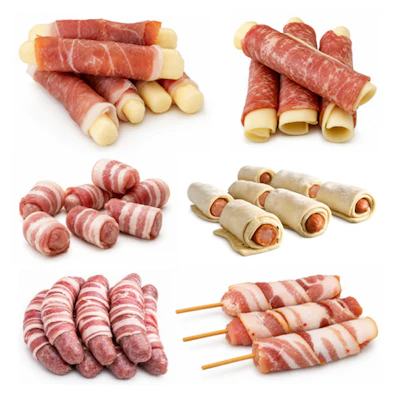
Rolled food products also cover a wide range of combinations and formats, from panino rolls and meat-and-cheese rolls to Mediterranean rollitos, bacon-wrapped sausages and skewers, and pigs in blankets.
ELCAT Food Technology designs flexible automatic rolling systems that can be configured around these different products and recipes, allowing manufacturers to automate multiple rolled-food applications according to their specific production requirements.
 ELCAT Food Technology
Product Preparation Before Rolling
Consistent rolling starts before the product reaches the rolling station. In fully automated lines, sliced portions can be received, buffered, aligned and prepared into the required format, while dedicated modules can create the required overlap between slices before rolling.
The different components are synchronized and positioned before entering the rolling station, whether the application requires overlapping multiple slices or combining a slice with a cheese stick, meat stick, sausage or skewer.
Controlling the Rolling Process
Different products can behave very differently during rolling. This is particularly evident with bacon and sliced meats, where characteristics such as consistency and temperature can significantly influence how the product rolls.
ELCAT rolling systems provide the adjustability required for different products and recipes, allowing dedicated machine settings to be defined for each application. Once the appropriate recipe has been set, the system delivers a stable and repeatable rolling process, helping achieve a consistent finished product while limiting deformation, product damage and unnecessary waste.
 ELCAT Food Technology
From Entry-Level Rolling to Fully Automated Lines
Different production environments require different levels of automation. ELCAT offers solutions ranging from compact entry-level rolling machines to fully automated rolling lines, allowing manufacturers to select the level of automation that best matches their products, production volumes and existing equipment.
Entry-level machines automate the core rolling process and can be fed either manually or automatically, providing manufacturers with a practical way to introduce automatic rolling with a lower initial investment. For applications requiring a higher level of automation, the rolling process can be integrated into complete automated lines incorporating portion diverting, buffering, format preparation, synchronization, overlapping and rolling.
Depending on the required capacity, two-track rolling machines can process up to 70 rolls per minute, while four-track machines can reach up to 140 rolls per minute. When higher overall production volumes are required, multiple rolling units can operate side by side, allowing the complete installation to be configured around the required production capacity.
Integration Around the Existing Production Line
Automatic rolling does not necessarily require replacing the equipment already in place. ELCAT rolling systems can be engineered to integrate with existing upstream and downstream equipment, allowing the automation to be developed around the customer's current production and packaging process.
Depending on the application, portions can be received directly from existing upstream equipment, while finished rolls can be transferred to the following production or packaging stage. This creates a coordinated process around the customer's existing equipment.
Each configuration is developed around the available layout, required capacity, product characteristics and existing equipment, allowing the rolling process to be integrated into both new and existing production environments.
Flexible Automation Around the Product
From entry-level rolling machines to fully automated lines, ELCAT solutions can be configured around different products, formats, recipes and production requirements. This flexibility allows manufacturers to automate a wide variety of rolled-food applications using dedicated recipes and process settings for each product.