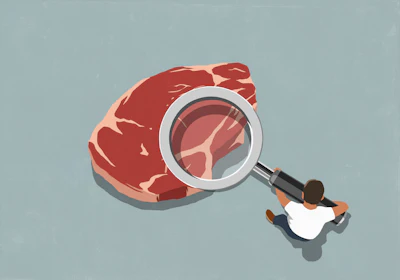
USDA is making up to $50 million available to states looking to launch or expand their own meat inspection programs, the agency says.
The Stand-Up Program, administered in partnership with USDA’s Food Safety and Inspection Service (FSIS), follows a September 4 executive order to expand market access for American meat producers.
“Too many states have wanted a food inspection program of their own and could not get past the start-up costs. Now they can. Food safety standards will not move, and more state programs mean more local processing, more competition for the rancher’s cattle, and more American meat on American tables,” says Brooke L. Rollins, U.S. Secretary of Agriculture.
Learn about USDA’s $500 million initiative to support independent and regional beef processors.
Currently, 31 states operate State Meat and Poultry Inspection (MPI) programs. New Mexico became the 31st state to start an MPI program on September 18, two days after the USDA’s Stand-Up Program announcement. Of those 31 states, 11 have joined a Cooperative Interstate Shipment (CIS) program.
Under MPI programs, participating plants can sell inspected products within their home state. State programs are required to maintain food safety standards “at least equal to” federal requirements.
States with an MPI program can also apply for the CIS program. CIS allows qualifying state-inspected plants to ship products across state lines under the USDA mark of inspection, provided the state demonstrates its inspection program is the “same as” federal inspection.
Read ProFood World’s recent coverage of beef import inspection gaps highlighted by a recent recall.
USDA says expanding state participation could provide additional local processing capacity, reduce costs and regulatory burdens for smaller processors, and keep more agricultural dollars in rural communities.
“The United States has one of the strongest, most interconnected food safety systems in the world, and our state inspection programs play a big role. State inspection programs share the same mission as FSIS, which is ensuring safe food for American families,” says USDA Under Secretary Dr. Mindy Brashears. “When we invest in our state partners, we’re not just adding processing capacity in rural America. We’re doing it in a way that is practical, backed by science and data, and built to protect public health.”