This content was written and submitted by the supplier. It has only been modified to comply with this publication’s space and style.
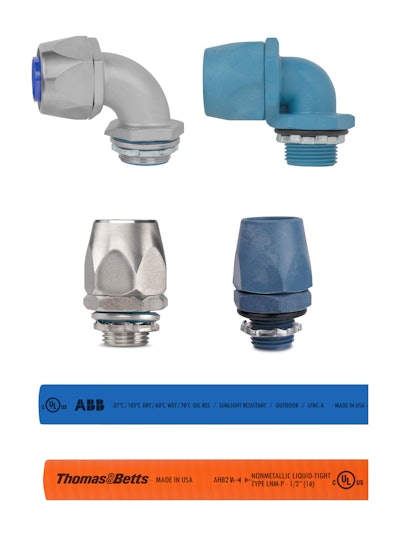
Developed for Food & Beverage installations, ABB Installation Products’ expanded portfolio of T&B Liquidtight Systems Type A Solutions include flexible non-metallic conduit and non-metallic and stainless steel fittings.
T&B Liquidtight Systems Type A reinforced, heavy-duty non-metallic conduit is available with an antimicrobial jacket to inhibit bacterial growth on the conduit. The T&B “System Solutions” for Type A conduit and fittings are designed and tested to deliver long-lasting performance and cable protection, as well as address critical application considerations such as material specifications, trade sizes, corrosive chemicals and cleaning protocols, temperature and ingress ratings, and other applications requirements.
The Type A T&B Liquidtight fittings are expanding the offering for straight, 45- and 90-degree elbows in trade sizes half-inch to 2 inches. The Type A fittings are UL Type 4/4X/12 and IEC IP69 rated, covering dust environments, UL hose test liquid ingress and IEC high-pressure washer performance requirements.