Pine Glo Products installed three modular robotic case packers that increased efficiency by 60% while enabling instant changeovers across 16 SKUs, reducing manual labor and supporting continued growth of over 20 million bottles annually.
- Pine Glo Products ships more than 20 million bottles annually through major retailers like Walmart and Dollar General
- Modular robotic case packers achieved a 60% efficiency increase compared to the initially expected 30%
- The system enables instantaneous changeovers across 16+ SKUs with no tools required, using software adjustments
- Three Schubert lightline systems were installed in phases from Thanksgiving 2025 through January 2026 without interrupting production
- The compact modular design has a small footprint of 3.5 x 2.5 meters and achieved a two-year payback on one shift
Founded in 1979 when Robert Diehl began developing cleaning formulas in a family bathtub, Pine Glo Products now manufactures disinfectants and floor cleaners sold through retailers that include Walmart, Family Dollar, and Dollar General. The company ships more than 20 million bottles annually.
Over the years, as volumes increased, manual case packing became a constraint.
To replace the labor-intensive process and support continued growth, Pine Glo Products installed three robotic case packers at its Zebulon, N.C., facility. The modular end-of-line system automatically erects, loads, and seals shipping cases while enabling instant changeovers across a number of SKUs. The result has been a significant reduction in manual labor and a significant increase in line efficiency.
Hand-packing creates bottlenecks
Before automation, operators packed cases by hand across a mix of bottle sizes and spray formats. The process was labor intensive and increasingly difficult to staff. In addition, labor shortages during the pandemic added urgency. “Staffing was quite an issue, so we had to find a way to efficiently get our product out and minimize the amount of labor to do so,” says Steven Williams, production and engineering manager.
Product variety further complicated operations. With more than 16 SKUs running on a single shift, the company needed fast, reliable changeovers. “We need real-world flexibility to change at a moment’s notice when the orders come in,” Williams says.
Adds Pine Glo Products President Matthew Diehl, “We wanted to reduce manual labor, increase throughput, and improve overall job satisfaction.”
A compact, modular approach to case packing
Williams approached the project with extensive packaging experience and a structured evaluation process. “My background was 25 years of experience in the pharmaceutical packaging industry. I went to PACK Expo in Chicago and in Vegas and networked there,” he says.
 Schubert’s lightline Casepacker combines multiple packaging functions within a compact, modular system designed for flexible, automated end-of-line operations.Schubert
After evaluating automation options, Pine Glo installed three preconfigured lightline Casepackers from Schubert. Each system is built as a compact, single-module unit, designed to integrate into existing lines with a relatively small footprint of 3.5 x 2.5 m. Robots are used in each part of the cell to erect, fill, and seal the cases.
To minimize disruption, Pine Glo installed the systems in phases, converting one line at a time while production continued. “We actually installed three different lines, six pieces of equipment in all at the end of the line without interrupting our production schedules at all, just doing one line at a time from Thanksgiving [2025] through the end of January [2026],” Williams says.
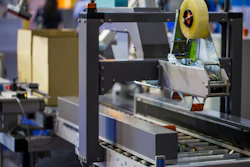
 The system’s case erector forms RSC cartons from flat blanks and positions them for automated loading.Schubert
The lightline platform is available in multiple configurations, including formats for trays, trays with lids, wraparound cartons, and RSC cases. At Pine Glo, the systems are configured to handle bottled cleaning products, with pack patterns ranging from four to 12 bottles per case.
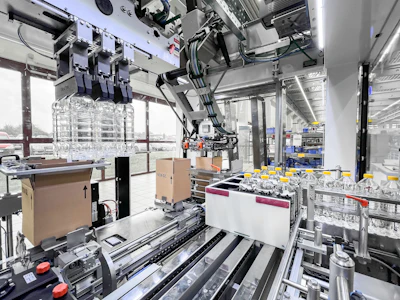
After bottles are filled, capped, and labeled, the case packers take over the end-of-line process. The machines erect corrugated cases, then use three Schubert F2 pick-and-place robots to load bottles into the case. These high-speed robots are designed for precise, repeatable handling, helping maintain product quality while supporting consistent throughput.
 The robotic pick-and-place system loads bottles of cleaning product into erected cases, ensuring precise, consistent packing while supporting high-speed, automated operation.Schubert
Once loaded, cases are sealed with hot-melt adhesive and conveyed downstream for palletizing. Depending on configuration, the system can achieve outputs of up to 25 cases/min.
The modular, robot-driven design allows the system to adapt to different products through software rather than mechanical changeparts. “We can do many SKUs with it with a touch of a button, so basically it’s an instantaneous changeover,” Williams explains. “There are no tools required.”
To fit the equipment into the existing layout, Schubert engineers customized the infeed with a 90-deg curve to accommodate the case packer’s fixed magazine position and improve product flow. They also worked with Pine Glo and its suppliers to improve case stability after sealing.
Efficiency gains exceed expectations
According to Williams, the automated case-packing system delivered results beyond initial projections. “We saw a 60% increase in efficiency, compared to the 30% we originally expected, with a two-year payback on one shift,” he says.
He adds that automation also reshaped workforce roles, reducing contract labor and enabling more employees to move into permanent roles with enhanced job responsibilities.
For consumer packaged goods companies considering automation, Williams recommends evaluating multiple suppliers and focusing on long-term performance rather than upfront cost. “Make sure you get at least three bids on any piece of equipment you’re going to want to try. And don’t go with the lowest bidder because you’ll find there’s a happy medium in there. It’s like buying a new car. Everybody wants to get one with all the bells and whistles, but sometimes all the bells and whistles aren’t needed. Get what you absolutely need to run efficiently and keep everybody on the same page.”
He adds that another effective strategy is to standardize machinery across each line. “When I buy equipment like this, I try to buy all similar equipment. If they’re left to right, I’ll buy them the same on every line, whether or not I have to reconfigure the line. This keeps things consistent for employees, with the same machine on each line set up in the exact same way.”
By implementing modular robotic case packing, Pine Glo has created an end-of-line system that supports continued growth while maintaining the flexibility required for a diverse product portfolio. PW