It was all the way back in 1999 that P&G’s Kevin Ashton coined the term Internet of Things (IoT), reminded Steve Statler, CEO of Ambient Chat AI, on a recent webinar on connected packaging hosted by the Active and Intelligent Packaging Association (AIPIA), now part of Alexander Watson Associates (AWA). The full AIPIA Congress is in Amsterdam in May.
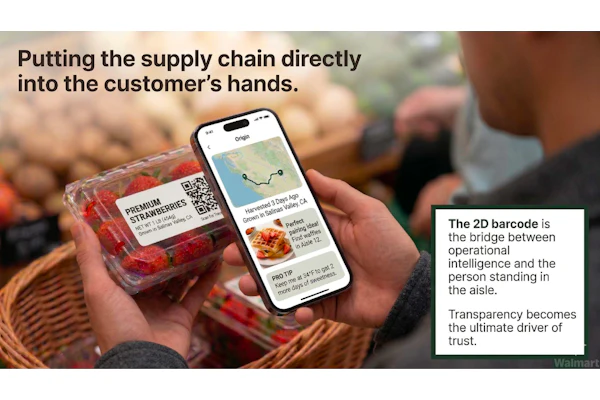
But if you’ve been keeping an eye on connected packaging, it has felt like a slow burn, with adoption in fits and starts. RFID has been expanding for years, following Moore’s Law to a threshold price point where Walmart has finally taken the leap (as we reported here). Meanwhile, GS1 Digital Link is working its way onto packs everywhere via a 2D barcode, and Digital Product Passports are coming to Europe whether brands who sell there are ready or not.
For all that time, the constraint hasn’t been the technology. It’s been the ability to use the data those technologies generate at scale. AI is starting to change that.
Until now, it’s largely meant: add a tag, hope the supply chain can read it. Or add a code, hope a consumer scans it. It depends on consumer behavior or supply chain infrastructure that’s aspirational at best.
In practice, connected packaging has meant attaching identifiers—RFID tags, NFC chips, or 2D barcodes—to physical products. What’s been missing is a consistent way to connect and interpret the product data behind those identifiers across systems.
Artificial intelligence is changing that, and not because it replaces any of the underlying technologies. What AI is changing is how the product data behind them gets used. Instead of building destinations—microsites, campaigns, landing pages—the interaction starts to look more like a question and answer. A consumer doesn’t navigate, they ask. The system responds.
That interaction tends to get framed in consumer terms, but it’s only part of the story. The same shift is happening upstream. Instead of building reports and dashboards, operations teams can start asking questions of the data—where products are stalling, how they’re moving through a facility, whether something has gone off-pattern—and getting answers in closer to real-time. AI isn’t replacing RFID, NFC, or 2D barcodes—it’s making the data behind them usable in ways that weren’t practical before. Panel Discussion: DPP Infrastructure - Managing Data Across the Product Lifecycle. Clockwise from top right: Eef de Ferrante, Member of the board, AIPIA; Stephen Tagg, Global Application Sales Manager Software, Markem Imaje; Dominique Guinard, DPP & 2D Consultant, Digimarc; Klaus Simonmeyer, Vice President, Strategic Accounts EMEA, Identiv.AIPIA, AWA webinar
AI Is Making Packaging Data Usable
That only works if the product data is in shape. It’s just not organized in a way that makes it usable outside the system it was created for. Stephen Tagg of Markem-Imaje described the reality bluntly: “you’ll see a lot of fragmented data, a lot of disconnected systems.” Most of that data already exists. It lives in different systems, built for different purposes, and not structured to be reused beyond them. Bringing that data into one place, he added, “has always been a challenge.”
CEC technologist Sarah Doery pointed to the next step: “ensuring you have structured data… optimized to be absorbed by these LLMs.”
Dominique Guinard at Digimarc took a similarly practical approach. “Choose a product identity… that is standard… (and nobody gets fired for selecting a standard)… and then start building APIs to access the data.”
It’s not exciting advice, but it’s useful. The standards are largely in place. What’s missing is the connective tissue, and the discipline to keep that data current as suppliers shift, formulations change, and claims evolve. It’s one thing to assemble a product record. It’s another to maintain it. Klaus Simonmeyer of Identiv puts it plainly: “collecting the data and structuring it is one thing, but to maintain it is also a big challenge because data is dynamic.” If packaging becomes a gateway to live product information, stale data quickly becomes a liability. RFID and optical codes can coexist on-pack, but unlocking the data behind them at scale has historically been the challenge AI is now starting to address.Adobe Stock 183426486
That becomes more important as connected packaging moves beyond a closed loop. Historically, the model was straightforward: scan the code, land where the brand wants you to land. AI opens that up. Now product data can be pulled into broader systems and surfaced alongside competing products.
That has implications beyond the experience itself. Product data can be compared, interpreted, and surfaced in contexts the brand doesn’t fully control—alongside competing products, across retail systems, or through third-party AI tools. Statler says, “it’s basically all about the data and who controls it.”
The distinction also shows up in how different identifiers are used. 2D barcodes are efficient and scalable, but they largely point to product data. Technologies like RFID and NFC can carry more data and do more. James Bevan of Vandagraf International points out that wireless devices like RFID and NFC “have a much higher data storage capacity than the optical versions.” That same data isn’t just for engagement. It can support supply chain visibility, expose inefficiencies on a production line, track product movement through distribution, or flag anomalies before they become larger problems. And when those capabilities are combined, the value compounds. “If the device can be used for more than one functionality, this can greatly enhance the ROI,” Bevan says. The challenge has been making that data usable at scale. AI starts to change that.
Billions of products, each with some form of digital identity, are feeding data into supply chains and consumer-facing systems. Getting them to work together has largely eluded us. That level of scale has always been the limiting factor. On its own, it’s just noise. But now, “AI can actually master the billions of IDs that are floating around now,” Statler says.
The industry has spent years trying to drive scans. That’s still relevant, but it may not be the only model going forward. More identifiers, more readers, more passive data capture. Less reliance on someone deciding to engage in the moment.
For brands and CPGs in the U.S., none of this requires a reset. Most of the building blocks are already available. The question is whether they’re connected in a way that supports what’s coming.
For brands, the immediate questions are practical:
- Where does product data live today?
- How fragmented is it?
- Can it be accessed across systems?
- And who is responsible for keeping it accurate over time?
That last one is a biggie since it doesn’t sit neatly in packaging, much less any single function. Tagg said on the webinar that it spans packaging, IT, data integration, and supply chain. “Not one department, but a cross-functional effort linking the physical and digital product.” It’ll also include legal, Simonmeyer added.
There’s a tendency to treat mandated tech like Digital Product Passports, or retailer-driven 2D barcode requirements, as compliance exercises. It’s understandable, but it undersells what’s being built. A single infrastructure will support traceability, recall execution, authentication, and even consumer-facing use cases.
Guinard sees this as opportunity, and his advice is to “start on what you know today and don’t try to boil the ocean.”